Making Toast and Eggs
Preparando tostadas y huevos
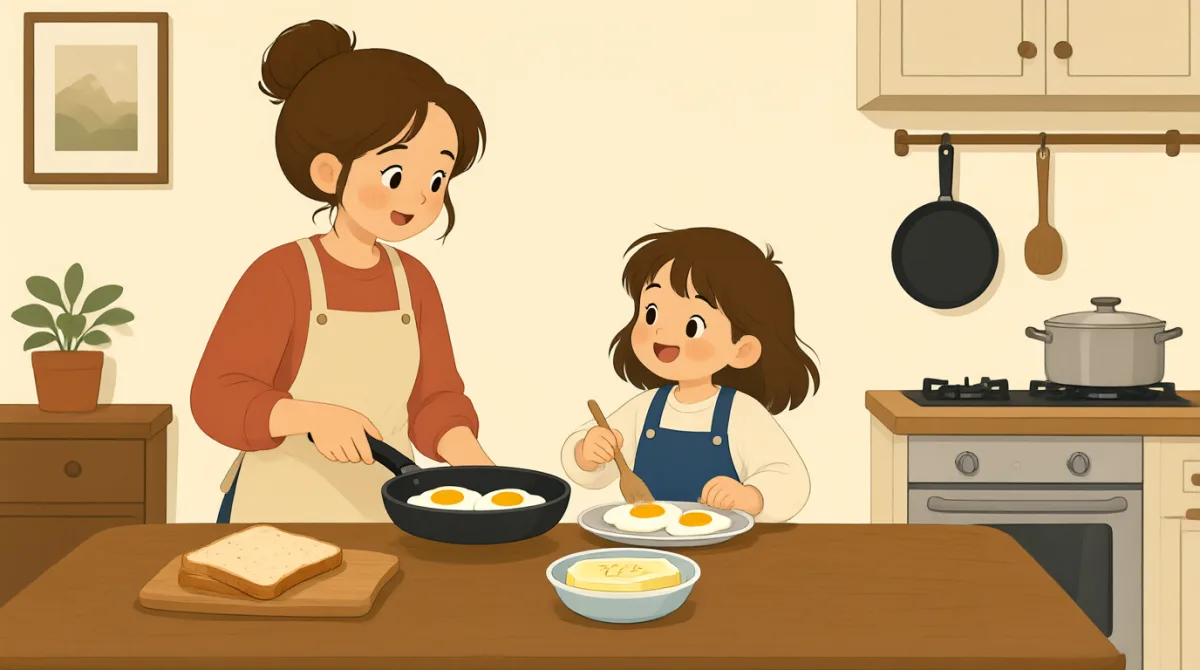
They make toast and cook eggs together. Emma asks Mia where to find the butter and a pan.
Preparan tostadas y cocinan huevos juntos. Emma le pregunta a Mia dónde están la mantequilla y una sartén.
Diálogo8

Where is the butter, Mia?
¿Dónde está la mantequilla, Mia?

It’s in the fridge, next to the milk.
Está en la nevera, al lado de la leche.
Thanks. Where is the pan?
Gracias. ¿Dónde está la sartén?
It’s on the shelf. I’ll get it.
Está en el estante. Voy a buscarla.
I’ll put the bread in the toaster.
Voy a poner el pan en la tostadora.
Great. I’ll cook the eggs in the pan.
Genial. Voy a cocinar los huevos en la sartén.
Do you need some butter?
¿Necesitas mantequilla?
Yes, please. Then our breakfast is ready.
Sí, por favor. Entonces ya estará listo el desayuno.
Vocabulario8
- in the fridgeen la nevera
This means inside the refrigerator. Use it to say where food is kept.
Significa dentro del refrigerador. Úsalo para decir dónde se guardan los alimentos.
- next toal lado de
This means beside something. Use it to describe where one thing is in relation to another.
Significa junto a algo. Úsalo para describir dónde está una cosa en relación con otra.
- on the shelfen el estante
This means resting on a shelf. Use it to say where an item is.
Significa colocado sobre un estante. Úsalo para decir dónde está un objeto.
- I’ll get it.Voy a buscarlo.
This means “I will go and bring it.” Use it when you offer to fetch something.
Significa «Voy a ir a traerlo». Úsalo cuando te ofreces a ir por algo.
- put the bread in the toasterponer el pan en la tostadora
This means to place bread inside a toaster so it can become toast. You can use “put [something] in [place]” to describe where you place things.
Significa colocar el pan dentro de una tostadora para que se tueste. Puedes usar “put [something] in [place]” para describir dónde colocas algo.
- cook the eggscocinar los huevos
This means to prepare the eggs with heat. Use “cook” with the name of a food you are preparing.
Significa preparar los huevos con calor. Usa “cook” con el nombre del alimento que estás preparando.
- some butterun poco de mantequilla
This means an unspecified amount of butter. Use “some” when asking for or offering an amount of food.
Se refiere a una cantidad no especificada de mantequilla. Usa “some” cuando pidas u ofrezcas cierta cantidad de comida.
- breakfast is readyel desayuno está listo
This means breakfast is prepared and ready to eat. Use “[meal] is ready” when food is finished.
Significa que el desayuno está preparado y listo para comer. Usa “[meal] is ready” cuando la comida ya esté lista.
Frases clave8
- 1
Where is the butter, Mia?
¿Dónde está la mantequilla, Mia?
Use this simple question to ask where something is. Replace “the butter” with another item, such as “the pan.”
Usa esta pregunta sencilla para preguntar dónde está algo. Sustituye “the butter” por otro objeto, como “the pan”.
- 2
It’s in the fridge, next to the milk.
Está en la nevera, al lado de la leche.
This sentence gives an item’s location. Use “It’s in…” and “next to…” to explain where something is.
Esta frase indica dónde está algo. Usa “It’s in…” y “next to…” para explicar dónde se encuentra.
- 3
Where is the pan?
¿Dónde está la sartén?
Use “Where is the…?” to ask where a single item is. Replace “the pan” with the thing you are looking for.
Usa “Where is the…?” para preguntar dónde está un objeto. Sustituye “the pan” por lo que estés buscando.
- 4
I’ll put the bread in the toaster.
Voy a poner el pan en la tostadora.
Use “I’ll put…” to say what you will place somewhere. Replace “the bread” and “the toaster” with other items and places.
Usa “I’ll put…” para decir qué vas a colocar en algún sitio. Sustituye “the bread” y “the toaster” por otros objetos y lugares.
- 5
I’ll cook the eggs in the pan.
Voy a cocinar los huevos en la sartén.
Use “I’ll cook…” to say what you plan to prepare and where you will cook it. Replace “the eggs” and “the pan” as needed.
Usa “I’ll cook…” para decir qué piensas preparar y dónde lo vas a cocinar. Sustituye “the eggs” y “the pan” según haga falta.
- 6
Do you need some butter?
¿Necesitas mantequilla?
Use this question to offer something someone may need. Replace “some butter” with another food or item.
Usa esta pregunta para ofrecer algo que otra persona podría necesitar. Sustituye “some butter” por otro alimento u objeto.
- 7
Yes, please.
Sí, por favor.
This is a polite way to accept an offer. You can use it when someone asks if you would like or need something.
Esta es una forma amable de aceptar un ofrecimiento. Puedes usarla cuando alguien te pregunte si quieres o necesitas algo.
- 8
Then our breakfast is ready.
Entonces ya estará listo el desayuno.
Use “Then…” to describe what happens next, and “is ready” to say something is prepared. Replace “our breakfast” with another meal or activity.
Usa “Then…” para describir lo que ocurre después e “is ready” para decir que algo está preparado. Sustituye “our breakfast” por otra comida o actividad.