Donating Your Old Clothes
Ihre alten Kleider spenden
Emma brings some old clothes to the store to donate. Jack explains where to leave them and what the store can accept.
Emma bringt einige alte Kleider in den Laden, um sie zu spenden. Jack erklärt ihr, wo sie die Kleider abstellen kann und was der Laden annimmt.
Dialog8
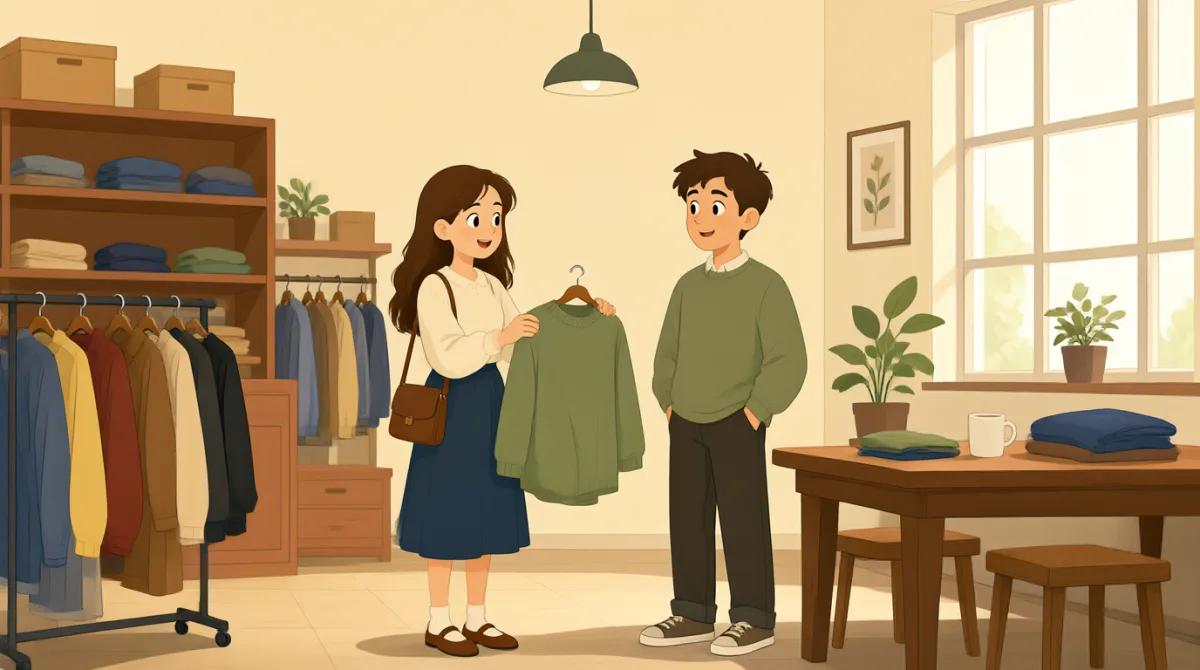

Hi, I have a bag of old clothes to donate. Where should I leave it?
Hallo, ich habe eine Tüte mit alten Kleidern zum Spenden dabei. Wo soll ich sie abstellen?

Thanks for bringing them in. You can leave the bag right here by the counter.
Danke, dass Sie die Sachen vorbeibringen. Sie können die Tüte hier direkt neben dem Tresen abstellen.
What kinds of clothes can the store accept? I have shirts, jeans, and a coat.
Welche Kleidung nimmt der Laden an? Ich habe Hemden, Jeans und einen Mantel dabei.
We take clean clothes in good condition. We can't accept anything wet or badly torn.
Wir nehmen saubere Kleidung in gutem Zustand an. Nasse oder stark zerrissene Sachen können wir nicht annehmen.
These are clean, but one shirt has a small tear near the sleeve. Is that okay?
Die Sachen sind sauber, aber ein Hemd hat in der Nähe des Ärmels einen kleinen Riss. Ist das in Ordnung?
A small tear is fine. We can check it and decide if we can sell it.
Ein kleiner Riss ist in Ordnung. Wir können uns das Hemd ansehen und entscheiden, ob wir es verkaufen können.
Great. Do I need to take everything out of the bag first?
Prima. Muss ich vorher alles aus der Tüte nehmen?
No, that's not necessary. Just leave the bag here, and we'll sort through it.
Nein, das ist nicht nötig. Lassen Sie die Tüte einfach hier, wir sehen die Sachen dann durch.
Wortschatz5
- to donatespenden
To give something to an organization without asking for money. Here, Emma is giving her old clothes to the store.
Etwas einer Organisation geben, ohne Geld dafür zu verlangen. Hier gibt Emma dem Laden ihre alten Kleider.
- in good conditionin gutem Zustand
Clean and not badly damaged. Stores often use this phrase to describe items they can accept or sell.
Sauber und nicht stark beschädigt. Läden verwenden diese Wendung oft, um Dinge zu beschreiben, die sie annehmen oder verkaufen können.
- badly tornstark zerrissen
Very badly ripped or damaged. You can use it to describe clothes that may not be suitable to donate.
Sehr stark eingerissen oder beschädigt. Mit dieser Wendung kannst du Kleidung beschreiben, die sich möglicherweise nicht zum Spenden eignet.
- a small tearein kleiner Riss
A little rip in fabric. This phrase is useful when explaining minor damage to clothing.
Ein kleiner Riss im Stoff. Diese Wendung ist nützlich, wenn du einen kleinen Schaden an Kleidung beschreibst.
- sort through itetwas durchsehen
To look at the things in a group one by one. Here, the store staff will check the clothes in the bag.
Dinge in einer Gruppe einzeln ansehen. Hier wird das Ladenpersonal die Kleidung in der Tüte durchsehen.
Wichtige Sätze7
- 1
I have a bag of old clothes to donate.
I have a bag of old clothes to donate.
Use this sentence to explain why you brought something to a store or charity. You can replace “old clothes” with another item you want to give away.
Verwende diesen Satz, um zu erklären, warum du etwas in einen Laden oder zu einer gemeinnützigen Organisation gebracht hast. Du kannst „old clothes“ durch etwas anderes ersetzen, das du verschenken möchtest.
- 2
Where should I leave it?
Where should I leave it?
Use this question to ask where to put something. Replace “it” with “them” when asking about more than one item.
Mit dieser Frage erkundigst du dich, wo du etwas abstellen sollst. Ersetze „it“ durch „them“, wenn du nach mehreren Dingen fragst.
- 3
What kinds of clothes can the store accept?
What kinds of clothes can the store accept?
This is a useful way to ask what items a store or organization will take. You can replace “clothes” with another type of donation.
So kannst du fragen, welche Dinge ein Laden oder eine Organisation annimmt. Du kannst „clothes“ durch eine andere Art von Spende ersetzen.
- 4
We take clean clothes in good condition.
We take clean clothes in good condition.
This sentence explains what kind of clothes the store accepts. You can reuse “We take…” to describe items accepted by a shop or organization.
Dieser Satz erklärt, welche Art von Kleidung der Laden annimmt. Mit „We take…“ kannst du auch beschreiben, welche Dinge ein Geschäft oder eine Organisation annimmt.
- 5
We can't accept anything wet or badly torn.
We can't accept anything wet or badly torn.
Use this sentence to explain which items are not allowed. You can replace “wet or badly torn” with other conditions.
Verwende diesen Satz, um zu erklären, welche Dinge nicht angenommen werden. Du kannst „wet or badly torn“ durch andere Zustände ersetzen.
- 6
A small tear is fine.
A small tear is fine.
This is a simple way to say that a little damage is acceptable. You can replace “A small tear” with another minor problem.
So kannst du einfach sagen, dass ein kleiner Schaden in Ordnung ist. Du kannst „A small tear“ durch ein anderes kleines Problem ersetzen.
- 7
Just leave the bag here, and we'll sort through it.
Just leave the bag here, and we'll sort through it.
Use this to tell someone what to do next and explain what you will do afterward. “Sort through” means to check the items one by one.
Mit diesem Satz sagst du jemandem, was als Nächstes zu tun ist, und erklärst, was du danach machen wirst. „Sort through“ bedeutet, die Dinge einzeln durchzusehen.