Counting the Money
Das Geld zählen
Mia gives Emma the money, and they count it together. Emma checks that the amount is right.
Mia gibt Emma das Geld, und sie zählen es zusammen. Emma prüft, ob der Betrag stimmt.
Dialog6
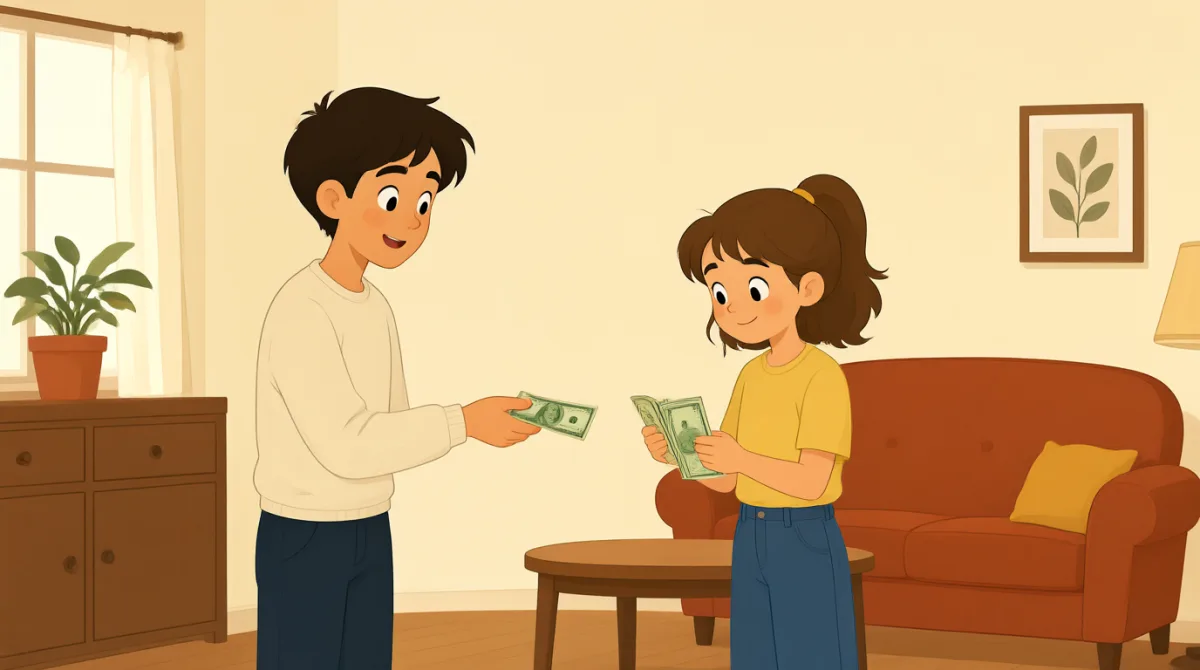

Here are your euros. Let's count them.
Hier sind deine Euro. Lass sie uns zählen.

Okay. One, two, three, four, five.
Okay. Eins, zwei, drei, vier, fünf.
And ten more. That makes fifty euros.
Und noch zehn. Das macht fünfzig Euro.
Let me check. Yes, that's fifty euros.
Lass mich nachzählen. Ja, das sind fünfzig Euro.
Great. Here is your receipt.
Super. Hier ist dein Beleg.
Thank you. Have a nice day!
Danke. Schönen Tag noch!
Wortschatz7
- eurosEuro
Euros are the money used in many European countries. Here, Mia gives Emma euros.
Euro ist das Zahlungsmittel in vielen europäischen Ländern. Hier gibt Mia Emma Euro.
- Let's count them.Lass sie uns zählen.
This means, “Let’s say the numbers to check how many there are.” Use it when you want to count things together.
Das bedeutet: „Lass uns die Zahlen sagen, um herauszufinden, wie viele es sind.“ Du kannst das sagen, wenn du etwas gemeinsam mit jemandem zählen möchtest.
- ten morenoch zehn
This means ten extra euros. Use “more” to talk about an additional amount.
Das bedeutet zehn Euro zusätzlich. Mit „more“ sprichst du von einer weiteren Menge.
- That makes fifty euros.Das macht fünfzig Euro.
This means the total amount is fifty euros. Use “That makes…” to say the result of adding numbers.
Das bedeutet, dass der Gesamtbetrag fünfzig Euro beträgt. Mit „That makes…“ nennst du das Ergebnis einer Addition.
- Let me check.Lass mich nachzählen.
This means, “I want to look and make sure it is right.” Use it when you want to check money or information.
Das bedeutet: „Ich möchte nachsehen und sicherstellen, dass es stimmt.“ Du kannst das sagen, wenn du Geld oder Informationen überprüfen möchtest.
- receiptBeleg
A receipt is a paper or message that shows what you paid or received. Here, Mia gives Emma a receipt.
Ein Beleg ist ein Papier oder eine Nachricht, auf dem steht, was du bezahlt oder erhalten hast. Hier gibt Mia Emma einen Beleg.
- Have a nice day!Schönen Tag noch!
This is a friendly way to say goodbye. You can use it with shop workers or other people.
Das ist eine freundliche Art, sich zu verabschieden. Du kannst das zu Angestellten in Geschäften oder zu anderen Leuten sagen.
Wichtige Sätze8
- 1
Here are your euros.
Hier sind deine Euro.
Use this sentence when giving someone euros. You can replace “euros” with another thing, such as “Here is your receipt.”
Diesen Satz kannst du sagen, wenn du jemandem Euro gibst. Du kannst „euros“ durch etwas anderes ersetzen, zum Beispiel durch „Here is your receipt.“
- 2
Let's count them.
Lass sie uns zählen.
Use this to suggest counting things together. “Them” refers to things already mentioned.
Mit diesem Satz schlägst du vor, etwas gemeinsam zu zählen. „Them“ bezieht sich auf Dinge, die bereits erwähnt wurden.
- 3
And ten more.
Und noch zehn.
This short phrase adds ten to a number or amount. You can use it when counting money or other things.
Mit diesem kurzen Ausdruck addierst du zehn zu einer Zahl oder Menge. Du kannst ihn beim Zählen von Geld oder anderen Dingen verwenden.
- 4
That makes fifty euros.
Das macht fünfzig Euro.
Use this to tell someone the total. Replace “fifty euros” with the correct amount.
Mit diesem Satz nennst du jemandem den Gesamtbetrag. Ersetze „fifty euros“ durch den richtigen Betrag.
- 5
Let me check.
Lass mich nachzählen.
Use this when you want a moment to make sure something is correct. It is useful when checking money, a receipt, or information.
Diesen Satz kannst du sagen, wenn du kurz etwas überprüfen möchtest. Er ist nützlich, wenn du Geld, einen Beleg oder Informationen kontrollierst.
- 6
Yes, that's fifty euros.
Ja, das sind fünfzig Euro.
Use this to confirm an amount is correct. You can replace “fifty euros” with another amount.
Mit diesem Satz bestätigst du, dass ein Betrag stimmt. Du kannst „fifty euros“ durch einen anderen Betrag ersetzen.
- 7
Here is your receipt.
Hier ist dein Beleg.
Use this when giving someone a receipt. You can replace “receipt” with another item, such as “ticket.”
Diesen Satz kannst du sagen, wenn du jemandem einen Beleg gibst. Du kannst „receipt“ durch einen anderen Gegenstand ersetzen, zum Beispiel durch „ticket“.
- 8
Have a nice day!
Schönen Tag noch!
Use this friendly phrase when saying goodbye. It works well in shops, cafés, and other everyday situations.
Mit diesem freundlichen Ausdruck verabschiedest du dich. Er passt gut in Geschäften, Cafés und anderen Alltagssituationen.