Saying Why You Are Here
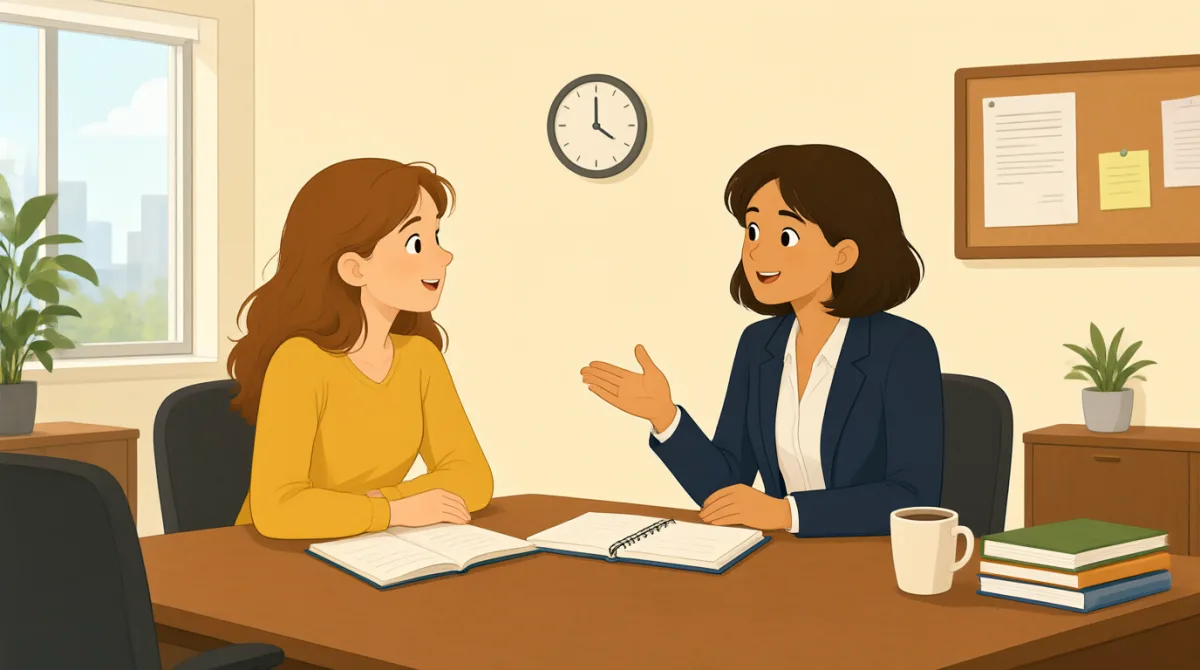
Emma tells Grace why she is at the office. Grace asks a short question.
Dialogue7

Hello. My number is forty-two.

Hello. What can I help you with today?
I need to pay my water bill.
Do you have your bill with you?
Yes, here it is.
Thank you. Please give me your ID, too.
Sure. Here you are.
Vocabulary7
- number
Your number shows when it is your turn. You can tell the worker your number.
- What can I help you with today?
This is a polite way to ask what someone needs. You can use it at an office or service counter.
- pay my water bill
This means give money to pay for water service. You can replace “water” with another bill, like “phone.”
- Do you have your bill with you?
This asks if you brought your bill. You can use “Do you have your [thing] with you?” to ask about other items.
- Here it is.
Say this when you give someone something they asked for. You can use it when handing over a bill or form.
- ID
ID is a card or document that shows who you are. An office may ask to see your ID.
- Here you are.
Say this when you give something to someone. It is a polite phrase to use at a service counter.
Key Sentences8
- 1
My number is forty-two.
Use this to tell a worker your number when you are waiting. Change “forty-two” to your own number.
- 2
What can I help you with today?
This is a friendly way to ask what someone needs. You can use it when helping a customer.
- 3
I need to pay my water bill.
Use “I need to” to explain why you are there. Replace “pay my water bill” with another simple task.
- 4
Do you have your bill with you?
Use this to ask if someone brought a document. You can replace “bill” with another item, such as “ID.”
- 5
Yes, here it is.
Use this when you have the item someone asked for and are giving it to them. It works for one item.
- 6
Please give me your ID, too.
This is a polite way to ask someone for their ID. “Too” means the person needs to give you one more thing.
- 7
Sure.
This is a short, friendly way to agree to a request. You can say it before giving someone an item.
- 8
Here you are.
Use this when you hand something to someone. It is polite and common in everyday conversations.