Asking How Long You Have Waited
Emma asks Jack how long he has been waiting for the bus. They talk about the delay.
Dialogue8
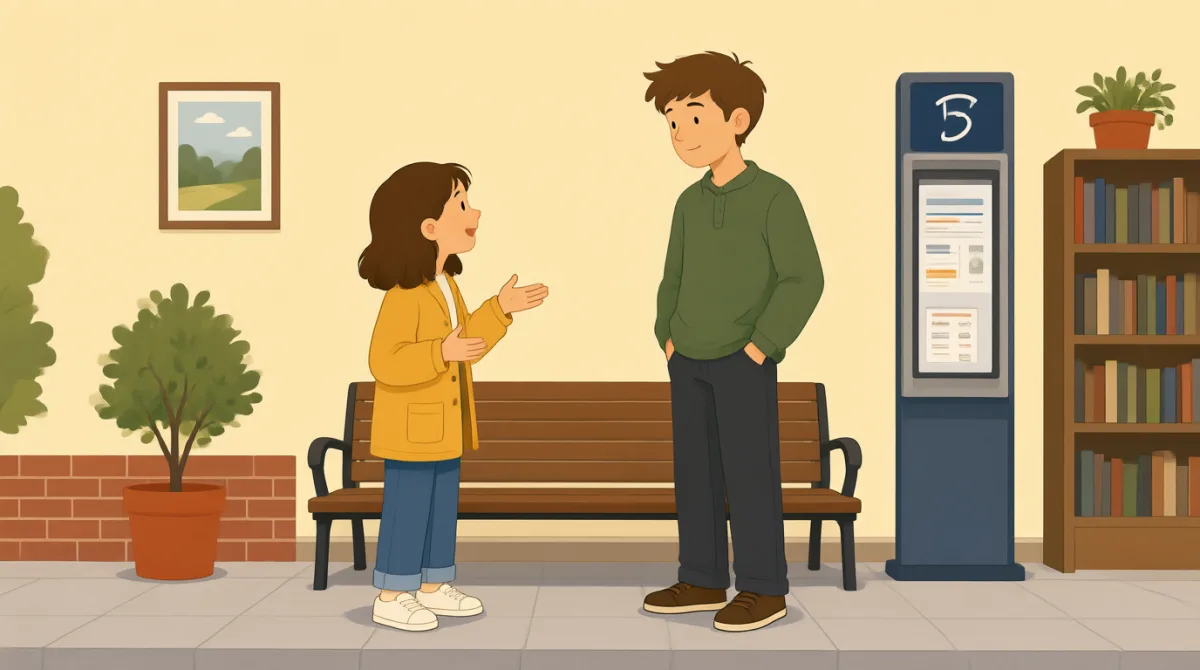

Hi. How long have you been waiting?

About twenty minutes. The bus is late.
Oh, that's a long time. Is it usually late?
No, it usually comes on time.
I hope it comes soon. I have work.
Me too. I don't want to be late.
How much longer do you think?
I'm not sure. Let's wait a little more.
Vocabulary8
- How long have you been waiting?
Ask this to find out how much time someone has spent waiting. You can use it when you meet someone at a bus stop or in a line.
- about twenty minutes
This means close to twenty minutes, but not exactly. Use “about” when you do not know the exact time.
- late
Something is late when it does not arrive at the expected time. You can say, “The bus is late.”
- on time
This means something happens at the expected time. You can say a bus usually comes on time.
- comes soon
This means arrives in a short time. Use “I hope it comes soon” when you want something to arrive quickly.
- How much longer
Ask this to find out how much more time you may need to wait. You can use it when you are waiting for a person or a bus.
- I'm not sure
Say this when you do not know the answer. It is a simple way to show that you are unsure.
- a little more
This means a small amount more. You can say, “Let's wait a little more,” to suggest waiting for a short time.
Key Sentences8
- 1
How long have you been waiting?
Use this question to ask how much time someone has spent waiting. You can also ask, “How long have you been here?”
- 2
The bus is late.
Use this short sentence to say that a bus has not arrived at the expected time. Replace “The bus” with another person or thing that is delayed.
- 3
Is it usually late?
Ask this to find out if something is often delayed. You can use it to ask about a train, a person, or an event.
- 4
I hope it comes soon.
Use this sentence to say that you want something to arrive soon. Replace “it” with a bus, a train, or a person.
- 5
I have work.
Use this simple sentence to explain that you need to go to work. You can also say, “I have school” or “I have a meeting.”
- 6
I don't want to be late.
Use this to say that you want to arrive on time. You can add a place or event, such as “I don't want to be late for work.”
- 7
How much longer do you think?
Use this question to ask someone to guess how much more time you may need to wait. You can use it when the arrival time is not clear.
- 8
Let's wait a little more.
Use this sentence to suggest waiting for a short time. You can replace “wait” with another action, such as “Let's talk a little more.”