Finding the Keys
Emma sees the keys next to her bag by the front door. She thanks Jack and is ready to go.
Dialogue7
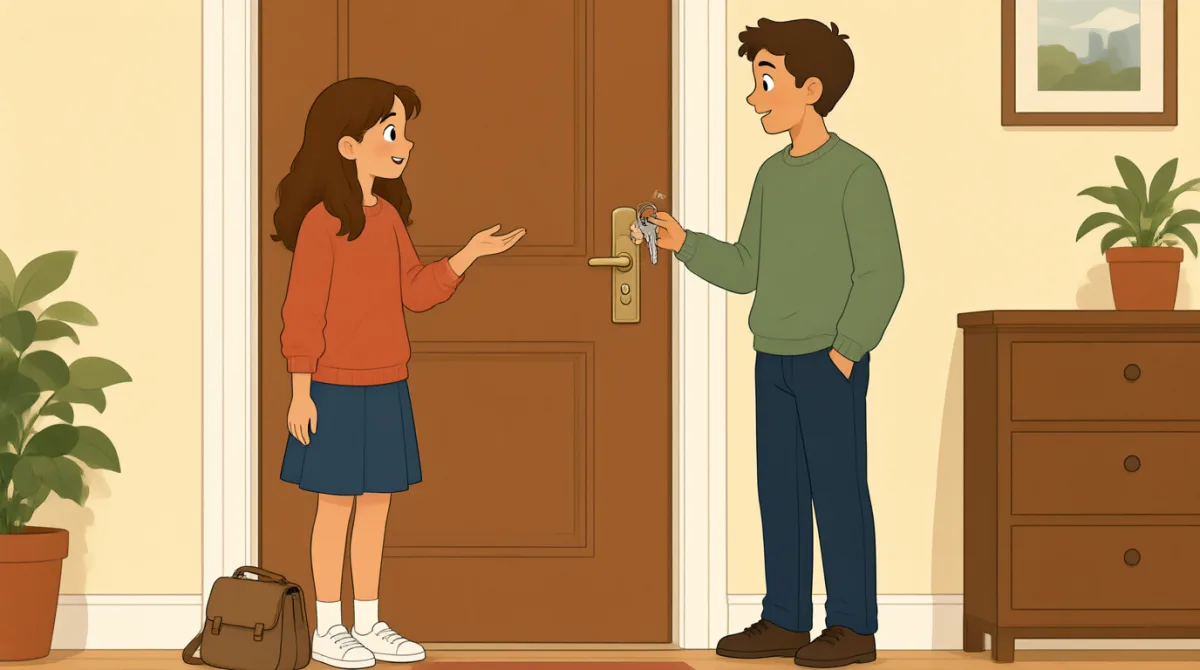

Oh, there they are! My keys are next to my bag.

I told you I saw them by the front door.
Thanks, Jack. I was looking everywhere.
You’re welcome. Your bag is right there, too.
Yes, I have my keys and my bag now.
Great. Are you ready to go?
Yes! Let’s go. I’m ready.
Vocabulary7
- there they are
This means you can see the things you were looking for. Use it when you find something.
- next to
This means beside something. You can use it to say where an object is.
- front door
This is the main door to a home or building. Use it when talking about the entrance.
- everywhere
This means in many different places. Here, Emma looked in many places for her keys.
- right there
This means in a place that is easy to see or very close. Use it to point out where something is.
- ready to go
This means prepared to leave. You can ask, “Are you ready to go?” before leaving.
- Let’s go
This is a friendly way to say that it is time to leave or start moving.
Key Sentences7
- 1
Oh, there they are!
Use this when you find something you were looking for. You can replace “they” with “it” for one thing.
- 2
My keys are next to my bag.
This sentence tells someone where your keys are. Use “next to” to describe where one thing is in relation to another.
- 3
I was looking everywhere.
Use this to say you searched in many places. You can replace “everywhere” with a place, such as “in my room.”
- 4
Your bag is right there, too.
This sentence points out where something is. Use “right there” when the object is close or easy to see.
- 5
Yes, I have my keys and my bag now.
Use this to say you have the things you need. You can name other items after “I have.”
- 6
Are you ready to go?
This is a common way to ask if someone is prepared to leave. You can replace “go” with another activity, such as “eat.”
- 7
Yes! Let’s go.
Use this to agree that it is time to leave or begin. “Let’s” means “let us” and invites someone to do something with you.