Finding the Keys
找到钥匙
Emma sees the keys next to her bag by the front door. She thanks Jack and is ready to go.
艾玛看到钥匙就在前门旁边、她的包边上。她向杰克道谢,准备出门。
对话7
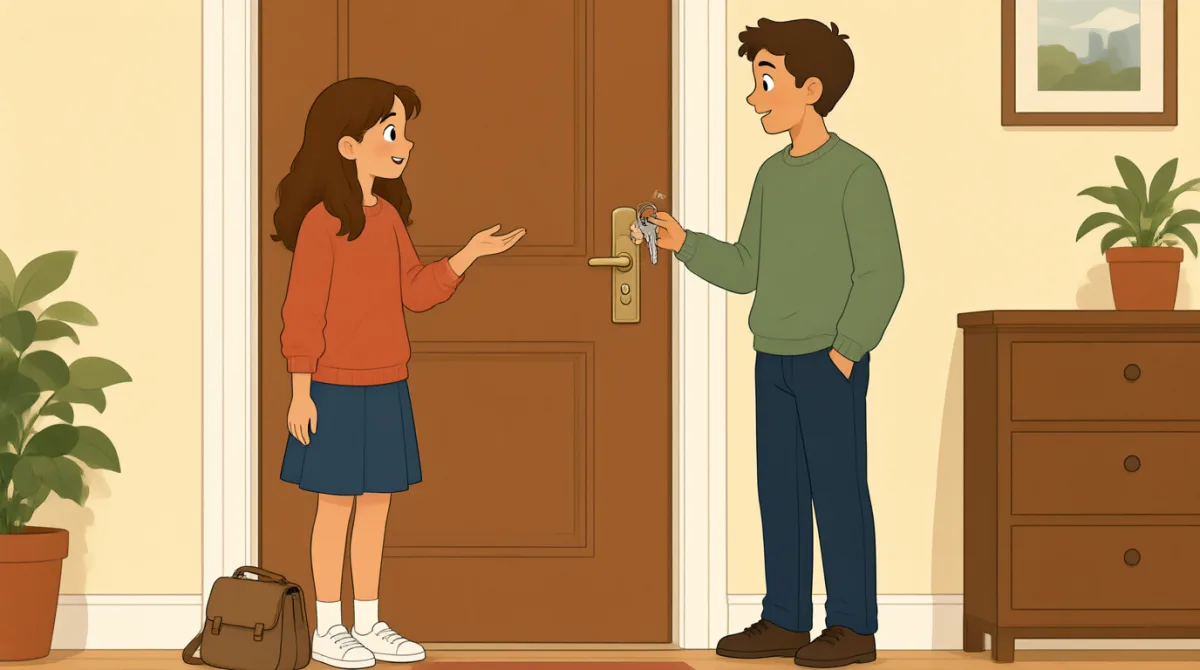

Oh, there they are! My keys are next to my bag.
哦,找到了!我的钥匙在包旁边。

I told you I saw them by the front door.
我说过我看到它们在前门旁边。
Thanks, Jack. I was looking everywhere.
谢谢你,杰克。我刚才到处找它们。
You’re welcome. Your bag is right there, too.
不客气。你的包也就在那儿。
Yes, I have my keys and my bag now.
是啊,现在钥匙和包都拿到了。
Great. Are you ready to go?
太好了。你准备好出门了吗?
Yes! Let’s go. I’m ready.
准备好了!我们走吧。
词汇7
- there they are找到了
This means you can see the things you were looking for. Use it when you find something.
当你看到正在寻找的东西时,可以这么说。找到一个东西时,可以用这句话。
- next to在……旁边
This means beside something. You can use it to say where an object is.
意思是挨着某样东西。你可以用它来说明物品的位置。
- front door前门
This is the main door to a home or building. Use it when talking about the entrance.
指住宅或建筑物的主要入口。谈到入口时可以用这个词。
- everywhere到处
This means in many different places. Here, Emma looked in many places for her keys.
意思是在许多不同的地方。这里,艾玛在很多地方找她的钥匙。
- right there就在那儿
This means in a place that is easy to see or very close. Use it to point out where something is.
意思是在很容易看到或离得很近的地方。你可以用它指出某样东西的位置。
- ready to go准备出发
This means prepared to leave. You can ask, “Are you ready to go?” before leaving.
意思是已经准备好离开。出门前,你可以问:“Are you ready to go?”(你准备好出发了吗?)
- Let’s go我们走吧
This is a friendly way to say that it is time to leave or start moving.
这是友好地表示该离开或动身了的一种说法。
重点句子7
- 1
Oh, there they are!
哦,找到了!
Use this when you find something you were looking for. You can replace “they” with “it” for one thing.
找到正在寻找的东西时,可以这么说。只有一个东西时,可以把“they”换成“it”。
- 2
My keys are next to my bag.
我的钥匙在包旁边。
This sentence tells someone where your keys are. Use “next to” to describe where one thing is in relation to another.
这句话告诉别人你的钥匙在哪里。用“next to”来说明一样东西相对于另一样东西的位置。
- 3
I was looking everywhere.
我刚才到处找了。
Use this to say you searched in many places. You can replace “everywhere” with a place, such as “in my room.”
用这句话表示你在很多地方找过。你可以把“everywhere”换成某个具体地点,比如“in my room”。
- 4
Your bag is right there, too.
你的包也就在那儿。
This sentence points out where something is. Use “right there” when the object is close or easy to see.
这句话指出某样东西的位置。物品就在附近或很容易看到时,可以用“right there”。
- 5
Yes, I have my keys and my bag now.
是啊,现在钥匙和包都拿到了。
Use this to say you have the things you need. You can name other items after “I have.”
用这句话表示你已经拿到了需要的东西。“I have”后面可以说出其他物品。
- 6
Are you ready to go?
你准备好出门了吗?
This is a common way to ask if someone is prepared to leave. You can replace “go” with another activity, such as “eat.”
这是询问某人是否准备好离开的一种常见说法。你可以把“go”换成其他活动,比如“eat”。
- 7
Yes! Let’s go.
准备好了!我们走吧。
Use this to agree that it is time to leave or begin. “Let’s” means “let us” and invites someone to do something with you.
当你同意该离开或开始行动时,可以这么说。“Let’s”是“let us”的缩写,表示邀请别人和你一起做某事。