Finding the Keys
Encontrando las llaves
Emma sees the keys next to her bag by the front door. She thanks Jack and is ready to go.
Emma ve las llaves junto a su bolso, cerca de la puerta principal. Le da las gracias a Jack y está lista para irse.
Diálogo7
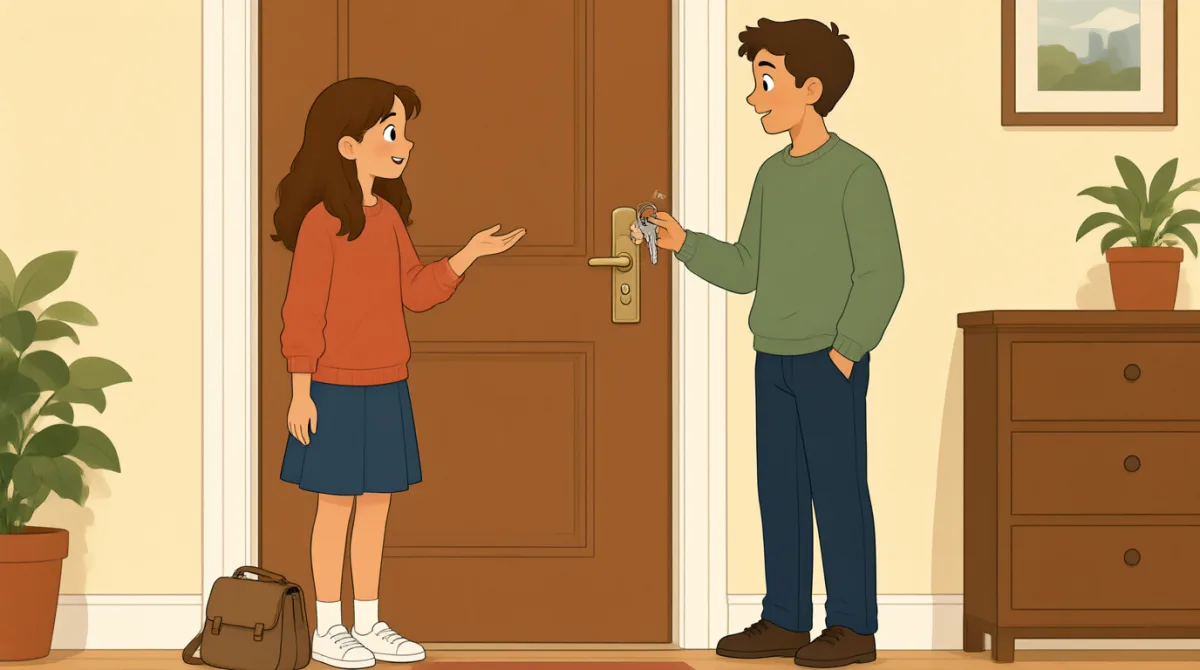

Oh, there they are! My keys are next to my bag.
¡Ah, ahí están! Mis llaves están junto a mi bolso.

I told you I saw them by the front door.
Te dije que las había visto junto a la puerta principal.
Thanks, Jack. I was looking everywhere.
Gracias, Jack. Las estuve buscando por todas partes.
You’re welcome. Your bag is right there, too.
De nada. Tu bolso también está justo ahí.
Yes, I have my keys and my bag now.
Sí, ya tengo mis llaves y mi bolso.
Great. Are you ready to go?
Genial. ¿Estás lista para irte?
Yes! Let’s go. I’m ready.
¡Sí! Vamos. Estoy lista.
Vocabulario7
- there they areahí están
This means you can see the things you were looking for. Use it when you find something.
Significa que ya puedes ver las cosas que estabas buscando. Se usa cuando encuentras algo.
- next tojunto a
This means beside something. You can use it to say where an object is.
Significa al lado de algo. Puedes usarlo para decir dónde está un objeto.
- front doorpuerta principal
This is the main door to a home or building. Use it when talking about the entrance.
Es la puerta principal de una casa o un edificio. Se usa al hablar de la entrada.
- everywherepor todas partes
This means in many different places. Here, Emma looked in many places for her keys.
Significa en muchos lugares distintos. Aquí, Emma buscó sus llaves en muchos lugares.
- right therejusto ahí
This means in a place that is easy to see or very close. Use it to point out where something is.
Significa en un lugar fácil de ver o muy cerca. Se usa para señalar dónde está algo.
- ready to golisto para irse
This means prepared to leave. You can ask, “Are you ready to go?” before leaving.
Significa estar preparado para salir. Antes de irse, puedes preguntar: “Are you ready to go?” (¿Estás listo para irte?).
- Let’s goVamos
This is a friendly way to say that it is time to leave or start moving.
Es una forma amigable de decir que es hora de irse o ponerse en marcha.
Frases clave7
- 1
Oh, there they are!
¡Ah, ahí están!
Use this when you find something you were looking for. You can replace “they” with “it” for one thing.
Usa esta frase cuando encuentres algo que estabas buscando. Puedes reemplazar “they” por “it” si se trata de una sola cosa.
- 2
My keys are next to my bag.
Mis llaves están junto a mi bolso.
This sentence tells someone where your keys are. Use “next to” to describe where one thing is in relation to another.
Esta oración le dice a alguien dónde están tus llaves. Usa “next to” para describir dónde está una cosa en relación con otra.
- 3
I was looking everywhere.
Las estuve buscando por todas partes.
Use this to say you searched in many places. You can replace “everywhere” with a place, such as “in my room.”
Usa esta frase para decir que buscaste en muchos lugares. Puedes reemplazar “everywhere” por un lugar, como “in my room.”
- 4
Your bag is right there, too.
Tu bolso también está justo ahí.
This sentence points out where something is. Use “right there” when the object is close or easy to see.
Esta oración señala dónde está algo. Usa “right there” cuando el objeto esté cerca o sea fácil de ver.
- 5
Yes, I have my keys and my bag now.
Sí, ya tengo mis llaves y mi bolso.
Use this to say you have the things you need. You can name other items after “I have.”
Usa esta frase para decir que tienes las cosas que necesitas. Después de “I have” puedes mencionar otros objetos.
- 6
Are you ready to go?
¿Estás listo para irte?
This is a common way to ask if someone is prepared to leave. You can replace “go” with another activity, such as “eat.”
Esta es una forma común de preguntar si alguien está preparado para irse. Puedes reemplazar “go” por otra actividad, como “eat.”
- 7
Yes! Let’s go.
¡Sí! Vamos.
Use this to agree that it is time to leave or begin. “Let’s” means “let us” and invites someone to do something with you.
Usa esta frase para decir que estás de acuerdo en que es hora de irse o empezar. “Let’s” significa “let us” e invita a alguien a hacer algo contigo.