Watching the Monkeys
Observer les singes
Emma and Jack find the monkeys. They watch them climb and play.
Emma et Jack trouvent les singes. Ils les regardent grimper et jouer.
Dialogue7
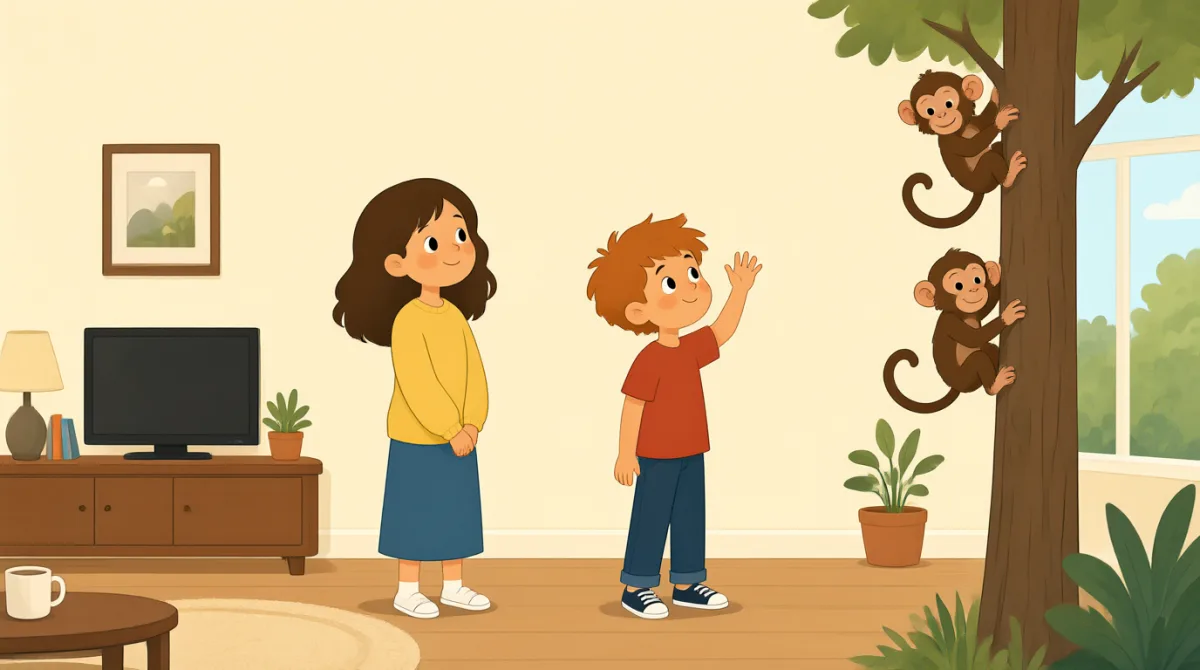

Look, Jack! The monkeys are over there.
Regarde, Jack ! Les singes sont là-bas.

They are climbing the trees.
Ils grimpent aux arbres.
That little monkey is so fast!
Ce petit singe est tellement rapide !
Yes, and this one is eating a banana.
Oui, et celui-ci mange une banane.
Can you see the baby monkey?
Tu vois le bébé singe ?
Yes! It is playing with its mother.
Oui ! Il joue avec sa mère.
They are so fun to watch.
C’est tellement amusant de les regarder.
Vocabulaire8
- over therelà-bas
This means in a place that is not near you. Use it to point out where something is.
Cela désigne un endroit qui n’est pas près de toi. Utilise cette expression pour indiquer où se trouve quelque chose.
- climbing the treesgrimper aux arbres
This means moving up the trees. You can use “climbing” to talk about moving up something.
Cela signifie monter dans les arbres. Tu peux utiliser “climbing” pour parler du fait de grimper quelque part.
- so fasttellement rapide
This means very fast. Use “so” before an adjective to show how you feel about something.
Cela signifie très rapide. Mets “so” devant un adjectif pour exprimer ce que tu ressens à propos de quelque chose.
- this onecelui-ci / celle-ci
This means the thing or animal you are pointing to. Use it when you choose one from a group.
Cela désigne la chose ou l’animal que tu montres du doigt. Utilise cette expression pour en choisir un parmi plusieurs.
- eating a bananamanger une banane
This means having a banana as food. Use “is eating” for an action happening now.
Cela signifie manger une banane. Utilise “is eating” pour parler d’une action qui se déroule en ce moment.
- baby monkeybébé singe
This means a very young monkey. You can use “baby” before an animal name to talk about its young.
Cela désigne un singe très jeune. Tu peux mettre “baby” devant le nom d’un animal pour parler de son petit.
- playing with its motherjouer avec sa mère
This means having fun together with its mother. Use “playing with” to say who someone is having fun with.
Cela signifie s’amuser avec sa mère. Utilise “playing with” pour dire avec qui quelqu’un s’amuse.
- fun to watchagréable à regarder
This means enjoyable to look at. Use “fun to watch” to describe something you like seeing.
Cela signifie qu’il est plaisant de regarder quelque chose. Utilise “fun to watch” pour décrire quelque chose que tu aimes regarder.
Phrases clés8
- 1
Look, Jack!
Regarde, Jack !
Use this short phrase to get someone's attention and point out something. You can say “Look!” before showing a person something interesting.
Utilise cette courte expression pour attirer l’attention de quelqu’un et lui montrer quelque chose. Tu peux dire “Look!” avant de lui montrer quelque chose d’intéressant.
- 2
The monkeys are over there.
Les singes sont là-bas.
This is useful for telling someone where something is. Replace “the monkeys” with another person or thing.
Cette phrase sert à dire à quelqu’un où se trouve quelque chose. Remplace “the monkeys” par une autre personne ou une autre chose.
- 3
They are climbing the trees.
Ils grimpent aux arbres.
Use “are” plus an action ending in “-ing” to describe what people or animals are doing now. You can change “climbing” to another action.
Utilise “are” suivi d’un verbe terminé par “-ing” pour décrire ce que des personnes ou des animaux font en ce moment. Tu peux remplacer “climbing” par une autre action.
- 4
That little monkey is so fast!
Ce petit singe est tellement rapide !
Use this sentence to describe an animal or person you can see. Replace “little monkey” and “fast” with other words.
Utilise cette phrase pour décrire un animal ou une personne que tu vois. Remplace “little monkey” et “fast” par d’autres mots.
- 5
Yes, and this one is eating a banana.
Oui, et celui-ci mange une banane.
This sentence agrees and adds information about something happening now. You can use “this one is” plus an action to describe one person or thing.
Cette phrase permet d’exprimer ton accord et d’ajouter une information sur quelque chose qui se passe en ce moment. Tu peux utiliser “this one is” suivi d’une action pour décrire une personne ou une chose.
- 6
Can you see the baby monkey?
Tu vois le bébé singe ?
Use this question to ask if someone can see something. Replace “the baby monkey” with another person or thing.
Utilise cette question pour demander à quelqu’un s’il voit quelque chose. Remplace “the baby monkey” par une autre personne ou une autre chose.
- 7
Yes!
Oui !
Use this short answer to agree or say that something is true. You can also use it to show excitement.
Utilise cette réponse courte pour être d’accord ou dire que quelque chose est vrai. Tu peux aussi l’utiliser pour montrer ton enthousiasme.
- 8
It is playing with its mother.
Il joue avec sa mère.
Use this sentence to describe what an animal is doing and who it is with. Replace “playing” and “its mother” to describe another activity or companion.
Utilise cette phrase pour décrire ce qu’un animal fait et avec qui il est. Remplace “playing” et “its mother” pour parler d’une autre activité ou d’un autre compagnon.