Asking for the Check
Demander l’addition
After breakfast, Emma asks the server for the check. Jack pays, and they leave the diner.
Après le petit-déjeuner, Emma demande l’addition au serveur. Jack paie, puis ils quittent le restaurant.
Dialogue6
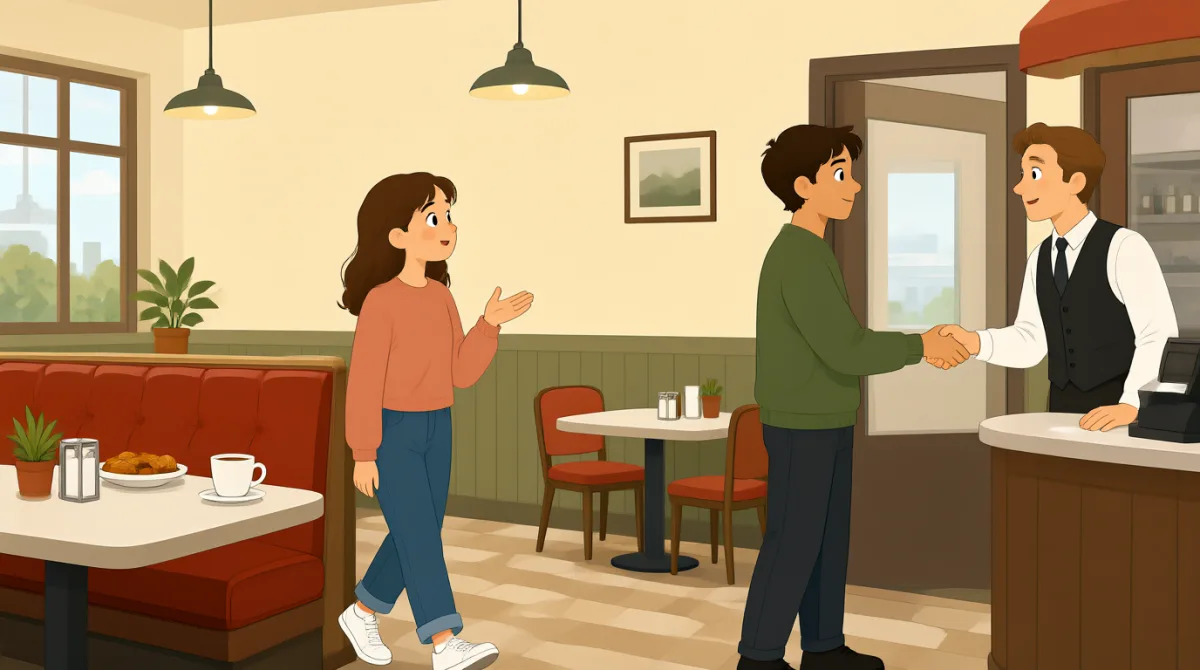

That was a good breakfast. Can we get the check?
C’était un bon petit-déjeuner. On peut avoir l’addition ?

Sure. I’ll pay today.
Bien sûr. Je paie aujourd’hui.
Thanks, Jack. The pancakes were great.
Merci, Jack. Les pancakes étaient délicieux.
You’re welcome. Here’s my card.
Je t’en prie. Voilà ma carte.
All set. Let’s go.
C’est bon. On y va.
Okay. Have a nice day!
D’accord. Bonne journée !
Vocabulaire7
- good breakfastbon petit-déjeuner
This means the breakfast was enjoyable. You can say, “That was a good breakfast,” after a meal.
Cela signifie que le petit-déjeuner était agréable. Vous pouvez dire « That was a good breakfast » (« C’était un bon petit-déjeuner ») après un repas.
- get the checkdemander l’addition
This means ask for the bill at a restaurant. You can say, “Can we get the check?” when you are ready to leave.
Cela signifie demander la note au restaurant. Vous pouvez dire « Can we get the check? » (« On peut avoir l’addition ? ») quand vous êtes prêts à partir.
- I’ll pay todayje paie aujourd’hui
This means the speaker will pay for the meal. You can use “I’ll pay today” to offer to pay.
Cela signifie que la personne qui parle va payer le repas. Vous pouvez proposer de payer en disant « I’ll pay today » (« Je paie aujourd’hui »).
- You’re welcomeje t’en prie
This is a polite reply when someone says thank you. You can use it in many everyday situations.
C’est une réponse polie quand quelqu’un vous remercie. Vous pouvez l’utiliser dans de nombreuses situations du quotidien.
- Here’s my cardvoilà ma carte
This means the speaker is giving their card to pay. You can say it when you hand your card to a server.
Cela signifie que la personne qui parle tend sa carte pour payer. Vous pouvez le dire en donnant votre carte au serveur.
- All setc’est bon
This means everything is ready or finished. You can use it when you have finished paying and are ready to go.
Cela signifie que tout est prêt ou terminé. Vous pouvez le dire après avoir fini de payer, quand vous êtes prêts à partir.
- Have a nice day!bonne journée !
This is a friendly way to say goodbye. You can use it when leaving a shop or restaurant.
C’est une façon amicale de dire au revoir. Vous pouvez le dire en quittant un magasin ou un restaurant.
Phrases clés8
- 1
That was a good breakfast.
C’était un bon petit-déjeuner.
This is a simple way to say you enjoyed a meal. You can change “breakfast” to “lunch” or “dinner.”
C’est une façon simple de dire que vous avez apprécié un repas. Vous pouvez remplacer « breakfast » par « lunch » ou « dinner ».
- 2
Can we get the check?
On peut avoir l’addition ?
Use this polite question to ask for the bill at a restaurant. You can also say, “Can we get the menu?” to ask for the menu.
Utilisez cette question polie pour demander l’addition au restaurant. Vous pouvez aussi dire « Can we get the menu? » pour demander la carte.
- 3
Sure.
Bien sûr.
This is a friendly way to say yes. You can use it to agree to a request.
C’est une façon amicale de dire oui. Vous pouvez l’utiliser pour accepter une demande.
- 4
I’ll pay today.
Je paie aujourd’hui.
Use this sentence to offer to pay. You can change “today” to a different time, such as “this time.”
Utilisez cette phrase pour proposer de payer. Vous pouvez remplacer « today » par un autre moment, comme « this time ».
- 5
The pancakes were great.
Les pancakes étaient délicieux.
This is a simple way to say you liked a food. You can replace “pancakes” with another dish.
C’est une façon simple de dire que vous avez aimé un plat. Vous pouvez remplacer « pancakes » par un autre plat.
- 6
Here’s my card.
Voilà ma carte.
Use this when you hand your card to someone. You can also say, “Here’s my ticket” when giving someone a ticket.
Utilisez cette phrase en tendant votre carte à quelqu’un. Vous pouvez aussi dire « Here’s my ticket » quand vous donnez un billet à quelqu’un.
- 7
Let’s go.
On y va.
This means you are ready to leave or move somewhere. You can use it with friends or family.
Cela signifie que vous êtes prêts à partir ou à vous rendre quelque part. Vous pouvez l’utiliser avec des amis ou en famille.
- 8
Have a nice day!
Bonne journée !
This is a friendly goodbye. You can say it when you leave a restaurant, shop, or other place.
C’est une façon amicale de dire au revoir. Vous pouvez le dire en quittant un restaurant, un magasin ou un autre lieu.