Asking Someone to Take Yours
Demander à quelqu’un de vous prendre en photo
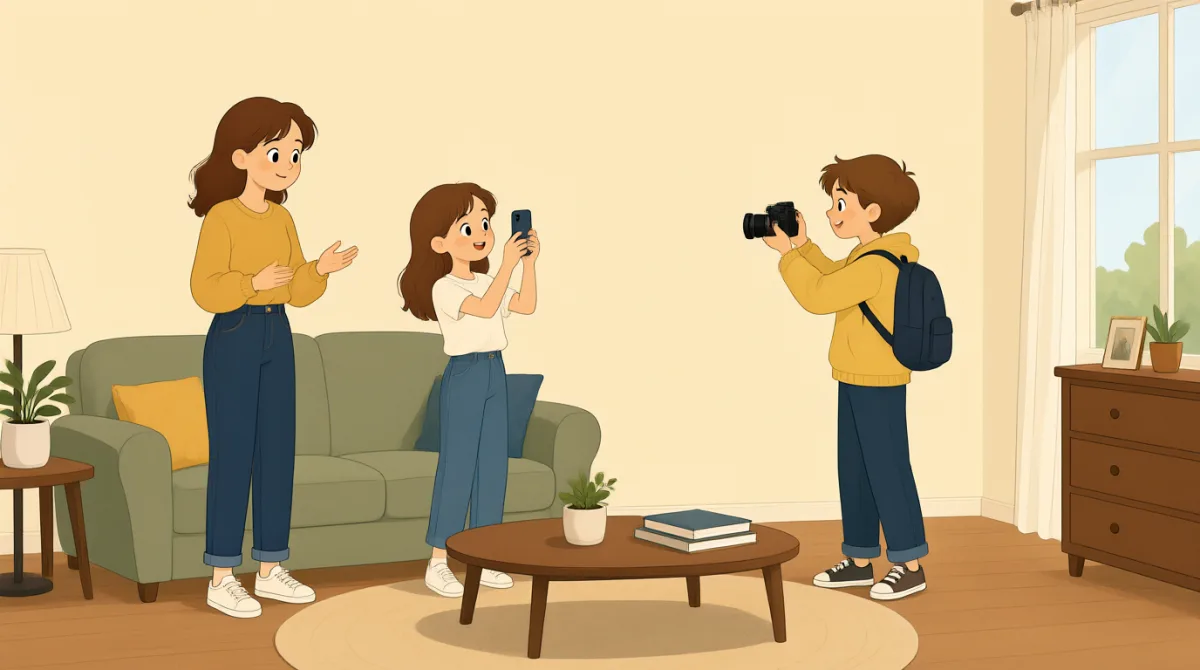
After taking Mia and Jack's photos, Emma asks Mia to take a picture of her with the landmark.
Après avoir pris Mia et Jack en photo, Emma demande à Mia de la photographier avec le monument.
Dialogue7

That was a nice photo of you and Jack.
La photo de toi et Jack est très réussie.

Thanks for taking it!
Merci de l’avoir prise !
Can you take a photo of me now?
Tu peux me prendre en photo, maintenant ?
Sure! Stand by the statue.
Bien sûr ! Mets-toi près de la statue.
Is the whole building in the picture?
On voit tout le bâtiment sur la photo ?
Yes. Look at the camera and smile!
Regarde l’objectif et souris !
Ready? Thanks, Mia!
Prête ? Merci, Mia !
Vocabulaire8
- nice photoune belle photo
A nice photo is a good or attractive picture. You can use “nice photo” to say you like someone’s picture.
Une « nice photo » est une photo réussie ou jolie. Tu peux dire « nice photo » pour montrer que tu aimes la photo de quelqu’un.
- Thanks for taking it!Merci de l’avoir prise !
This is a friendly way to thank someone for taking a photo. “It” means the photo.
C’est une façon amicale de remercier quelqu’un d’avoir pris une photo. « It » désigne la photo.
- take a photoprendre une photo
This means to make a picture with a camera or phone. You can say, “Can you take a photo of me?”
Cela signifie faire une photo avec un appareil ou un téléphone. Tu peux dire : « Can you take a photo of me? » (Tu peux me prendre en photo ?)
- stand by the statuese mettre près de la statue
This tells someone where to stand. You can replace “the statue” with another place or object.
Cette expression indique à quelqu’un où se placer. Tu peux remplacer « the statue » par un autre lieu ou objet.
- the whole buildingtout le bâtiment
“The whole building” means all of the building, not just part of it. Use “the whole” before a thing when you mean all of it.
« The whole building » signifie le bâtiment en entier, et pas seulement une partie. Utilise « the whole » avant un nom pour parler de quelque chose dans son intégralité.
- in the picturesur la photo
This asks if something can be seen in a photo. You can ask, “Is the sign in the picture?”
Cette expression permet de demander si quelque chose est visible sur une photo. Tu peux demander : « Is the sign in the picture? » (On voit le panneau sur la photo ?)
- look at the cameraregarder l’objectif
This tells someone to face the camera. It is a useful direction when taking a photo.
Cette expression demande à quelqu’un de se tourner vers l’appareil photo. C’est une indication pratique quand on prend une photo.
- smilesourire
“Smile” is a simple instruction to make a happy expression for a photo.
« Smile » est une consigne simple pour demander à quelqu’un de prendre un air joyeux sur une photo.
Phrases clés8
- 1
That was a nice photo of you and Jack.
La photo de toi et Jack est très réussie.
Use this to compliment a photo someone has taken. You can change “you and Jack” to name the people in the picture.
Utilise cette phrase pour complimenter quelqu’un sur une photo qu’il a prise. Tu peux remplacer « you and Jack » par les noms des personnes sur la photo.
- 2
Thanks for taking it!
Merci de l’avoir prise !
Use this to thank someone for taking a photo. Replace “it” with a person or thing when the meaning is clear.
Utilise cette phrase pour remercier quelqu’un d’avoir pris une photo. Tu peux remplacer « it » par une personne ou une chose lorsque le contexte permet de comprendre.
- 3
Can you take a photo of me now?
Tu peux me prendre en photo, maintenant ?
This is a polite, simple way to ask someone to take your picture. You can replace “me” with another person.
C’est une façon simple et polie de demander à quelqu’un de te prendre en photo. Tu peux remplacer « me » par une autre personne.
- 4
Sure!
Bien sûr !
This is a friendly way to agree to a request. You can use it when someone asks you for help.
C’est une façon amicale d’accepter une demande. Tu peux l’utiliser quand quelqu’un te demande de l’aide.
- 5
Stand by the statue.
Mets-toi près de la statue.
Use this to tell someone where to stand for a photo. Replace “the statue” with a different place or object.
Utilise cette phrase pour indiquer à quelqu’un où se placer pour une photo. Tu peux remplacer « the statue » par un autre lieu ou objet.
- 6
Is the whole building in the picture?
On voit tout le bâtiment sur la photo ?
Use this question to check if something appears completely in a photo. Replace “the whole building” with the thing you want to see.
Utilise cette question pour vérifier si quelque chose apparaît en entier sur une photo. Tu peux remplacer « the whole building » par ce que tu veux voir.
- 7
Look at the camera and smile!
Regarde l’objectif et souris !
This gives two simple directions for a photo. You can use it to help someone face the camera and look happy.
Cette phrase donne deux consignes simples pour une photo. Tu peux l’utiliser pour aider quelqu’un à regarder l’appareil et à avoir l’air joyeux.
- 8
Ready? Thanks, Mia!
Prête ? Merci, Mia !
“Ready?” checks if someone is prepared, and “Thanks” shows appreciation. You can use these short phrases before and after a photo.
« Ready? » permet de vérifier si quelqu’un est prêt, et « Thanks » exprime sa reconnaissance. Tu peux utiliser ces petites phrases avant et après une photo.