Looking in the Living Room
Im Wohnzimmer suchen
Emma and Mia look around the living room. They check the table and the chair.
Emma und Mia suchen im Wohnzimmer. Sie schauen auf dem Tisch und auf dem Stuhl nach.
Dialog7
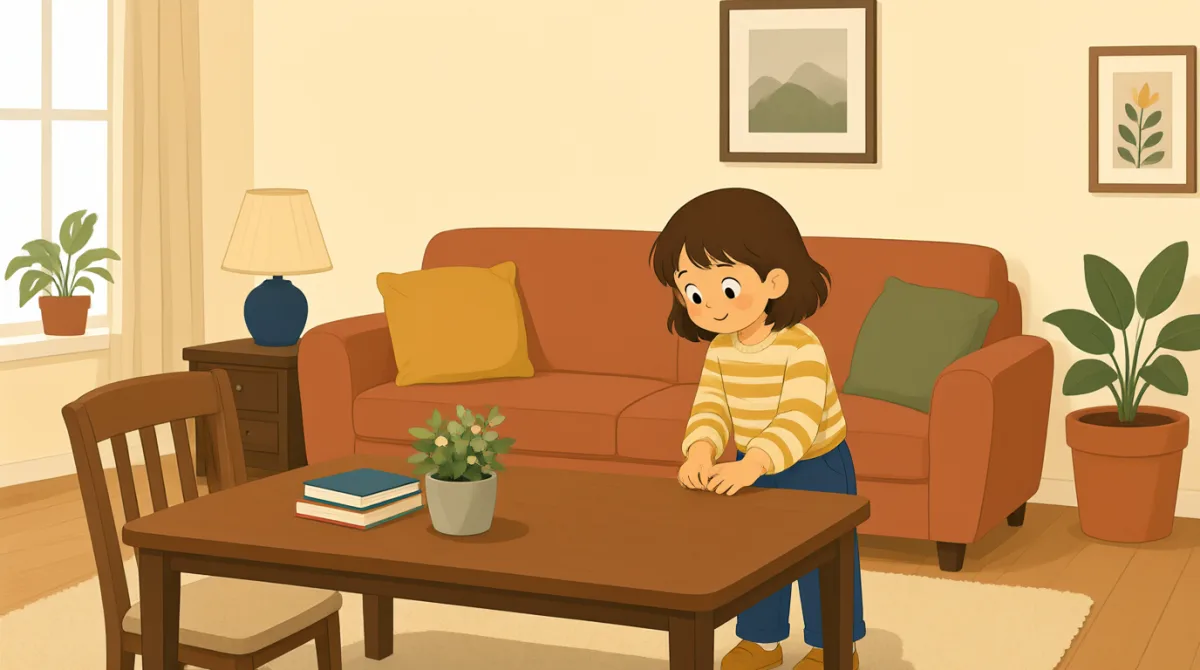

Can you help me look in the living room?
Kannst du mir helfen, im Wohnzimmer zu suchen?

Sure. Where did you last see them?
Klar. Wo hast du sie zuletzt gesehen?
I think they were on the table.
Ich glaube, sie lagen auf dem Tisch.
The table is empty. Check the chair.
Der Tisch ist leer. Schau mal auf dem Stuhl nach.
I see a book on the chair, but no keys.
Ich sehe ein Buch auf dem Stuhl, aber keine Schlüssel.
Look next to the table. Do you see them?
Schau neben dem Tisch nach. Siehst du sie?
No, I don't. Let's look by the sofa.
Nein, sehe ich nicht. Lass uns beim Sofa nachsehen.
Wortschatz6
- look in the living roomim Wohnzimmer suchen
To search inside the living room. Use this phrase to say where you want to look for something.
Im Wohnzimmer nach etwas suchen. Mit dieser Wendung sagst du, wo du nach etwas suchen möchtest.
- last seezuletzt sehen
To remember the most recent time or place you saw something. Ask, “Where did you last see it?” when looking for a lost item.
Sich daran erinnern, wann oder wo man etwas zuletzt gesehen hat. Wenn du etwas Verlorenes suchst, kannst du fragen: „Where did you last see it?“ (Wo hast du es zuletzt gesehen?)
- on the tableauf dem Tisch
This means on top of the table. Use “on” to say where something is.
Das bedeutet, dass etwas oben auf dem Tisch liegt. Mit „on“ sagst du, wo sich etwas befindet.
- emptyleer
There is nothing on or inside a place. Here, there are no keys on the table.
An oder in einem Ort befindet sich nichts. Hier liegen keine Schlüssel auf dem Tisch.
- next to the tableneben dem Tisch
This means beside the table. Use “next to” to describe where something is.
Das bedeutet, dass sich etwas direkt neben dem Tisch befindet. Mit „next to“ beschreibst du, wo etwas ist.
- by the sofabeim Sofa
This means near the sofa. Use “by” to say that something is close to a place or object.
Das bedeutet, dass sich etwas in der Nähe des Sofas befindet. Mit „by“ sagst du, dass etwas nahe bei einem Ort oder Gegenstand ist.
Wichtige Sätze8
- 1
Can you help me look in the living room?
Kannst du mir helfen, im Wohnzimmer zu suchen?
Use this question to ask someone to help you search a place. You can replace “the living room” with another place.
Mit dieser Frage bittest du jemanden, dir bei der Suche an einem Ort zu helfen. Du kannst „the living room“ durch einen anderen Ort ersetzen.
- 2
Where did you last see them?
Wo hast du sie zuletzt gesehen?
Use this question to ask where someone saw something most recently. Replace “them” with the item you are looking for.
Mit dieser Frage fragst du, wo jemand etwas zuletzt gesehen hat. Ersetze „them“ durch den Gegenstand, den du suchst.
- 3
I think they were on the table.
Ich glaube, sie lagen auf dem Tisch.
Use this sentence to say where you think something was. “I think” shows that you are not completely sure.
Mit diesem Satz sagst du, wo etwas deiner Meinung nach war. „I think“ zeigt, dass du dir nicht ganz sicher bist.
- 4
The table is empty.
Der Tisch ist leer.
Use this simple sentence to say that nothing is on the table. You can replace “the table” with another place.
Mit diesem einfachen Satz sagst du, dass nichts auf dem Tisch liegt. Du kannst „the table“ durch einen anderen Ort ersetzen.
- 5
Check the chair.
Schau auf dem Stuhl nach.
Use this short instruction to tell someone to look at or search a place. Replace “the chair” with another place or object.
Mit dieser kurzen Aufforderung bittest du jemanden, an einem Ort oder bei etwas nachzusehen. Ersetze „the chair“ durch einen anderen Ort oder Gegenstand.
- 6
I see a book on the chair, but no keys.
Ich sehe ein Buch auf dem Stuhl, aber keine Schlüssel.
Use this sentence to say what you can see and what is missing. You can change the objects to describe what you find.
Mit diesem Satz sagst du, was du siehst und was fehlt. Du kannst die Gegenstände austauschen, um zu beschreiben, was du findest.
- 7
Do you see them?
Siehst du sie?
Use this question to ask if someone can see the things you are looking for. Replace “them” with a person or object.
Mit dieser Frage fragst du, ob jemand die Dinge sehen kann, nach denen ihr sucht. Ersetze „them“ durch eine Person oder einen Gegenstand.
- 8
Let's look by the sofa.
Lass uns beim Sofa nachsehen.
Use “Let's” to suggest doing something together. Replace “by the sofa” with another place to suggest where to search.
Mit „Let's“ schlägst du vor, etwas gemeinsam zu tun. Ersetze „by the sofa“ durch einen anderen Ort, um vorzuschlagen, wo ihr suchen könnt.