Asking a Roommate
Die Mitbewohnerin fragen
Emma asks her roommate Jack if he has seen the keys. Jack remembers seeing them near the front door.
Emma fragt ihren Mitbewohner Jack, ob er die Schlüssel gesehen hat. Jack erinnert sich, sie in der Nähe der Haustür gesehen zu haben.
Dialog7
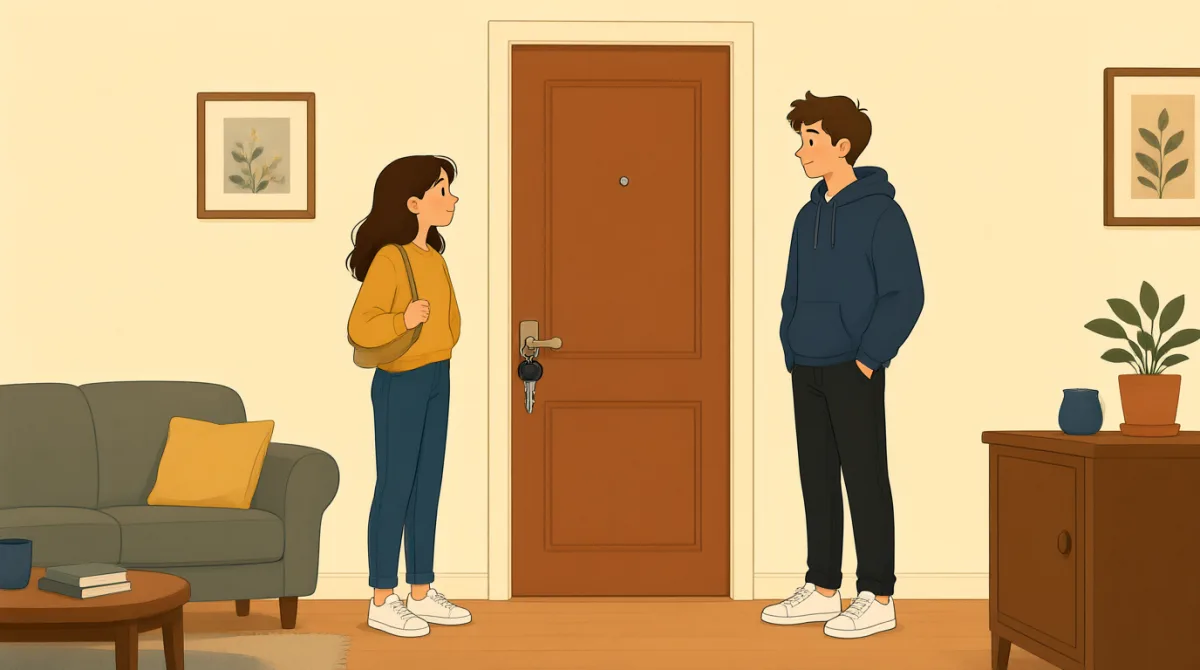

Jack, have you seen my keys?
Jack, hast du meine Schlüssel gesehen?

Your keys? What do they look like?
Deine Schlüssel? Wie sehen sie aus?
They are small, with a blue key ring.
Sie sind klein und haben einen blauen Schlüsselanhänger.
I saw them near the front door earlier.
Ich habe sie vorhin in der Nähe der Haustür gesehen.
Were they on the table or on the floor?
Waren sie auf dem Tisch oder auf dem Boden?
I think they were next to your bag.
Ich glaube, sie lagen neben deiner Tasche.
Okay, I'll look by the front door.
Okay, ich suche bei der Haustür.
Wortschatz7
- have you seen my keys?have you seen my keys? — Hast du meine Schlüssel gesehen?
Use this to ask if someone has seen your keys. You can replace “my keys” with another missing item.
Mit „have you seen my keys?“ fragst du, ob jemand deine Schlüssel gesehen hat. Du kannst „my keys“ durch einen anderen vermissten Gegenstand ersetzen.
- What do they look like?What do they look like? — Wie sehen sie aus?
Use this to ask someone to describe something. “They” refers to the keys.
Mit „What do they look like?“ bittest du jemanden, etwas zu beschreiben. „They“ bezieht sich hier auf die Schlüssel.
- key ringkey ring — Schlüsselanhänger
A key ring holds keys together. You can describe its color to help someone find your keys.
Ein „key ring“ hält mehrere Schlüssel zusammen. Du kannst seine Farbe beschreiben, damit jemand deine Schlüssel leichter findet.
- front doorfront door — Haustür
The front door is the main entrance to a home or building. Use this phrase to say where something is.
Die „front door“ ist der Haupteingang eines Hauses oder Gebäudes. Mit diesem Ausdruck kannst du sagen, wo sich etwas befindet.
- on the tableon the table — auf dem Tisch
Use this phrase to say that something is resting on a table. “On” tells us where it is.
Mit „on the table“ sagst du, dass etwas auf einem Tisch liegt oder steht. „On“ gibt an, wo es sich befindet.
- next to your bagnext to your bag — neben deiner Tasche
Use this phrase to say that something is beside a bag. You can replace “your bag” with another object.
Mit „next to your bag“ sagst du, dass etwas neben einer Tasche liegt. Du kannst „your bag“ durch einen anderen Gegenstand ersetzen.
- look by the front doorlook by the front door — bei der Haustür suchen
Use this phrase to say that you will search near the front door. “By” means near.
Mit „look by the front door“ sagst du, dass du in der Nähe der Haustür suchen wirst. „By“ bedeutet hier „in der Nähe von“.
Wichtige Sätze7
- 1
Jack, have you seen my keys?
Jack, hast du meine Schlüssel gesehen?
This is a simple way to ask if someone has seen something you cannot find. Replace “my keys” with another missing item.
Mit „Jack, have you seen my keys?“ fragst du auf einfache Weise, ob jemand etwas gesehen hat, das du nicht finden kannst. Ersetze „my keys“ durch einen anderen vermissten Gegenstand.
- 2
What do they look like?
Wie sehen sie aus?
Use this question to ask for a description. You can change “they” to “it” when asking about one item.
Mit „What do they look like?“ bittest du jemanden um eine Beschreibung. Wenn du nach einem einzelnen Gegenstand fragst, kannst du „they“ durch „it“ ersetzen.
- 3
They are small, with a blue key ring.
Sie sind klein und haben einen blauen Schlüsselanhänger.
This sentence describes the keys and their key ring. Use “They are…” to give details about more than one thing.
Dieser Satz beschreibt die Schlüssel und ihren Schlüsselanhänger. Mit „They are…“ kannst du mehrere Dinge näher beschreiben.
- 4
I saw them near the front door earlier.
Ich habe sie vorhin in der Nähe der Haustür gesehen.
Use this to say where and when you last saw something. Replace “them” with the thing you saw.
Mit „I saw them near the front door earlier.“ sagst du, wo und wann du etwas zuletzt gesehen hast. Ersetze „them“ durch den Gegenstand, den du gesehen hast.
- 5
Were they on the table or on the floor?
Waren sie auf dem Tisch oder auf dem Boden?
This question asks someone to choose between two possible places. You can use the same pattern to ask where something was.
Mit „Were they on the table or on the floor?“ bittest du jemanden, zwischen zwei möglichen Orten zu wählen. Du kannst das gleiche Muster verwenden, um zu fragen, wo etwas war.
- 6
I think they were next to your bag.
Ich glaube, sie lagen neben deiner Tasche.
Use “I think…” when you are not completely sure. “Next to” tells where something was.
Mit „I think…“ drückst du aus, dass du dir nicht ganz sicher bist. „Next to“ sagt, wo sich etwas befand.
- 7
Okay, I'll look by the front door.
Okay, ich suche bei der Haustür.
Use this to say you will search near a place. “I'll” is short for “I will.”
Mit „Okay, I'll look by the front door.“ sagst du, dass du in der Nähe eines Ortes suchen wirst. „I'll“ ist die Kurzform von „I will.“