Asking Where the Paint Is
Nach dem Standort der Farbe fragen
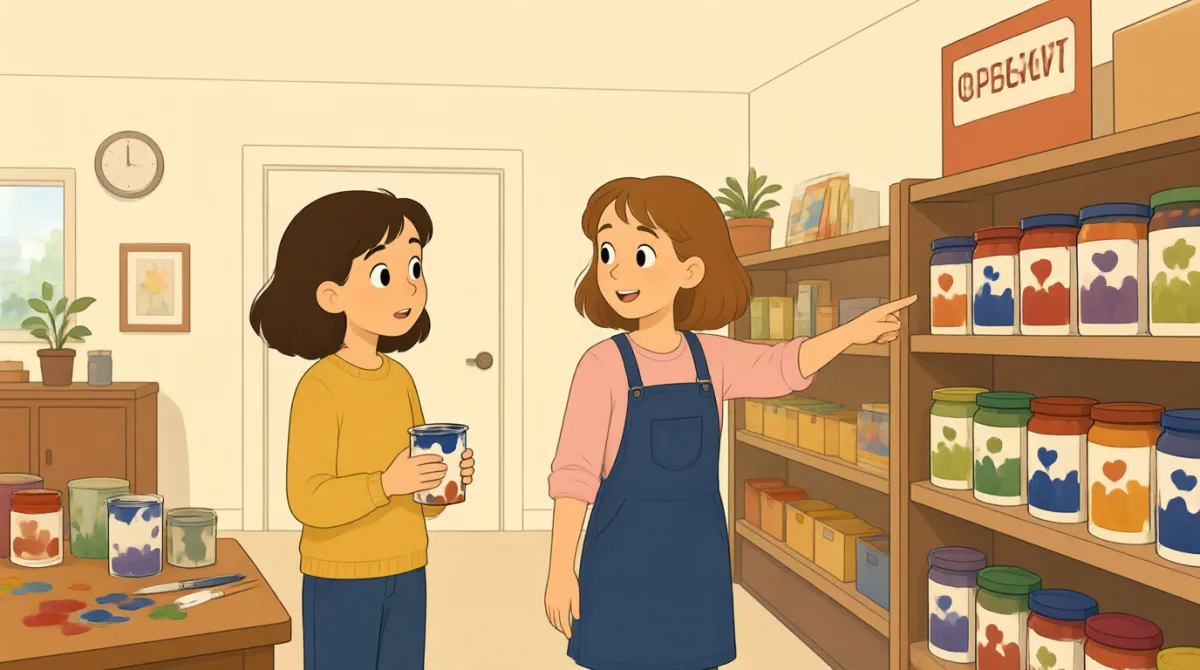
Emma asks Grace where the paint is. Grace points her to the paint section.
Emma fragt Grace, wo die Farbe ist. Grace zeigt ihr die Farbenabteilung.
Dialog7

Excuse me, where is the paint?
Entschuldigung, wo finde ich die Farbe?

It’s in aisle six, near the brushes.
Im Gang sechs, in der Nähe der Pinsel.
Thanks. Is it easy to find?
Danke. Findet man sie leicht?
Yes. Look for the big paint cans.
Ja. Halten Sie Ausschau nach den großen Farbeimern.
I need a small can, please.
Ich brauche bitte einen kleinen Eimer.
Small cans are on the lower shelf.
Die kleinen Eimer stehen im unteren Regal.
Great, thank you for your help!
Super, vielen Dank für Ihre Hilfe!
Wortschatz8
- Excuse meEntschuldigung
A polite way to get someone's attention before asking a question.
„Excuse me“ ist eine höfliche Art, die Aufmerksamkeit einer Person zu bekommen, bevor du eine Frage stellst.
- where is the paint?Wo ist die Farbe?
Use this question to ask where something is in a store.
Mit „where is the paint?“ fragst du, wo sich etwas in einem Geschäft befindet.
- aisle sixGang sechs
An aisle is a passage between shelves. You can use this phrase to say where something is.
Ein „aisle“ ist ein Gang zwischen Regalen. Mit „aisle six“ kannst du angeben, wo sich etwas befindet.
- near the brushesin der Nähe der Pinsel
This tells someone that something is close to the brushes.
„near the brushes“ sagt jemandem, dass etwas nicht weit von den Pinseln entfernt ist.
- easy to findleicht zu finden
Use this phrase to ask if something is simple to locate.
Mit „easy to find“ kannst du fragen, ob sich etwas leicht finden lässt.
- paint cansFarbeimer
These are containers that hold paint. You can use this phrase to ask for or describe paint in a store.
„Paint cans“ sind Behälter, in denen Farbe aufbewahrt wird. Mit diesem Ausdruck kannst du im Geschäft nach Farbe fragen oder sie beschreiben.
- lower shelfunteres Regal
This means a shelf that is low down. Use it to describe where an item is.
„Lower shelf“ bedeutet ein Regalbrett weiter unten. Mit diesem Ausdruck beschreibst du, wo sich ein Artikel befindet.
- thank you for your helpVielen Dank für Ihre Hilfe
A polite way to thank someone after they help you.
„Thank you for your help“ ist eine höfliche Art, dich bei jemandem zu bedanken, nachdem die Person dir geholfen hat.
Wichtige Sätze7
- 1
Excuse me, where is the paint?
Entschuldigung, wo finde ich die Farbe?
Use this polite question to ask where an item is. Replace “the paint” with another item, such as “the soap.”
Mit dieser höflichen Frage erkundigst du dich, wo sich ein Artikel befindet. Ersetze “the paint” durch einen anderen Artikel, zum Beispiel “the soap.”
- 2
It’s in aisle six, near the brushes.
Im Gang sechs, in der Nähe der Pinsel.
Use this sentence to tell someone where an item is. Replace “aisle six” and “the brushes” with the location and nearby items.
Mit diesem Satz erklärst du jemandem, wo sich ein Artikel befindet. Ersetze “aisle six” und “the brushes” durch den Standort und Dinge in der Nähe.
- 3
Is it easy to find?
Findet man sie leicht?
Use this question to ask if something is simple to locate. Replace “it” with the item you are looking for.
Mit dieser Frage erkundigst du dich, ob sich etwas leicht finden lässt. Ersetze “it” durch den Artikel, den du suchst.
- 4
Yes. Look for the big paint cans.
Ja. Halten Sie Ausschau nach den großen Farbeimern.
Use “Look for…” to tell someone what to search for. Replace “the big paint cans” with a helpful sign or item.
Mit “Look for…” sagst du jemandem, wonach die Person suchen soll. Ersetze “the big paint cans” durch ein hilfreiches Schild oder einen passenden Artikel.
- 5
I need a small can, please.
Ich brauche bitte einen kleinen Eimer.
Use this sentence to ask for a particular size or type of item. Replace “a small can” with what you need.
Mit diesem Satz bittest du um einen Artikel in einer bestimmten Größe oder Ausführung. Ersetze “a small can” durch das, was du brauchst.
- 6
Small cans are on the lower shelf.
Die kleinen Eimer stehen im unteren Regal.
Use this sentence to say where items are. Replace “Small cans” and “the lower shelf” with the item and its location.
Mit diesem Satz sagst du, wo sich Artikel befinden. Ersetze “Small cans” und “the lower shelf” durch den Artikel und seinen Standort.
- 7
Great, thank you for your help!
Super, vielen Dank für Ihre Hilfe!
Use this friendly sentence to thank someone who has helped you.
Mit diesem freundlichen Satz bedankst du dich bei jemandem, der dir geholfen hat.