Finding the Police Station
Die Polizeiwache finden
Emma asks Officer David where the police station is. He tells her how to get there on foot.
Emma fragt Officer David, wo die Polizeiwache ist. Er erklärt ihr den Fußweg dorthin.
Dialog7
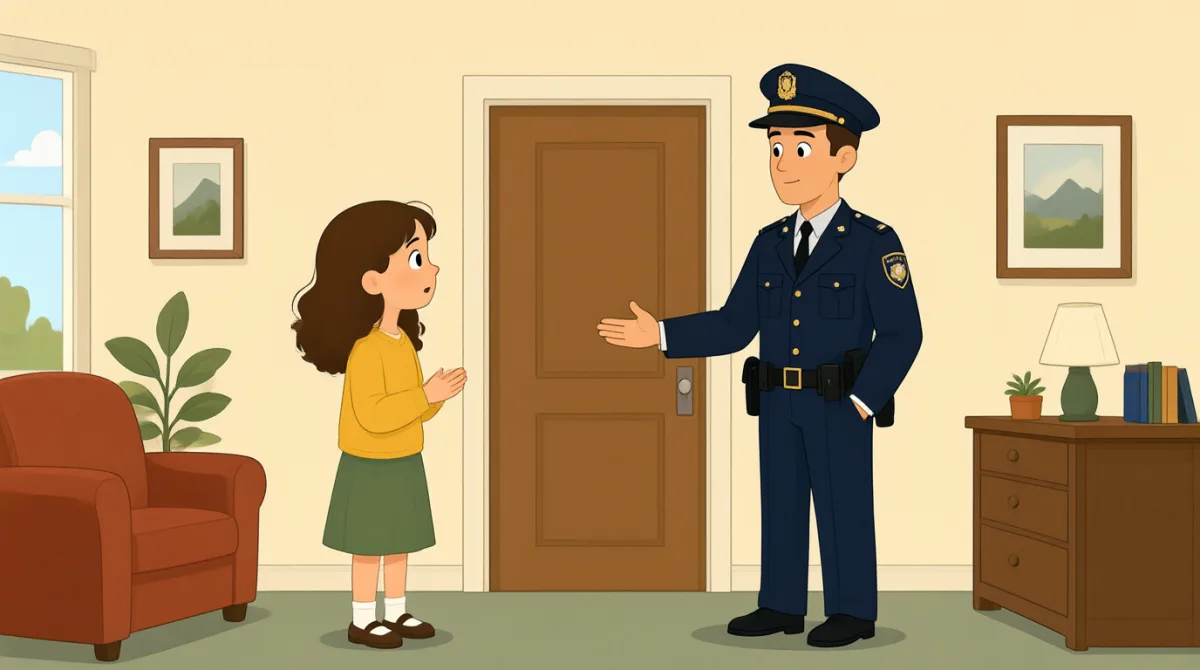

Excuse me, where is the police station?
Entschuldigen Sie, wo ist die Polizeiwache?

It’s not far. Walk straight on this street.
Sie ist nicht weit. Gehen Sie diese Straße geradeaus.
How many blocks do I walk?
Wie viele Häuserblocks muss ich gehen?
Walk two blocks, then turn left.
Gehen Sie zwei Blocks weiter und biegen Sie dann links ab.
Is it near the bus stop?
Ist sie in der Nähe der Bushaltestelle?
Yes. It’s next to the bus stop.
Ja. Sie ist direkt neben der Bushaltestelle.
Thank you. I can find it now.
Danke. Jetzt finde ich sie.
Wortschatz8
- Excuse meEntschuldigen Sie
Use this polite phrase to get someone's attention before asking a question.
Mit dieser höflichen Wendung machst du jemanden auf dich aufmerksam, bevor du eine Frage stellst.
- police stationPolizeiwache
This is a place where police officers work. You can ask where it is if you need help.
Das ist ein Ort, an dem Polizistinnen und Polizisten arbeiten. Wenn du Hilfe brauchst, kannst du fragen, wo die Polizeiwache ist.
- not farnicht weit
This means a place is close by. You can use it to describe a short distance.
Damit sagst du, dass ein Ort ganz in der Nähe ist. Du kannst die Wendung für eine kurze Entfernung verwenden.
- Walk straight on this street.Gehen Sie diese Straße geradeaus.
This tells someone to keep walking forward on the same street. Use it to give simple directions.
Damit sagst du jemandem, dass er auf derselben Straße weiter nach vorne gehen soll. Die Wendung eignet sich für einfache Wegbeschreibungen.
- blocksBlocks
Blocks are sections of a street between two crossings. You can ask how many blocks to walk.
Ein Block ist ein Straßenabschnitt zwischen zwei Kreuzungen. Du kannst fragen, wie viele Blocks du gehen musst.
- turn leftlinks abbiegen
This means to go in the direction on your left. Use it when giving or following directions.
Das bedeutet, in die Richtung zu gehen, die links von dir liegt. Die Wendung hilft dir, den Weg zu beschreiben oder einer Wegbeschreibung zu folgen.
- next toneben
This means beside or very close to something. Use it to say where a place is.
Das bedeutet, dass etwas direkt daneben oder ganz in der Nähe ist. Du kannst damit sagen, wo sich ein Ort befindet.
- bus stopBushaltestelle
This is a place where people wait for a bus. It can help someone find a nearby location.
An einer Bushaltestelle warten Menschen auf den Bus. Sie kann dir helfen, einen Ort in der Nähe zu finden.
Wichtige Sätze8
- 1
Excuse me, where is the police station?
Entschuldigen Sie, wo ist die Polizeiwache?
Use this polite question to ask for the location of a police station. You can replace “the police station” with another place.
Mit dieser höflichen Frage erkundigst du dich, wo eine Polizeiwache ist. Du kannst “the police station” durch einen anderen Ort ersetzen.
- 2
It’s not far.
Sie ist nicht weit.
This is a short way to say that a place is close. You can use it to reassure someone about the distance.
Das ist eine kurze Art zu sagen, dass ein Ort in der Nähe ist. Du kannst die Wendung verwenden, um jemandem zu versichern, dass der Weg nicht weit ist.
- 3
Walk straight on this street.
Gehen Sie diese Straße geradeaus.
Use this sentence to give a simple direction. You can change “this street” to the name of another street.
Mit diesem Satz gibst du eine einfache Wegbeschreibung. Du kannst “this street” durch den Namen einer anderen Straße ersetzen.
- 4
How many blocks do I walk?
Wie viele Blocks muss ich gehen?
Use this question to ask how far you should walk. You can replace “blocks” with another unit of distance.
Mit dieser Frage erkundigst du dich, wie weit du gehen sollst. Du kannst “blocks” durch eine andere Entfernungsangabe ersetzen.
- 5
Walk two blocks, then turn left.
Gehen Sie zwei Blocks weiter und biegen Sie dann links ab.
This gives two steps in a walking direction. Change “two” or “left” to give different directions.
Dieser Satz nennt zwei Schritte einer Wegbeschreibung zu Fuß. Ändere “two” oder “left”, um eine andere Richtung anzugeben.
- 6
Is it near the bus stop?
Ist sie in der Nähe der Bushaltestelle?
Use this question to check whether a place is close to a landmark. You can replace “the bus stop” with another nearby place.
Mit dieser Frage prüfst du, ob ein Ort in der Nähe eines Orientierungspunkts liegt. Du kannst “the bus stop” durch einen anderen Ort in der Nähe ersetzen.
- 7
Yes. It’s next to the bus stop.
Ja. Sie ist direkt neben der Bushaltestelle.
This confirms the location and explains where it is. Replace “the bus stop” with another landmark.
Damit bestätigst du den Standort und erklärst, wo sich der Ort befindet. Ersetze “the bus stop” durch einen anderen Orientierungspunkt.
- 8
Thank you. I can find it now.
Danke. Jetzt finde ich sie.
Use this to thank someone and say you understand how to get there. You can change “it” to name the place.
Damit bedankst du dich und sagst, dass du jetzt weißt, wie du dorthin kommst. Du kannst “it” durch den Namen des Ortes ersetzen.