Asking in a Shopping Mall/Large Venue
在購物中心/大型場所詢問
Someone is in a large public space like a shopping mall, airport, or museum and needs directions to the restroom. They approach an information desk attendant or security guard.
某人在一個大型公共場所,如購物中心、機場或博物館,需要詢問洗手間的方向。他們走向資訊臺服務員或保安。
對話6
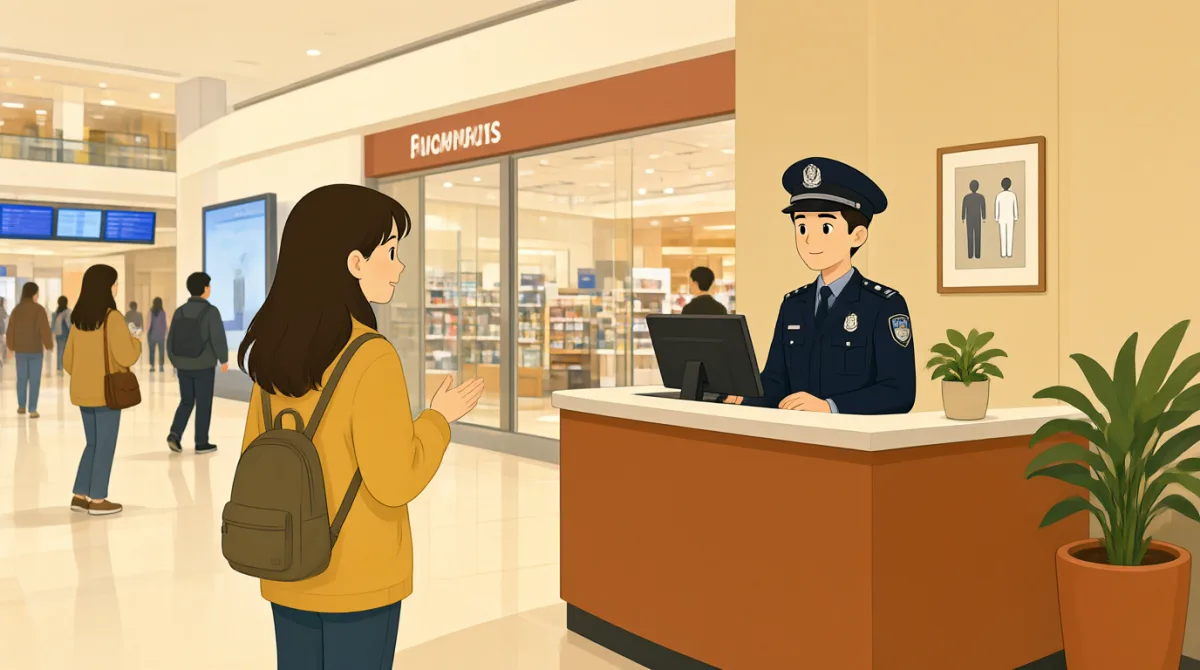

Excuse me, I'm a bit lost. Could you tell me where the restrooms are?
打擾一下,我有點迷路了。請問洗手間在哪裡?

Certainly! The closest restrooms are on this floor. Go straight down this main aisle, and you'll see them on your left, just past the food court.
當然可以!最近的洗手間就在這一層。沿著這條主通道直走,過了美食廣場,你會在左手邊看到它們。
Straight down, past the food court, on my left. Got it. Thank you so much!
直走,過了美食廣場,在左手邊。明白了。非常感謝!
You're welcome! Is there anything else I can help you with today?
不客氣!今天還有什麼可以幫助您的嗎?
No, that's all for now. Thanks again!
暫時沒有了。再次感謝!
My pleasure. Have a great day!
樂意效勞。祝您有愉快的一天!
詞彙7
- restrooms洗手間
A polite word for bathrooms or toilets in public places, commonly used in American English instead of 'bathroom' or 'toilet'.
在公共場所表示衛生間的禮貌說法,在美式英語中很常見,通常用來代替 'bathroom' 或 'toilet'。
- lost迷路的
Feeling confused about your location or direction; here, it means not knowing where to go in a building.
指不清楚自己所在的位置或該往哪個方向走;這裡表示不知道在建築物裡該往哪裡走。
- certainly當然可以
A polite way to say 'yes' or 'of course' when agreeing to help someone.
答應幫助別人時,用來禮貌地表示“可以”或“當然可以”。
- straight直走
Going directly forward without turning; used in directions like 'go straight ahead'.
不轉彎,直接向前走;常用於 'go straight ahead'(一直往前走)這樣的指路表達。
- aisle通道
A walkway or passage between rows, like in a store or mall, where you walk to get from one place to another.
商店或購物中心裡兩排貨架之間的通道,人們可以從這裡走到其他地方。
- food court美食廣場
An area in a mall or venue with multiple food stalls or restaurants where people eat.
購物中心或大型場所裡有多個餐飲攤位或餐廳、供人們用餐的區域。
- my pleasure樂意效勞
A polite response to 'thank you', meaning 'I'm happy to help' or 'you're welcome'.
對 'thank you'(謝謝)的一種禮貌回應,意思是“我很樂意幫忙”或“不客氣”。
關鍵句6
- 1
Excuse me, I'm a bit lost. Could you tell me where the restrooms are?
打擾一下,我有點迷路了。請問洗手間在哪裡?
This is a polite way to start asking for directions. 'Excuse me' gets attention, 'I'm a bit lost' explains the situation softly, and 'Could you tell me...' is a polite request using 'could' for possibility. Useful for approaching strangers in public.
這是禮貌地開始問路的說法。'Excuse me'(打擾一下)用來引起對方注意,'I'm a bit lost'(我有點迷路了)委婉地說明情況,而 'Could you tell me...' 則用 'could' 禮貌地提出請求。在公共場所向陌生人問路時很實用。
- 2
Certainly! The closest restrooms are on this floor.
當然可以!最近的洗手間就在這一層。
A helpful response starting with 'Certainly!' to agree eagerly. 'Closest' means nearest, and 'on this floor' specifies location. This pattern is useful for giving simple directions in buildings.
用 'Certainly!'(當然可以!)熱情地答應對方的請求。'Closest' 表示最近的,'on this floor' 表示在這一層。這個句型適合用來簡單介紹建築物裡的地點。
- 3
Go straight down this main aisle, and you'll see them on your left, just past the food court.
沿著這條主通道直走,過了美食廣場後,你會在左手邊看到洗手間。
This gives clear directions using action words like 'go straight' and prepositions like 'on your left' and 'past'. 'You'll see' predicts what happens next. Great for describing paths in large spaces; practice with landmarks like 'food court'.
這句話用 'go straight'(直走)這樣的動作表達,以及 'on your left'(在你的左手邊)和 'past'(經過)這樣的方位表達來清楚地指路。'You'll see' 表示接下來會看到什麼。在大型場所描述路線時很實用;也可以練習用 'food court'(美食廣場)這樣的地標來指路。
- 4
Straight down, past the food court, on my left. Got it. Thank you so much!
直走,過了美食廣場,在左手邊。明白了。非常感謝!
Repeating directions shows understanding ('Got it' means 'I understand'). 'Thank you so much' expresses strong gratitude. Useful to confirm info and end politely; repetition helps memory in conversations.
重複對方說的路線,能表示你聽懂了;'Got it' 的意思是“我明白了”。'Thank you so much' 用來表達由衷的感謝。複述路線有助於確認資訊、禮貌地結束對話,也能幫助你在交談中記住路線。
- 5
You're welcome! Is there anything else I can help you with today?
不客氣!今天還有什麼我可以幫您的嗎?
Standard polite reply to thanks ('You're welcome'), followed by an offer for more help using 'Is there anything else...' This shows good customer service; use it when assisting others to keep the conversation open.
這是對感謝的常見禮貌回應,'You're welcome' 的意思是“不客氣”。接著用 'Is there anything else...' 詢問是否還需要其他幫助,體現良好的服務態度,也能讓對話繼續進行。
- 6
My pleasure. Have a great day!
樂意效勞。祝您有愉快的一天!
A friendly way to end the interaction. 'My pleasure' means 'happy to help', and 'Have a great day' is a common positive goodbye. Useful in service situations to leave a good impression.
這是友好結束對話的說法。'My pleasure' 的意思是“樂意幫忙”,'Have a great day' 則是常見的祝福語。服務場合中這樣說,能給對方留下好印象。