Asking Where You Are
Perguntando onde você está
Emma asks a station worker where they are. Jack listens and checks the station sign.
Emma pergunta a uma funcionária da estação onde eles estão. Jack escuta e confere a placa da estação.
Diálogo7
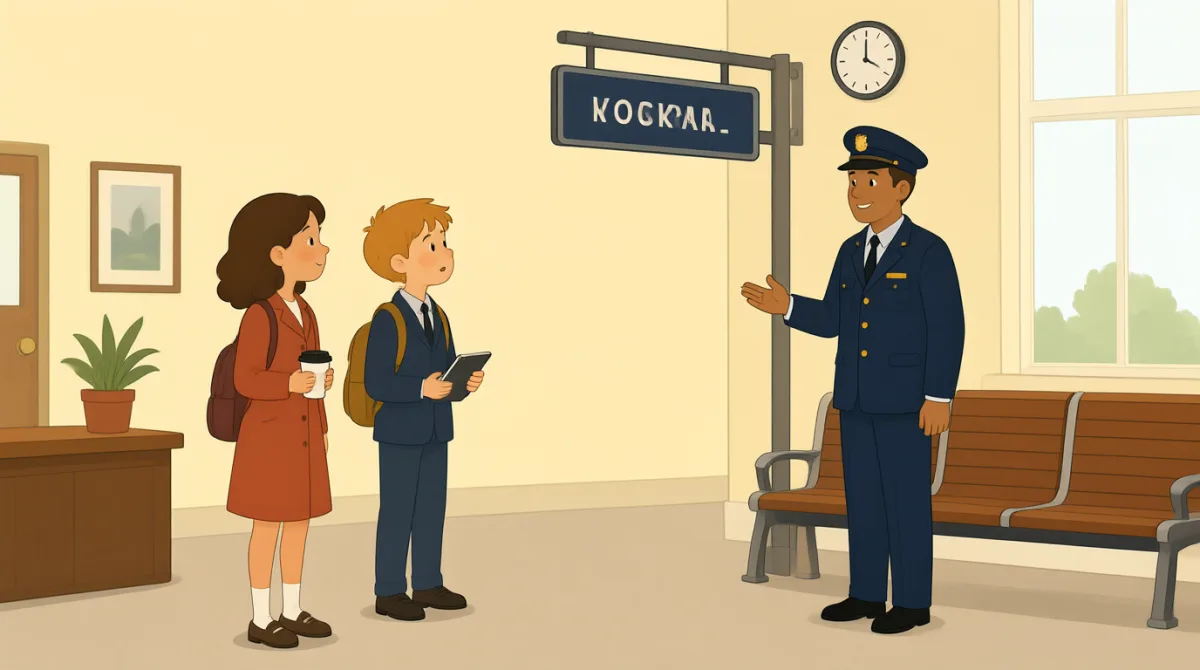

Excuse me, where are we?
Com licença, onde estamos?

This is Pine Street Station.
Esta é a estação Pine Street.
Is this Central Station?
Esta é a estação Central?
No, this is Pine Street Station.
Não, esta é a estação Pine Street.

The sign says Pine Street.
A placa diz Pine Street.
Oh, we are at the wrong stop.
Ah, descemos no ponto errado.
Yes, you are one stop past Central.
Sim, vocês passaram uma estação da Central.
Vocabulário6
- Excuse meCom licença
A polite way to get someone’s attention. Use it before asking a stranger for help.
Uma maneira educada de chamar a atenção de alguém. Use essa expressão antes de pedir ajuda a uma pessoa desconhecida.
- where are we?onde estamos?
A question asking what place you are in. Use it when you are unsure of your location.
Uma pergunta para saber em que lugar você está. Use-a quando não souber onde está.
- stationestação
A place where trains stop. You can use it with a name, like “Pine Street Station.”
Um lugar onde os trens param. Você pode usar essa palavra com um nome, como “Pine Street Station”.
- The sign says Pine Street.A placa diz Pine Street.
This means the sign has the words “Pine Street” on it. Use “The sign says…” to share information you read on a sign.
Isso quer dizer que as palavras “Pine Street” estão escritas na placa. Use “The sign says…” para contar uma informação que você leu em uma placa.
- wrong stopponto errado
A stop that is not the one you wanted. Use it when you get off at the wrong place.
Um ponto que não era o que você queria. Use essa expressão quando descer no lugar errado.
- one stop past Centraluma estação depois da Central
This means the train went one stop farther than Central. Use “one stop past” to explain where you are compared with another stop.
Isso quer dizer que o trem passou uma estação além da Central. Use “one stop past” para explicar onde você está em relação a outra estação.
Frases-chave7
- 1
Excuse me, where are we?
Com licença, onde estamos?
Use this polite question when you do not know where you are. You can replace “where” with another question, such as “Excuse me, where is the station?”
Use essa pergunta educada quando não souber onde está. Você pode substituir “where” por outra pergunta, como “Excuse me, where is the station?”
- 2
This is Pine Street Station.
Esta é a estação Pine Street.
Use “This is…” to say the name of a place. Replace “Pine Street Station” with the name of another station or location.
Use “This is…” para dizer o nome de um lugar. Substitua “Pine Street Station” pelo nome de outra estação ou lugar.
- 3
Is this Central Station?
Esta é a estação Central?
Use this yes-or-no question to check if you are at a particular place. Replace “Central Station” with the place you are looking for.
Use essa pergunta de sim ou não para confirmar se você está em um determinado lugar. Substitua “Central Station” pelo lugar que está procurando.
- 4
No, this is Pine Street Station.
Não, esta é a estação Pine Street.
Use this sentence to correct someone and give the right place name. You can replace “Pine Street Station” with another location.
Use essa frase para corrigir alguém e informar o nome correto do lugar. Você pode substituir “Pine Street Station” por outro lugar.
- 5
The sign says Pine Street.
A placa diz Pine Street.
Use “The sign says…” to tell someone what you read on a sign. Replace “Pine Street” with the words you see.
Use “The sign says…” para dizer a alguém o que você leu em uma placa. Substitua “Pine Street” pelas palavras que você vê.
- 6
Oh, we are at the wrong stop.
Ah, descemos no ponto errado.
Use this sentence when you realize you got off at a stop you did not want. You can replace “stop” with another place, such as “station.”
Use essa frase quando perceber que desceu em um ponto que não queria. Você pode substituir “stop” por outro lugar, como “station”.
- 7
Yes, you are one stop past Central.
Sim, vocês passaram uma estação da Central.
Use “one stop past” to explain that someone has gone one stop farther than a place. Replace “Central” with the name of another stop.
Use “one stop past” para explicar que alguém passou uma estação de determinado lugar. Substitua “Central” pelo nome de outra estação.