Asking Where You Are
Preguntar dónde estás
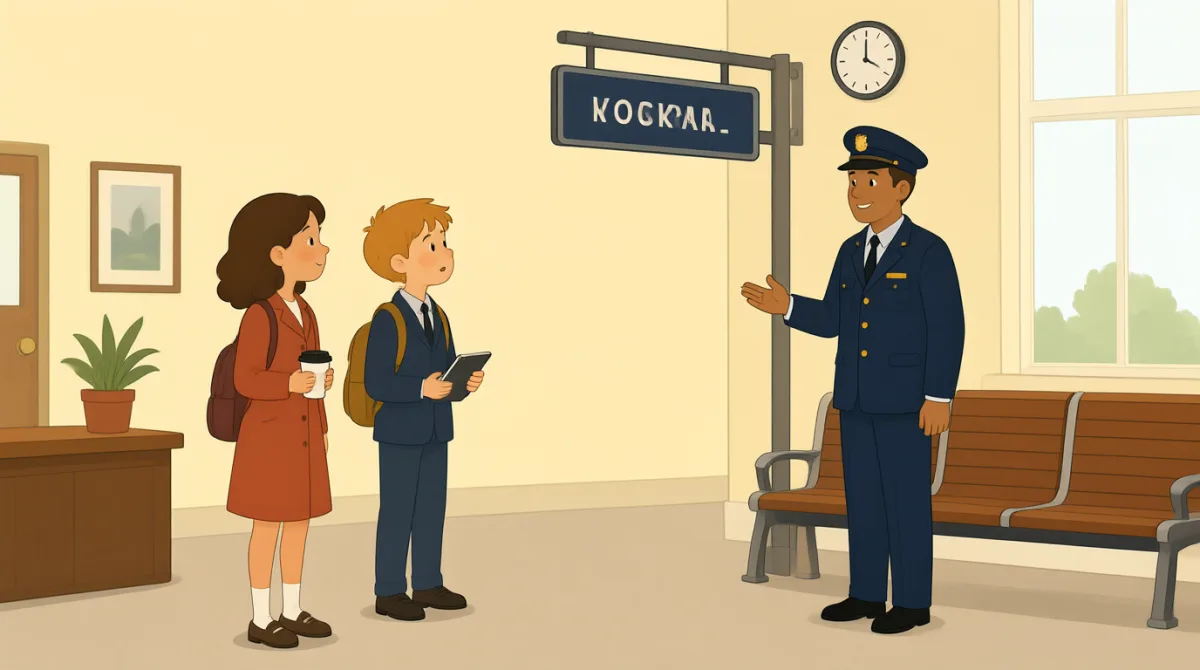
Emma asks a station worker where they are. Jack listens and checks the station sign.
Emma le pregunta a una empleada de la estación dónde están. Jack escucha y mira el letrero de la estación.
Diálogo7

Excuse me, where are we?
Disculpe, ¿dónde estamos?

This is Pine Street Station.
Esta es la estación de Pine Street.
Is this Central Station?
¿Esta es la estación Central?
No, this is Pine Street Station.
No, esta es la estación de Pine Street.

The sign says Pine Street.
El letrero dice Pine Street.
Oh, we are at the wrong stop.
Ay, nos bajamos en la parada equivocada.
Yes, you are one stop past Central.
Sí, se pasaron una parada de Central.
Vocabulario6
- Excuse meDisculpe
A polite way to get someone’s attention. Use it before asking a stranger for help.
Una forma educada de llamar la atención de alguien. Úsala antes de pedir ayuda a una persona desconocida.
- where are we?¿dónde estamos?
A question asking what place you are in. Use it when you are unsure of your location.
Una pregunta para saber en qué lugar estás. Úsala cuando no tengas claro dónde te encuentras.
- stationestación
A place where trains stop. You can use it with a name, like “Pine Street Station.”
Un lugar donde paran los trenes. Puedes usarla junto con un nombre, como “Pine Street Station”.
- The sign says Pine Street.El letrero dice Pine Street.
This means the sign has the words “Pine Street” on it. Use “The sign says…” to share information you read on a sign.
Esto significa que el letrero tiene las palabras “Pine Street”. Usa “The sign says…” para compartir información que leíste en un letrero.
- wrong stopparada equivocada
A stop that is not the one you wanted. Use it when you get off at the wrong place.
Una parada que no es la que querías. Úsala cuando te bajas en el lugar equivocado.
- one stop past Centraluna parada después de Central
This means the train went one stop farther than Central. Use “one stop past” to explain where you are compared with another stop.
Esto significa que el tren avanzó una parada más allá de Central. Usa “one stop past” para explicar dónde estás en relación con otra parada.
Frases clave7
- 1
Excuse me, where are we?
Disculpe, ¿dónde estamos?
Use this polite question when you do not know where you are. You can replace “where” with another question, such as “Excuse me, where is the station?”
Usa esta pregunta educada cuando no sabes dónde estás. Puedes cambiar “where” por otra palabra interrogativa, como en “Excuse me, where is the station?”
- 2
This is Pine Street Station.
Esta es la estación de Pine Street.
Use “This is…” to say the name of a place. Replace “Pine Street Station” with the name of another station or location.
Usa “This is…” para decir el nombre de un lugar. Cambia “Pine Street Station” por el nombre de otra estación o ubicación.
- 3
Is this Central Station?
¿Esta es la estación Central?
Use this yes-or-no question to check if you are at a particular place. Replace “Central Station” with the place you are looking for.
Usa esta pregunta de sí o no para confirmar si estás en un lugar determinado. Cambia “Central Station” por el lugar que estás buscando.
- 4
No, this is Pine Street Station.
No, esta es la estación de Pine Street.
Use this sentence to correct someone and give the right place name. You can replace “Pine Street Station” with another location.
Usa esta frase para corregir a alguien y decirle el nombre correcto del lugar. Puedes cambiar “Pine Street Station” por otra ubicación.
- 5
The sign says Pine Street.
El letrero dice Pine Street.
Use “The sign says…” to tell someone what you read on a sign. Replace “Pine Street” with the words you see.
Usa “The sign says…” para decirle a alguien lo que leíste en un letrero. Cambia “Pine Street” por las palabras que ves.
- 6
Oh, we are at the wrong stop.
Ay, nos bajamos en la parada equivocada.
Use this sentence when you realize you got off at a stop you did not want. You can replace “stop” with another place, such as “station.”
Usa esta frase cuando te das cuenta de que te bajaste en una parada que no querías. Puedes cambiar “stop” por otro lugar, como “station”.
- 7
Yes, you are one stop past Central.
Sí, se pasaron una parada de Central.
Use “one stop past” to explain that someone has gone one stop farther than a place. Replace “Central” with the name of another stop.
Usa “one stop past” para explicar que alguien avanzó una parada más allá de cierto lugar. Cambia “Central” por el nombre de otra parada.