Asking Where You Are
Pytanie, gdzie jesteście
Emma asks a station worker where they are. Jack listens and checks the station sign.
Emma pyta pracownicę stacji, gdzie się znajdują. Jack słucha i sprawdza nazwę stacji na tablicy.
Dialog7
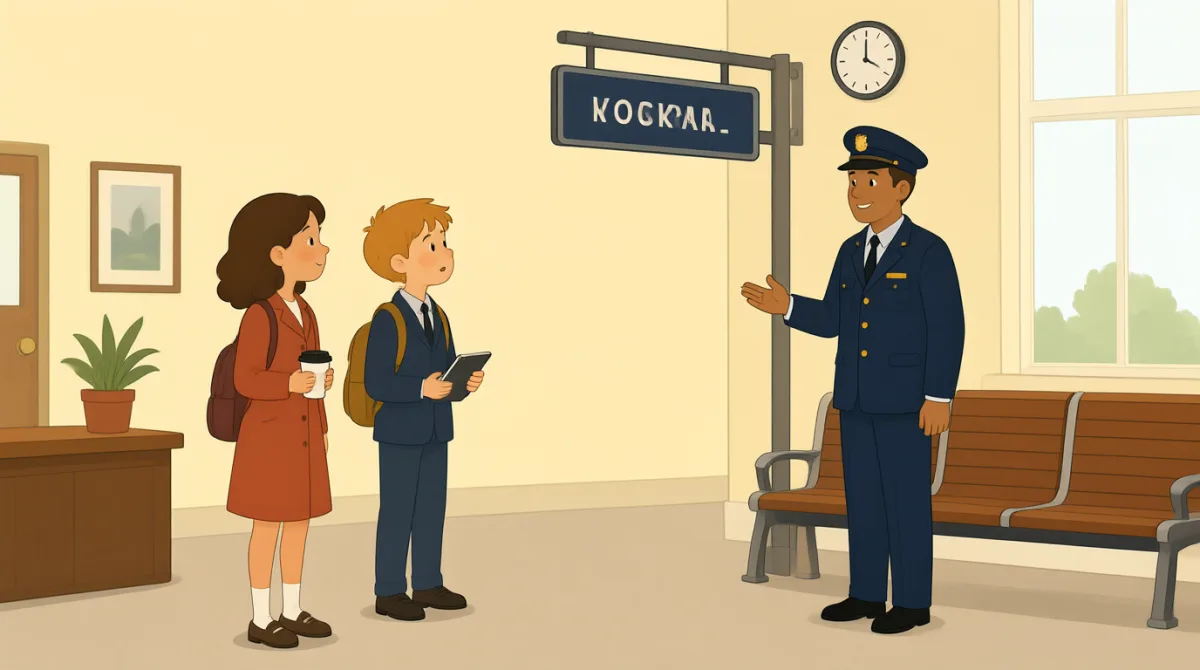

Excuse me, where are we?
Przepraszam, gdzie jesteśmy?

This is Pine Street Station.
To stacja Pine Street.
Is this Central Station?
Czy to stacja Central?
No, this is Pine Street Station.
Nie, to stacja Pine Street.

The sign says Pine Street.
Na tablicy jest napisane Pine Street.
Oh, we are at the wrong stop.
Och, wysiedliśmy na złym przystanku.
Yes, you are one stop past Central.
Tak, jesteście jeden przystanek za stacją Central.
Słownictwo6
- Excuse meprzepraszam
A polite way to get someone’s attention. Use it before asking a stranger for help.
Uprzejmy sposób, by zwrócić czyjąś uwagę. Użyj tego zwrotu, zanim poprosisz nieznajomą osobę o pomoc.
- where are we?gdzie jesteśmy?
A question asking what place you are in. Use it when you are unsure of your location.
Pytanie o to, w jakim miejscu się znajdujesz. Użyj go, gdy nie masz pewności, gdzie jesteś.
- stationstacja
A place where trains stop. You can use it with a name, like “Pine Street Station.”
Miejsce, na którym zatrzymują się pociągi. Możesz użyć tego słowa z nazwą, na przykład „Pine Street Station”.
- The sign says Pine Street.Na tablicy jest napisane Pine Street.
This means the sign has the words “Pine Street” on it. Use “The sign says…” to share information you read on a sign.
To znaczy, że na tablicy widnieje napis „Pine Street”. Użyj zwrotu “The sign says…”, by przekazać komuś informację odczytaną z tablicy.
- wrong stopzły przystanek
A stop that is not the one you wanted. Use it when you get off at the wrong place.
Przystanek inny niż ten, na którym chciałeś wysiąść. Użyj tego wyrażenia, gdy wysiądziesz w niewłaściwym miejscu.
- one stop past Centraljeden przystanek za stacją Central
This means the train went one stop farther than Central. Use “one stop past” to explain where you are compared with another stop.
To znaczy, że pociąg pojechał o jeden przystanek dalej niż stacja Central. Użyj zwrotu “one stop past”, by określić swoje położenie względem innego przystanku.
Kluczowe zdania7
- 1
Excuse me, where are we?
Przepraszam, gdzie jesteśmy?
Use this polite question when you do not know where you are. You can replace “where” with another question, such as “Excuse me, where is the station?”
Użyj tego uprzejmego pytania, gdy nie wiesz, gdzie jesteś. Możesz zastąpić “where” innym pytaniem, na przykład “Excuse me, where is the station?” (Przepraszam, gdzie jest stacja?).
- 2
This is Pine Street Station.
To stacja Pine Street.
Use “This is…” to say the name of a place. Replace “Pine Street Station” with the name of another station or location.
Użyj “This is…”, by podać nazwę miejsca. Zastąp “Pine Street Station” nazwą innej stacji lub lokalizacji.
- 3
Is this Central Station?
Czy to stacja Central?
Use this yes-or-no question to check if you are at a particular place. Replace “Central Station” with the place you are looking for.
Użyj tego pytania, na które można odpowiedzieć tak lub nie, by sprawdzić, czy jesteś w konkretnym miejscu. Zastąp “Central Station” nazwą miejsca, którego szukasz.
- 4
No, this is Pine Street Station.
Nie, to stacja Pine Street.
Use this sentence to correct someone and give the right place name. You can replace “Pine Street Station” with another location.
Użyj tego zdania, by poprawić kogoś i podać właściwą nazwę miejsca. Możesz zastąpić “Pine Street Station” nazwą innej lokalizacji.
- 5
The sign says Pine Street.
Na tablicy jest napisane Pine Street.
Use “The sign says…” to tell someone what you read on a sign. Replace “Pine Street” with the words you see.
Użyj “The sign says…”, by powiedzieć komuś, co jest napisane na tablicy. Zastąp “Pine Street” słowami, które widzisz.
- 6
Oh, we are at the wrong stop.
Och, wysiedliśmy na złym przystanku.
Use this sentence when you realize you got off at a stop you did not want. You can replace “stop” with another place, such as “station.”
Użyj tego zdania, gdy zdasz sobie sprawę, że wysiadłeś na przystanku, na którym nie chciałeś wysiąść. Możesz zastąpić “stop” innym miejscem, na przykład “station”.
- 7
Yes, you are one stop past Central.
Tak, jesteście jeden przystanek za stacją Central.
Use “one stop past” to explain that someone has gone one stop farther than a place. Replace “Central” with the name of another stop.
Użyj “one stop past”, by wyjaśnić, że ktoś pojechał o jeden przystanek dalej niż dane miejsce. Zastąp “Central” nazwą innego przystanku.