Asking Where You Are
Emma asks a station worker where they are. Jack listens and checks the station sign.
Dialogue7
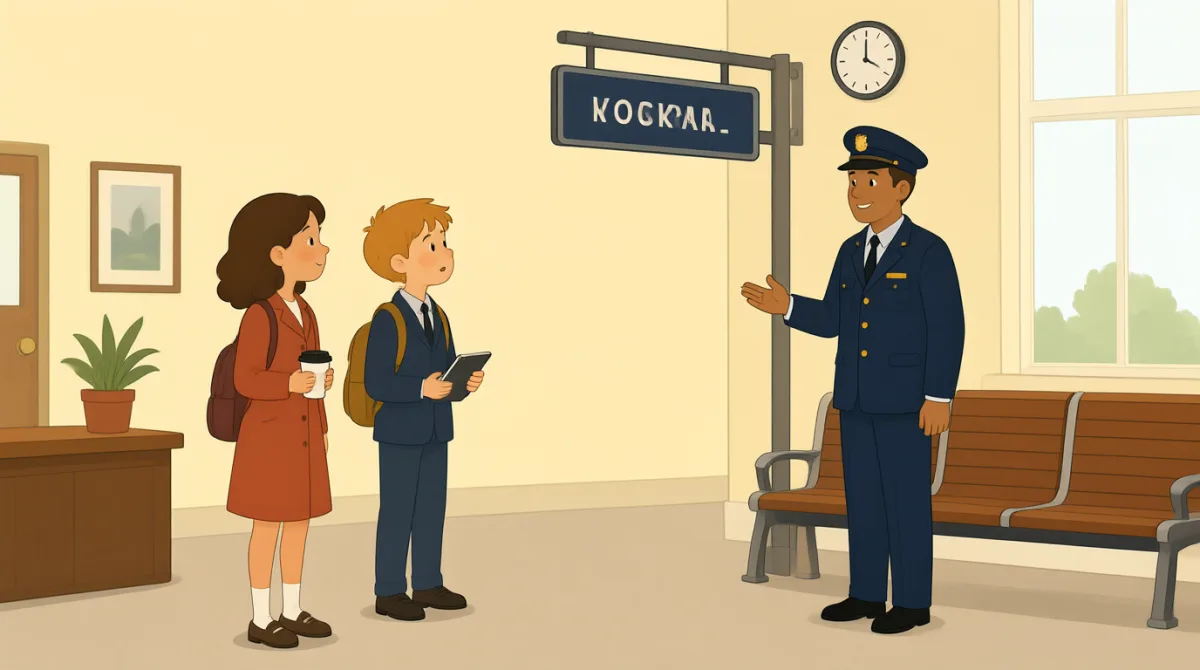

Excuse me, where are we?

This is Pine Street Station.
Is this Central Station?
No, this is Pine Street Station.

The sign says Pine Street.
Oh, we are at the wrong stop.
Yes, you are one stop past Central.
Vocabulary6
- Excuse me
A polite way to get someone’s attention. Use it before asking a stranger for help.
- where are we?
A question asking what place you are in. Use it when you are unsure of your location.
- station
A place where trains stop. You can use it with a name, like “Pine Street Station.”
- The sign says Pine Street.
This means the sign has the words “Pine Street” on it. Use “The sign says…” to share information you read on a sign.
- wrong stop
A stop that is not the one you wanted. Use it when you get off at the wrong place.
- one stop past Central
This means the train went one stop farther than Central. Use “one stop past” to explain where you are compared with another stop.
Key Sentences7
- 1
Excuse me, where are we?
Use this polite question when you do not know where you are. You can replace “where” with another question, such as “Excuse me, where is the station?”
- 2
This is Pine Street Station.
Use “This is…” to say the name of a place. Replace “Pine Street Station” with the name of another station or location.
- 3
Is this Central Station?
Use this yes-or-no question to check if you are at a particular place. Replace “Central Station” with the place you are looking for.
- 4
No, this is Pine Street Station.
Use this sentence to correct someone and give the right place name. You can replace “Pine Street Station” with another location.
- 5
The sign says Pine Street.
Use “The sign says…” to tell someone what you read on a sign. Replace “Pine Street” with the words you see.
- 6
Oh, we are at the wrong stop.
Use this sentence when you realize you got off at a stop you did not want. You can replace “stop” with another place, such as “station.”
- 7
Yes, you are one stop past Central.
Use “one stop past” to explain that someone has gone one stop farther than a place. Replace “Central” with the name of another stop.