Locating Restrooms and Amenities
Znalezienie toalety i innych udogodnień
A traveler stops at the gas station and asks an attendant where the restrooms are located and if there's a convenience store.
Podróżny zatrzymuje się na stacji benzynowej i pyta pracownika, gdzie znajduje się toaleta oraz czy jest tu sklepik.
Dialog8
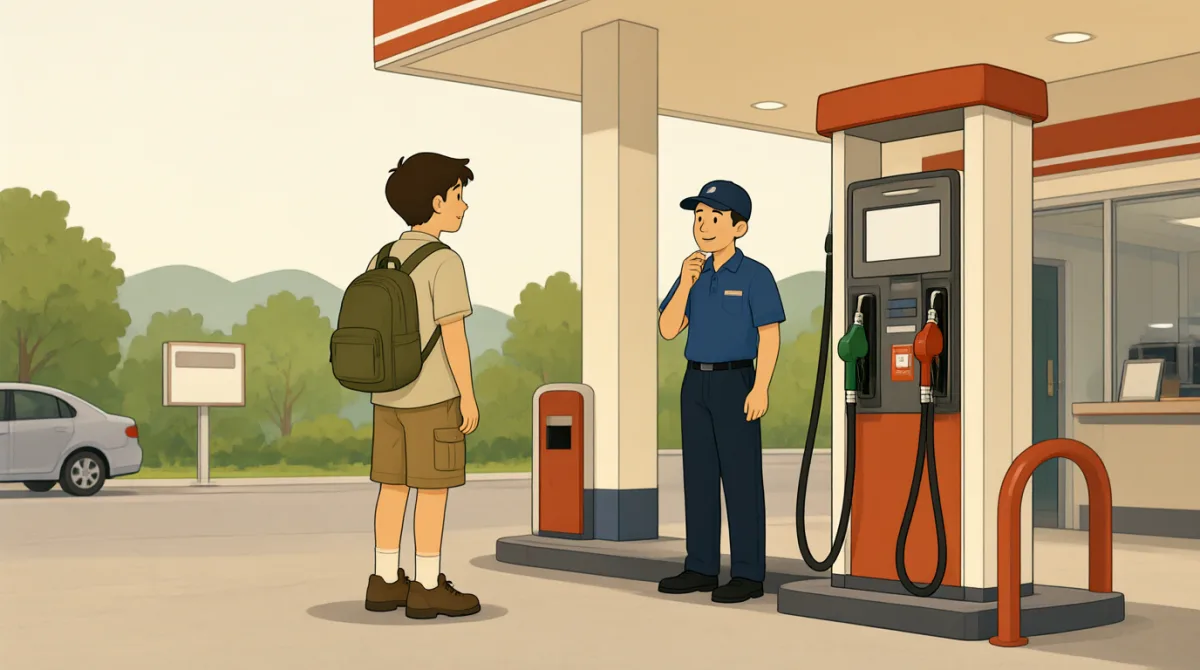

Excuse me, I just pulled in. Could you tell me where the restrooms are located?
Przepraszam, właśnie zajechałam. Czy może mi pan powiedzieć, gdzie znajduje się toaleta?

No problem! The restrooms are inside, just to your right after you enter the main building.
Nie ma problemu! Toaleta jest w środku, zaraz po prawej stronie, kiedy wejdzie pani do głównego budynku.
Great, thanks! And is there a convenience store here as well? I was hoping to grab a drink.
Świetnie, dziękuję! A czy jest tu również sklepik? Chciałam kupić coś do picia.
Yes, there is! It's the same building, right next to the cash register. We've got a good selection of drinks and snacks.
Tak, jest! Znajduje się w tym samym budynku, tuż obok kasy. Mamy duży wybór napojów i przekąsek.
Perfect! That's really convenient. So, just to confirm, main building, restrooms to the right, and the store is inside too?
Świetnie! To naprawdę wygodne. Czyli, żeby się upewnić: główny budynek, toaleta po prawej, a sklepik też jest w środku?
That's right! You can't miss it. Is there anything else I can help you with today?
Zgadza się! Na pewno pani go nie przeoczy. Czy mogę dziś jeszcze w czymś pani pomóc?
No, I think that's everything for now. Thanks so much for your help!
Nie, myślę, że to wszystko na razie. Bardzo dziękuję za pomoc!
You're welcome! Have a good rest of your trip.
Nie ma za co! Życzę udanej dalszej podróży.
Słownictwo7
- restroomsrestrooms — toalety
A polite word for bathrooms or toilets, often used in public places like gas stations in American English.
To uprzejme określenie łazienek lub toalet, często używane w amerykańskim angielskim w miejscach publicznych, takich jak stacje benzynowe.
- pulled inpulled in — zajechać, wjechać
A phrasal verb meaning to drive a vehicle into a parking spot or gas station area; useful for describing arriving by car.
Czasownik frazowy oznaczający wjechanie samochodem na miejsce parkingowe lub na teren stacji benzynowej; przydaje się do opisywania przyjazdu samochodem.
- convenience storeconvenience store — sklepik
A small shop at places like gas stations that sells drinks, snacks, and everyday items; also called a 'convenience shop' or 'mini-mart'.
Mały sklep w miejscu takim jak stacja benzynowa, w którym sprzedaje się napoje, przekąski i artykuły codziennego użytku; nazywany też 'convenience shop' lub 'mini-mart'.
- cash registercash register — kasa
The counter or machine where you pay for items in a store; it's where the cashier works.
Miejsce lub urządzenie w sklepie, przy którym płaci się za zakupy; tam pracuje kasjer.
- selectionselection — wybór, asortyment
A range or variety of choices, like different types of drinks or snacks available in a store.
Zakres lub różnorodność dostępnych możliwości, na przykład różne rodzaje napojów lub przekąsek w sklepie.
- confirmconfirm — potwierdzić, upewnić się
To check or make sure that information is correct; useful when repeating directions to avoid mistakes.
Sprawdzić lub upewnić się, że informacja jest prawidłowa; przydaje się przy powtarzaniu wskazówek, aby uniknąć pomyłek.
- can't miss itcan't miss it — nie sposób tego przeoczyć
An informal expression meaning something is very easy to find or notice; helps give reassurance about locations.
Nieformalne wyrażenie oznaczające, że coś bardzo łatwo znaleźć lub zauważyć; pomaga zapewnić rozmówcę, że bez trudu trafi we wskazane miejsce.
Kluczowe zdania7
- 1
Excuse me, I just pulled in. Could you tell me where the restrooms are located?
Przepraszam, właśnie zajechałam. Czy może mi pan powiedzieć, gdzie znajduje się toaleta?
This is a polite way to start a conversation and ask for directions. 'Excuse me' gets attention, and 'could you tell me' is a formal request. Use this when approaching someone for help in public places like a gas station.
To uprzejmy sposób na rozpoczęcie rozmowy i poproszenie o wskazówki. 'Excuse me' zwraca uwagę rozmówcy, a 'could you tell me' jest formalną prośbą. Użyj tego, gdy prosisz kogoś o pomoc w miejscu publicznym, takim jak stacja benzynowa.
- 2
No problem! The restrooms are inside, just to your right after you enter the main building.
Nie ma problemu! Toaleta jest w środku, zaraz po prawej stronie, kiedy wejdzie pani do głównego budynku.
A friendly response to a request. 'No problem' means it's easy to help. The sentence uses directional language like 'to your right' and 'after you enter' to give clear instructions. Practice this for giving or understanding simple directions.
To przyjazna odpowiedź na prośbę. 'No problem' oznacza, że udzielenie pomocy nie stanowi trudności. To zdanie wykorzystuje określenia kierunku, takie jak 'to your right' i 'after you enter', aby przekazać jasne wskazówki. Poćwicz je, aby udzielać prostych wskazówek lub je rozumieć.
- 3
Great, thanks! And is there a convenience store here as well?
Świetnie, dziękuję! A czy jest tu również sklepik?
This shows appreciation with 'great, thanks' and asks a follow-up question using 'as well' to mean 'also'. It's useful for continuing a conversation and inquiring about additional services at a location.
To wyraża wdzięczność za pomocą 'great, thanks' i zawiera dodatkowe pytanie z użyciem 'as well', które oznacza 'also'. Przydaje się do kontynuowania rozmowy i pytania o dodatkowe usługi w danym miejscu.
- 4
Yes, there is! It's the same building, right next to the cash register.
Tak, jest! Znajduje się w tym samym budynku, tuż obok kasy.
An affirmative answer with enthusiasm. 'Right next to' describes location precisely. This pattern is helpful for confirming availability and providing more details in service situations.
To entuzjastyczna odpowiedź twierdząca. 'Right next to' dokładnie określa położenie. Ten wzór pomaga potwierdzić dostępność czegoś i podać więcej szczegółów w sytuacjach związanych z obsługą klienta.
- 5
Perfect! That's really convenient. So, just to confirm, main building, restrooms to the right, and the store is inside too?
Świetnie! To naprawdę wygodne. Czyli, żeby się upewnić: główny budynek, toaleta po prawej, a sklepik też jest w środku?
Expresses satisfaction with 'perfect' and 'convenient', then uses 'just to confirm' to repeat for clarity. This is a good way to summarize information and ensure understanding, especially with directions.
To wyraża zadowolenie za pomocą 'perfect' i 'convenient', a następnie używa 'just to confirm', aby powtórzyć informacje dla jasności. To dobry sposób na podsumowanie informacji i upewnienie się, że wszystko zostało zrozumiane, szczególnie przy podawaniu wskazówek.
- 6
That's right! You can't miss it. Is there anything else I can help you with today?
Zgadza się! Na pewno pani go nie przeoczy. Czy mogę dziś jeszcze w czymś pani pomóc?
Confirms correctness with 'that's right' and offers more help. 'Can't miss it' reassures ease of finding something. This is a common service phrase to end or continue assisting customers politely.
'That's right' potwierdza, że informacja jest prawidłowa, a dalsza część oferuje dodatkową pomoc. 'Can't miss it' zapewnia, że coś łatwo znaleźć. To częsty zwrot używany przez pracowników obsługi, aby uprzejmie zakończyć rozmowę lub zaproponować dalszą pomoc.
- 7
No, I think that's everything for now. Thanks so much for your help!
Nie, myślę, że to wszystko na razie. Bardzo dziękuję za pomoc!
Politely ends the conversation. 'That's everything' means no more questions, and 'thanks so much' shows strong gratitude. Use this to wrap up interactions when you're satisfied.
To uprzejmy sposób na zakończenie rozmowy. 'That's everything' oznacza, że nie ma już więcej pytań, a 'thanks so much' wyraża dużą wdzięczność. Użyj tego, aby zakończyć rozmowę, gdy uzyskasz wszystkie potrzebne informacje.