Cross-Checking the Evidence
Emma consults David Chen, a veteran records specialist, to authenticate documents and compare their dates with public inspection logs. David cautions her that inconsistencies may point to clerical errors rather than deliberate tampering.
Dialogue12
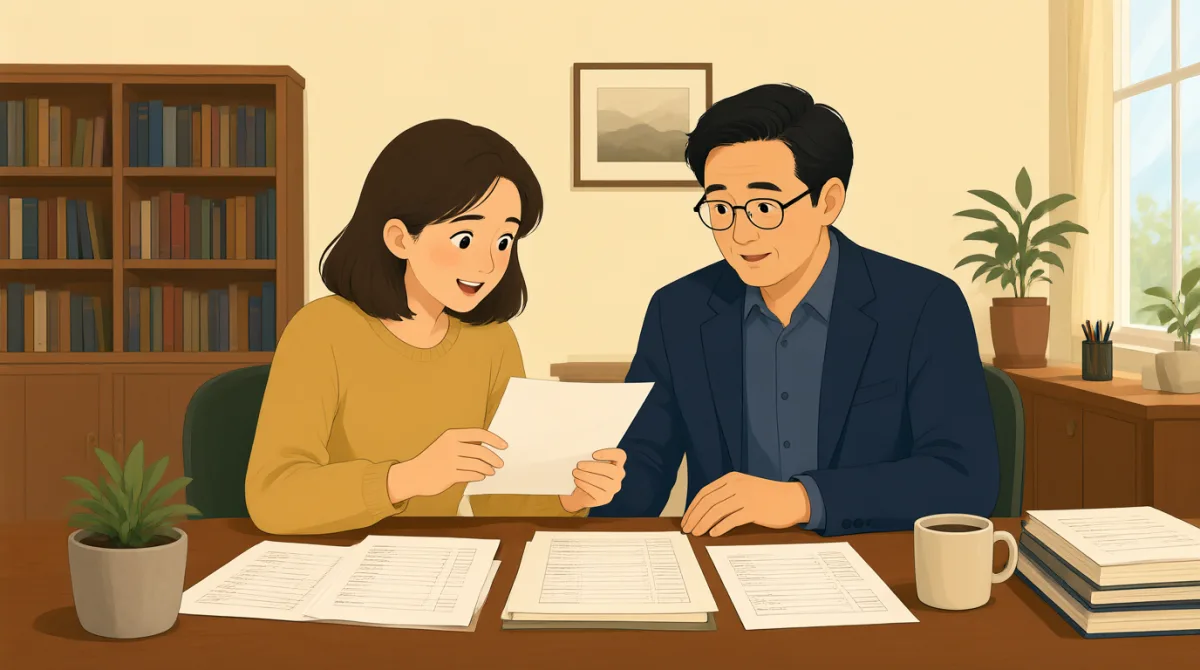

I’ve brought the inspection forms and the public logs. The dates don’t line up, but I don’t want to call that evidence of tampering before we know how these records were created.

Good instinct. A discrepancy is a question, not a conclusion. First, let’s establish whether these are original records, copies, or entries exported from a database that may have been updated later.
The forms came from a former employee. They have handwritten dates and initials, but there’s no cover sheet, and I can’t tell whether the pages are complete or in their original order.
Then we should treat provenance as unresolved. Do you have the files as they were received, including the email or message that transmitted them? Metadata and transmission history may help establish what changed—and when.
I saved the original attachment and made a working copy. The attachment’s timestamp is two years later than the handwritten inspection date, though, so it could simply be a scan made after the fact.
Exactly. A file timestamp usually tells you when that digital file was created or modified, not when the underlying inspection occurred. We’ll need to separate what the metadata proves from what it merely suggests.
The public log lists an inspection on that date, but it describes a different section of the plant. Could that indicate the form was misdated, or are we comparing records that use different location codes?
Either is possible. Let’s compare the codes against the agency’s documentation, then check whether its log records the inspection date, the filing date, or the date an entry was entered into the system.
If the log was entered later, a mismatch might be routine. But if the initials on the form match the inspector’s signature elsewhere, would that strengthen the document’s authenticity?
It would be one useful point of comparison, not proof by itself. We should verify the signature against an independent record and ask the agency how its forms were handled at the time.
Understood. I’ll preserve the originals, document how I received them, and request the agency’s filing procedures and the relevant log history. I won’t describe the discrepancy as deliberate alteration unless the evidence supports that.
That’s the right standard. And keep a clear distinction in your notes between what the documents show, what someone told you, and what you’re still trying to establish. Readers deserve that precision.
Vocabulary7
- discrepancy
A difference between two pieces of information that are expected to match. Here, it describes the dates or details that do not line up across records.
- provenance
The history of where a document came from and how it has been handled. Journalists use provenance to assess a record’s reliability.
- metadata
Information about a digital file, such as when it was created or modified. It may help establish a file’s history, but not necessarily the date of the event described in it.
- underlying inspection
The actual inspection that a document refers to, as distinct from the later creation of a digital copy. The phrase helps separate an event’s date from a file’s timestamp.
- independent record
A separate source that can be used to check a claim. Comparing a signature with an independent record can support authentication, though it does not prove it on its own.
- filing procedures
The rules or routine steps an organization follows to submit and store records. Asking about them can help explain why dates or entries differ.
- deliberate alteration
An intentional change made to a document or record. The phrase should be used only when evidence supports the conclusion that the change was intentional.
Key Sentences7
- 1
A discrepancy is a question, not a conclusion.
This concise sentence cautions against treating an inconsistency as proof. Use it to emphasize that a finding needs further investigation before it supports a conclusion.
- 2
Then we should treat provenance as unresolved.
This is a careful way to say that a document’s origins and handling have not yet been established. Reuse the pattern “treat [issue] as unresolved” when evidence is incomplete.
- 3
We’ll need to separate what the metadata proves from what it merely suggests.
This sentence distinguishes confirmed facts from possible interpretations. It is useful when explaining why digital information should be interpreted cautiously.
- 4
Either is possible.
This brief response acknowledges multiple plausible explanations without choosing between them prematurely. Use it when the available evidence does not yet settle a question.
- 5
It would be one useful point of comparison, not proof by itself.
This sentence explains that a piece of supporting evidence has limits. Reuse the structure “one useful point of comparison, not proof by itself” to describe evidence that needs corroboration.
- 6
I’ll preserve the originals, document how I received them, and request the agency’s filing procedures and the relevant log history.
This sentence lays out practical steps for maintaining a clear record of evidence and seeking context. Its parallel verbs make it useful when describing a careful investigation plan.
- 7
Readers deserve that precision.
This short statement connects accurate reporting with responsibility to the audience. Use it to underscore why a journalist should distinguish facts, claims, and unanswered questions.