Telling a Friend You Have a Headache
Dire à une amie qu’on a mal à la tête
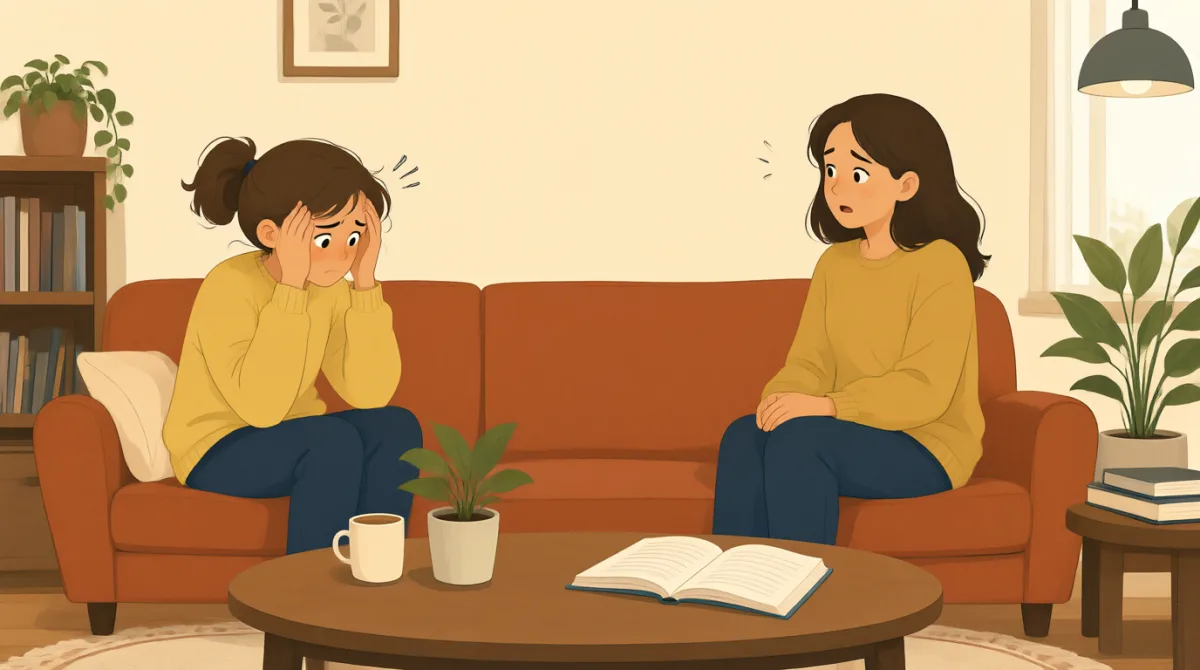
Emma tells Mia that she has a headache. Mia asks if she needs help.
Emma dit à Mia qu’elle a mal à la tête. Mia lui demande si elle a besoin d’aide.
Dialogue8

Mia, I have a headache.
Mia, j’ai mal à la tête.

Oh, I’m sorry. Do you need help?
Oh, je suis désolée. Tu as besoin d’aide ?
Can I sit down for a minute?
Je peux m’asseoir un instant ?
Of course. Sit here.
Bien sûr. Assieds-toi ici.
Thank you. My head really hurts.
Merci. J’ai vraiment mal à la tête.
Do you want some water?
Tu veux un peu d’eau ?
Yes, please. That would help.
Oui, s’il te plaît. Ça m’aiderait.
Here you go. Take it easy.
Tiens. Repose-toi bien.
Vocabulaire7
- headachemal à la tête
A headache is pain in your head. You can say “I have a headache” to tell someone how you feel.
Un mal de tête, c’est une douleur à la tête. Tu peux dire “I have a headache” (j’ai mal à la tête) pour expliquer à quelqu’un comment tu te sens.
- Do you need help?Tu as besoin d’aide ?
Use this question to ask if someone needs your help. You can change “help” to name a kind of help.
Pose cette question pour savoir si quelqu’un a besoin de ton aide. Tu peux remplacer “help” par le type d’aide dont la personne a besoin.
- sit downs’asseoir
This means to move into a sitting position. You can say “Can I sit down?” when you want to sit.
Cela signifie prendre la position assise. Tu peux dire “Can I sit down?” (Est-ce que je peux m’asseoir ?) quand tu veux t’asseoir.
- for a minuteun instant
This means for a short time. You can use it to ask to do something briefly.
Cela signifie pendant un court moment. Tu peux employer cette expression pour demander à faire quelque chose brièvement.
- Of course.Bien sûr.
This is a friendly way to say yes. You can use it when you agree to help someone.
C’est une façon amicale de dire oui. Tu peux l’utiliser quand tu acceptes d’aider quelqu’un.
- some waterun peu d’eau
This means an amount of water, without saying exactly how much. You can use “some” before many foods and drinks.
Cela désigne une certaine quantité d’eau, sans préciser laquelle. Tu peux mettre “some” devant de nombreux noms d’aliments et de boissons.
- Take it easy.Repose-toi bien.
This means to rest and not do too much. You can say it to someone who feels sick or tired.
Cela signifie qu’il faut se reposer et éviter d’en faire trop. Tu peux le dire à quelqu’un qui est malade ou fatigué.
Phrases clés8
- 1
Mia, I have a headache.
Mia, j’ai mal à la tête.
Use this sentence to tell someone you have pain in your head. You can replace “a headache” with another problem, such as “a cold.”
Utilise cette phrase pour dire à quelqu’un que tu as mal à la tête. Tu peux remplacer “a headache” par un autre problème, comme “a cold” (un rhume).
- 2
Do you need help?
Tu as besoin d’aide ?
Use this question to ask if someone needs help. You can also ask, “Do you need some water?”
Utilise cette question pour savoir si quelqu’un a besoin d’aide. Tu peux aussi demander “Do you need some water?” (Tu as besoin d’un peu d’eau ?).
- 3
Can I sit down for a minute?
Je peux m’asseoir un instant ?
Use this polite question when you want to sit for a short time. Replace “sit down” with another action to ask permission.
Utilise cette question polie quand tu veux t’asseoir un court moment. Remplace “sit down” par une autre action pour demander la permission de la faire.
- 4
Of course.
Bien sûr.
This is a friendly way to agree to a request. You can say it before offering help.
C’est une façon amicale d’accepter une demande. Tu peux le dire avant de proposer ton aide.
- 5
My head really hurts.
J’ai vraiment mal à la tête.
Use this sentence to say that your head is very painful. You can replace “My head” with another body part, such as “My stomach.”
Utilise cette phrase pour dire que tu as très mal à la tête. Tu peux remplacer “My head” par une autre partie du corps, comme “My stomach” (mon ventre).
- 6
Do you want some water?
Tu veux un peu d’eau ?
Use this question to offer someone a drink. Replace “water” with another drink, like “tea.”
Utilise cette question pour proposer une boisson à quelqu’un. Remplace “water” par une autre boisson, comme “tea” (du thé).
- 7
Yes, please.
Oui, s’il te plaît.
Use this polite phrase to accept an offer. You can use it when someone offers you food, a drink, or help.
Utilise cette formule polie pour accepter une proposition. Tu peux l’employer quand quelqu’un te propose à manger, à boire ou de l’aide.
- 8
Take it easy.
Repose-toi bien.
Use this phrase to tell someone to rest and not do too much. It is often said to someone who feels unwell.
Utilise cette expression pour dire à quelqu’un de se reposer et de ne pas en faire trop. On la dit souvent à une personne qui ne se sent pas bien.