Telling a Friend You Have a Headache
Einer Freundin sagen, dass man Kopfschmerzen hat
Emma tells Mia that she has a headache. Mia asks if she needs help.
Emma sagt Mia, dass sie Kopfschmerzen hat. Mia fragt, ob sie Hilfe braucht.
Dialog8
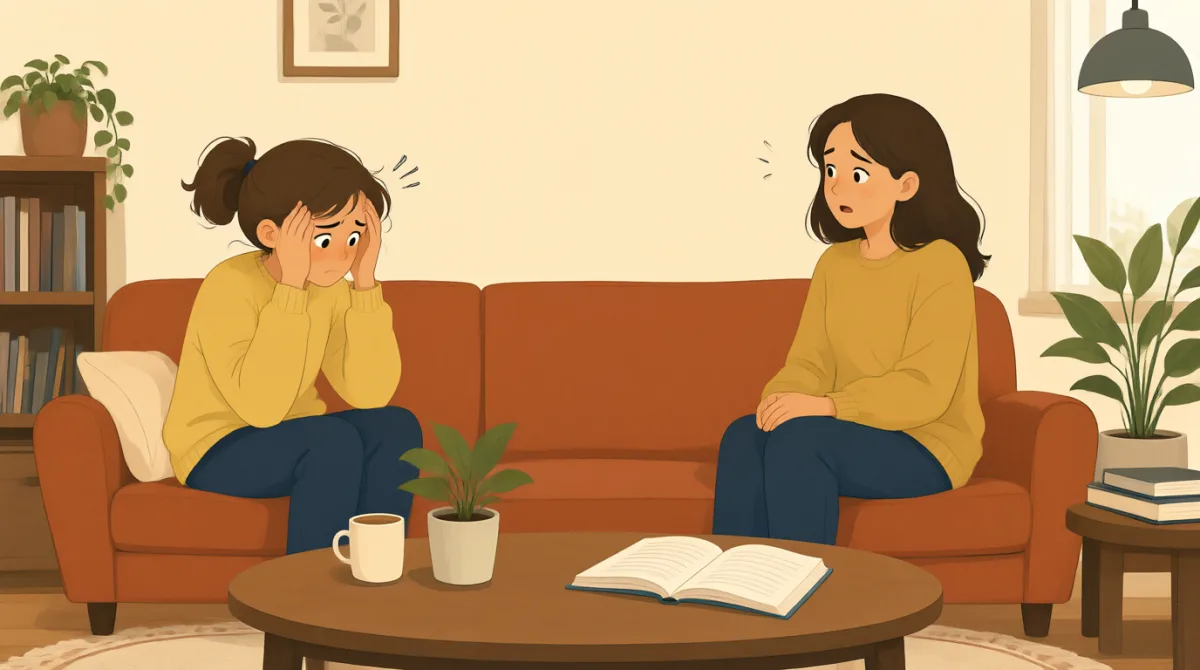

Mia, I have a headache.
Mia, ich habe Kopfschmerzen.

Oh, I’m sorry. Do you need help?
Oh, das tut mir leid. Brauchst du Hilfe?
Can I sit down for a minute?
Kann ich mich kurz hinsetzen?
Of course. Sit here.
Natürlich. Setz dich hierhin.
Thank you. My head really hurts.
Danke. Mein Kopf tut wirklich weh.
Do you want some water?
Möchtest du etwas Wasser?
Yes, please. That would help.
Ja, bitte. Das würde helfen.
Here you go. Take it easy.
Hier, bitte. Ruh dich aus.
Wortschatz7
- headacheKopfschmerzen
A headache is pain in your head. You can say “I have a headache” to tell someone how you feel.
Kopfschmerzen sind Schmerzen im Kopf. Mit „I have a headache“ (Ich habe Kopfschmerzen) kannst du jemandem sagen, wie du dich fühlst.
- Do you need help?Brauchst du Hilfe?
Use this question to ask if someone needs your help. You can change “help” to name a kind of help.
Mit dieser Frage kannst du fragen, ob jemand deine Hilfe braucht. Du kannst „help“ durch eine bestimmte Art von Hilfe ersetzen.
- sit downsich hinsetzen
This means to move into a sitting position. You can say “Can I sit down?” when you want to sit.
Das bedeutet, in eine sitzende Position zu wechseln. Du kannst „Can I sit down?“ sagen, wenn du dich setzen möchtest.
- for a minutekurz
This means for a short time. You can use it to ask to do something briefly.
Das bedeutet, dass etwas nur für eine kurze Zeit dauert. Du kannst es verwenden, wenn du darum bittest, etwas nur kurz zu tun.
- Of course.Natürlich.
This is a friendly way to say yes. You can use it when you agree to help someone.
Das ist eine freundliche Art, Ja zu sagen. Du kannst es sagen, wenn du dich bereit erklärst, jemandem zu helfen.
- some wateretwas Wasser
This means an amount of water, without saying exactly how much. You can use “some” before many foods and drinks.
Damit ist eine nicht näher bestimmte Menge Wasser gemeint. „Some“ kannst du vor viele Speisen und Getränke setzen.
- Take it easy.Ruh dich aus.
This means to rest and not do too much. You can say it to someone who feels sick or tired.
Das bedeutet, dass jemand sich ausruhen und sich nicht zu viel zumuten soll. Du kannst das zu jemandem sagen, der sich krank oder müde fühlt.
Wichtige Sätze8
- 1
Mia, I have a headache.
Mia, ich habe Kopfschmerzen.
Use this sentence to tell someone you have pain in your head. You can replace “a headache” with another problem, such as “a cold.”
Mit diesem Satz sagst du jemandem, dass du Schmerzen im Kopf hast. Du kannst „a headache“ durch ein anderes Problem ersetzen, zum Beispiel durch „a cold“.
- 2
Do you need help?
Brauchst du Hilfe?
Use this question to ask if someone needs help. You can also ask, “Do you need some water?”
Mit dieser Frage kannst du fragen, ob jemand Hilfe braucht. Du kannst auch fragen: „Do you need some water?“
- 3
Can I sit down for a minute?
Kann ich mich kurz hinsetzen?
Use this polite question when you want to sit for a short time. Replace “sit down” with another action to ask permission.
Mit dieser höflichen Frage bittest du darum, dich kurz hinsetzen zu dürfen. Ersetze „sit down“ durch eine andere Handlung, um um Erlaubnis dafür zu bitten.
- 4
Of course.
Natürlich.
This is a friendly way to agree to a request. You can say it before offering help.
So stimmst du freundlich einer Bitte zu. Du kannst das sagen, bevor du deine Hilfe anbietest.
- 5
My head really hurts.
Mein Kopf tut wirklich weh.
Use this sentence to say that your head is very painful. You can replace “My head” with another body part, such as “My stomach.”
Mit diesem Satz sagst du, dass dein Kopf sehr weh tut. Du kannst „My head“ durch einen anderen Körperteil ersetzen, zum Beispiel durch „My stomach.“
- 6
Do you want some water?
Möchtest du etwas Wasser?
Use this question to offer someone a drink. Replace “water” with another drink, like “tea.”
Mit dieser Frage kannst du jemandem etwas zu trinken anbieten. Ersetze „water“ durch ein anderes Getränk, zum Beispiel „tea“.
- 7
Yes, please.
Ja, bitte.
Use this polite phrase to accept an offer. You can use it when someone offers you food, a drink, or help.
Mit dieser höflichen Wendung nimmst du ein Angebot an. Du kannst sie verwenden, wenn dir jemand Essen, ein Getränk oder Hilfe anbietet.
- 8
Take it easy.
Ruh dich aus.
Use this phrase to tell someone to rest and not do too much. It is often said to someone who feels unwell.
Mit dieser Wendung sagst du jemandem, dass er sich ausruhen und sich nicht zu viel zumuten soll. Das sagt man oft zu jemandem, der sich nicht wohlfühlt.