Walking to School
À pied jusqu’à l’école
Mia and her child walk to school together. They talk about the day and watch for traffic.
Mia et son enfant vont à l’école à pied ensemble. Ils parlent de leur journée et font attention à la circulation.
Dialogue8
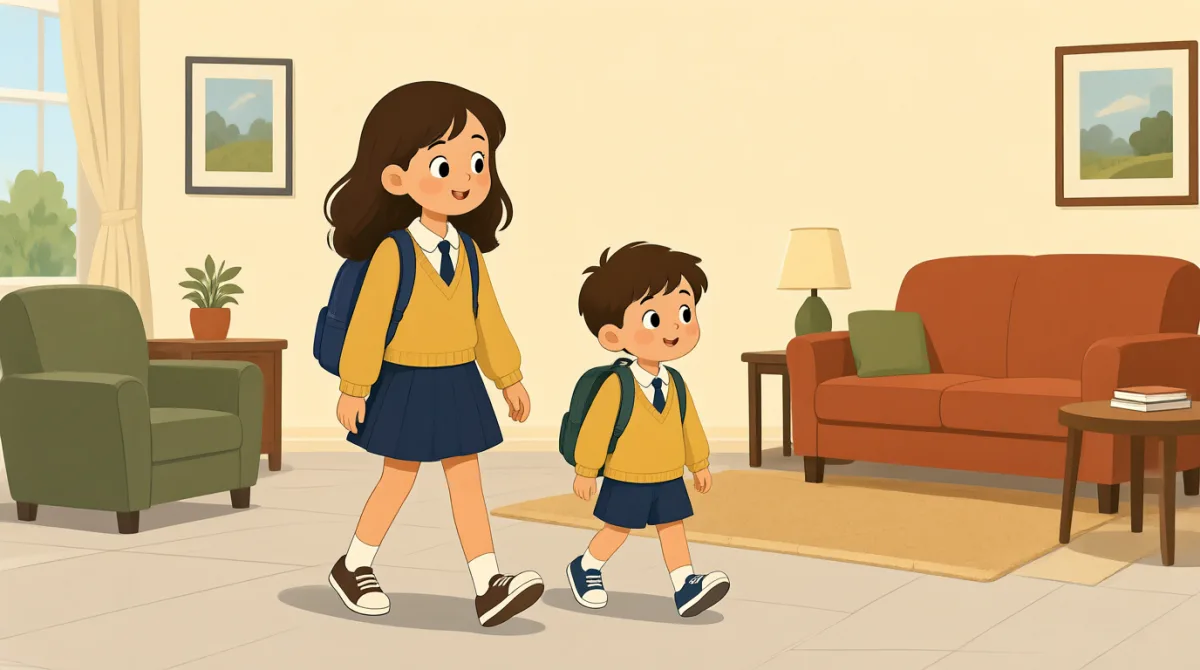

Hold my hand, Emma. We are crossing the street.
Donne-moi la main, Emma. On traverse la rue.

Okay, Mom. Is the school far?
D’accord, maman. L’école est loin ?
No, it is close. We can walk there.
Non, elle est tout près. On peut y aller à pied.
What do we do at school today?
Qu’est-ce qu’on va faire à l’école aujourd’hui ?
You can read and play with your friends.
Tu peux lire et jouer avec tes amis.
That sounds fun! Can I run now?
Ça a l’air amusant ! Je peux courir maintenant ?
Not near the street. Walk with me, please.
Pas près de la rue. Marche avec moi, s’il te plaît.
Okay. I see our school!
D’accord. Je vois notre école !
Vocabulaire8
- Hold my handDonne-moi la main
This means to keep your hand in someone else's hand. A parent can say this to keep a child safe.
Cela veut dire prendre la main de quelqu’un et la garder dans la sienne. Un parent peut dire cela pour assurer la sécurité de son enfant.
- crossing the streettraverser la rue
This means going from one side of the street to the other. Look for traffic when you cross.
Cela veut dire aller d’un côté de la rue à l’autre. Fais attention à la circulation quand tu traverses.
- Is the school far?L’école est loin ?
Use this question to ask if a place is a long way away. You can replace “the school” with another place.
Pose cette question pour savoir si un endroit est loin. Tu peux remplacer “the school” par un autre endroit.
- closetout près
Here, “close” means not far away. You can say, “The store is close.”
Ici, “close” veut dire qu’un endroit n’est pas loin. Tu peux dire : “The store is close.”
- walk therey aller à pied
This means go to that place on foot. You can say, “We can walk there” when a place is nearby.
Cela veut dire aller à cet endroit en marchant. Tu peux dire “We can walk there” quand un endroit est proche.
- with your friendsavec tes amis
This means together with people who are your friends. You can use it to talk about who you spend time with.
Cela veut dire être avec les personnes qui sont tes amis. Tu peux utiliser cette expression pour parler des personnes avec qui tu passes du temps.
- near the streetprès de la rue
This means close to the street. Use it to talk about a place where you should be careful.
Cela veut dire à proximité de la rue. Utilise cette expression pour parler d’un endroit où il faut faire attention.
- I see our school!Je vois notre école !
Use this sentence when you can see the school. You can replace “our school” with another place you can see.
Utilise cette phrase quand tu peux voir l’école. Tu peux remplacer “our school” par un autre endroit que tu vois.
Phrases clés8
- 1
Hold my hand, Emma.
Donne-moi la main, Emma.
This is a simple way to ask a child to hold your hand. Replace “Emma” with the person's name.
C’est une façon simple de demander à un enfant de te donner la main. Remplace “Emma” par le prénom de la personne.
- 2
We are crossing the street.
On traverse la rue.
Use this to say that you are crossing the street now. You can replace “the street” with another place you are crossing.
Utilise cette phrase pour dire que tu traverses la rue en ce moment. Tu peux remplacer “the street” par un autre endroit que tu traverses.
- 3
Is the school far?
L’école est loin ?
This is a useful question when you want to know how far away a place is. Replace “the school” with another place.
Cette question est pratique quand tu veux savoir à quelle distance se trouve un endroit. Remplace “the school” par un autre endroit.
- 4
We can walk there.
On peut y aller à pied.
Use this to say that walking is a way to get to a place. Replace “there” with a place you have already mentioned.
Utilise cette phrase pour dire qu’on peut se rendre quelque part en marchant. Remplace “there” par un endroit dont tu as déjà parlé.
- 5
You can read and play with your friends.
Tu peux lire et jouer avec tes amis.
This sentence tells someone about things they can do. You can name other activities after “can.”
Cette phrase indique à quelqu’un ce qu’il peut faire. Tu peux nommer d’autres activités après “can.”
- 6
Can I run now?
Je peux courir maintenant ?
Use this question to ask permission to do something. Replace “run” with another action, such as “play.”
Pose cette question pour demander la permission de faire quelque chose. Remplace “run” par une autre action, comme “play.”
- 7
Not near the street.
Pas près de la rue.
This is a short warning about where not to do something. You can use “Not near…” to warn someone about a place.
C’est un avertissement bref pour dire où il ne faut pas faire quelque chose. Tu peux utiliser “Not near…” pour avertir quelqu’un à propos d’un endroit.
- 8
Walk with me, please.
Marche avec moi, s’il te plaît.
This is a polite way to ask someone to walk beside you. Replace “walk” with another action, such as “wait.”
C’est une façon polie de demander à quelqu’un de marcher à côté de toi. Remplace “walk” par une autre action, comme “wait.”