Bath Time
L’heure du bain
Grace helps the child take a bath. She asks the child to wash and rinse.
Grace aide l’enfant à prendre son bain. Elle lui demande de se laver et de se rincer.
Dialogue8
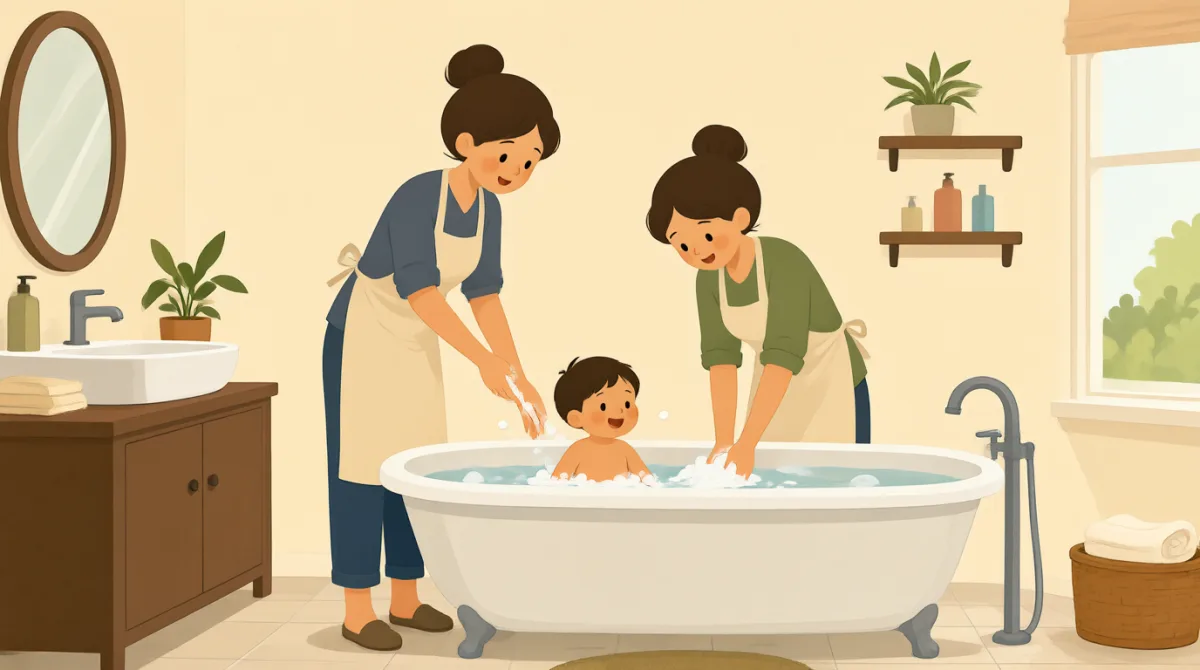

It's bath time, Emma. Please get in.
C’est l’heure du bain, Emma. Allez, entre.

The water is warm, Grace.
L’eau est chaude, Grace.
Good. Wash your arms and legs.
Bien. Lave-toi les bras et les jambes.
Can I wash my toy too?
Je peux laver mon jouet aussi ?
Sure. Now wash your tummy.
Bien sûr. Maintenant, lave-toi le ventre.
I am all clean now.
Je suis toute propre maintenant.
Great! Rinse off with the water.
Super ! Rince-toi à l’eau.
Okay. I'm ready to get out.
D’accord. Je suis prête à sortir.
Vocabulaire8
- bath timel’heure du bain
The time to take a bath. You can say, “It’s bath time” when it is time to get in the bath.
Le moment de prendre un bain. Tu peux dire “It’s bath time” quand c’est l’heure d’entrer dans le bain.
- get inentrer
To go into something, such as a bath. You can say, “Please get in” to ask someone to enter.
Aller à l’intérieur de quelque chose, comme une baignoire. Tu peux dire “Please get in” pour demander à quelqu’un d’entrer.
- warmchaud
A little hot, but not too hot. You can use it to describe the water in a bath.
Un peu chaud, mais pas trop. Tu peux employer ce mot pour décrire l’eau du bain.
- washlaver
To clean something with water and soap. You can say, “Wash your hands” or “Wash your arms.”
Nettoyer quelque chose avec de l’eau et du savon. Tu peux dire “Wash your hands” ou “Wash your arms.”
- toyjouet
A thing a child plays with. In this dialogue, Emma asks if she can wash her toy.
Un objet avec lequel un enfant joue. Dans ce dialogue, Emma demande si elle peut laver son jouet.
- tummyventre
An informal word for the front part of your body, below your chest. You can use it when talking with young children.
Un mot familier pour désigner la partie avant du corps, sous la poitrine. Tu peux l’employer quand tu parles avec de jeunes enfants.
- rinse offse rincer
To wash away soap with clean water. You can say, “Rinse off with the water” after washing.
Enlever le savon avec de l’eau propre. Après s’être lavé, tu peux dire “Rinse off with the water.”
- get outsortir
To leave or come out of something. You can say, “I’m ready to get out” when you are ready to leave the bath.
Quitter ou sortir de quelque chose. Tu peux dire “I’m ready to get out” quand tu es prête à sortir du bain.
Phrases clés8
- 1
It's bath time, Emma.
C’est l’heure du bain, Emma.
Use this sentence to tell someone it is time to take a bath. You can replace “bath” with another activity, as in “It’s lunch time.”
Utilise cette phrase pour dire à quelqu’un que c’est le moment de prendre un bain. Tu peux remplacer “bath” par une autre activité, comme dans “It’s lunch time.”
- 2
Please get in.
Allez, entre.
This is a polite way to ask someone to enter something, such as a bath or a car. Use “Please” to make the request friendly.
C’est une façon polie de demander à quelqu’un d’entrer quelque part, par exemple dans une baignoire ou une voiture. “Please” rend la demande plus aimable.
- 3
The water is warm, Grace.
L’eau est chaude, Grace.
Use this sentence to describe the temperature of water. You can replace “warm” with “cold” or “hot.”
Utilise cette phrase pour décrire la température de l’eau. Tu peux remplacer “warm” par “cold” ou “hot.”
- 4
Wash your arms and legs.
Lave-toi les bras et les jambes.
This is a simple instruction to tell someone what to clean. You can name other body parts, such as hands or feet.
C’est une consigne simple qui indique à quelqu’un ce qu’il doit laver. Tu peux nommer d’autres parties du corps, comme les mains ou les pieds.
- 5
Can I wash my toy too?
Je peux laver mon jouet aussi ?
Use “Can I…?” to ask permission to do something. Add “too” when you want to do the same thing as someone else.
Utilise “Can I…?” pour demander la permission de faire quelque chose. Ajoute “too” si tu veux faire la même chose que quelqu’un d’autre.
- 6
Now wash your tummy.
Maintenant, lave-toi le ventre.
Use “Now” to tell someone what to do next. You can replace “your tummy” with another body part.
Utilise “Now” pour indiquer à quelqu’un ce qu’il doit faire ensuite. Tu peux remplacer “your tummy” par une autre partie du corps.
- 7
Great! Rinse off with the water.
Super ! Rince-toi à l’eau.
This sentence tells someone to wash away soap with water. You can use “rinse off” after washing your hands, hair, or body.
Cette phrase demande à quelqu’un d’enlever le savon avec de l’eau. Tu peux employer “rinse off” après t’être lavé les mains, les cheveux ou le corps.
- 8
I'm ready to get out.
Je suis prête à sortir.
Use this sentence to say you are ready to leave a place or get out of something. For example, you can say it when you are done with a bath.
Utilise cette phrase pour dire que tu es prête à quitter un endroit ou à sortir de quelque chose. Par exemple, tu peux la dire quand tu as fini ton bain.