Paying and Getting Change
Payer et récupérer la monnaie
Emma pays for the fruit with cash. David gives her the change and a friendly goodbye.
Emma paie les fruits en espèces. David lui rend la monnaie et lui dit au revoir avec gentillesse.
Dialogue7
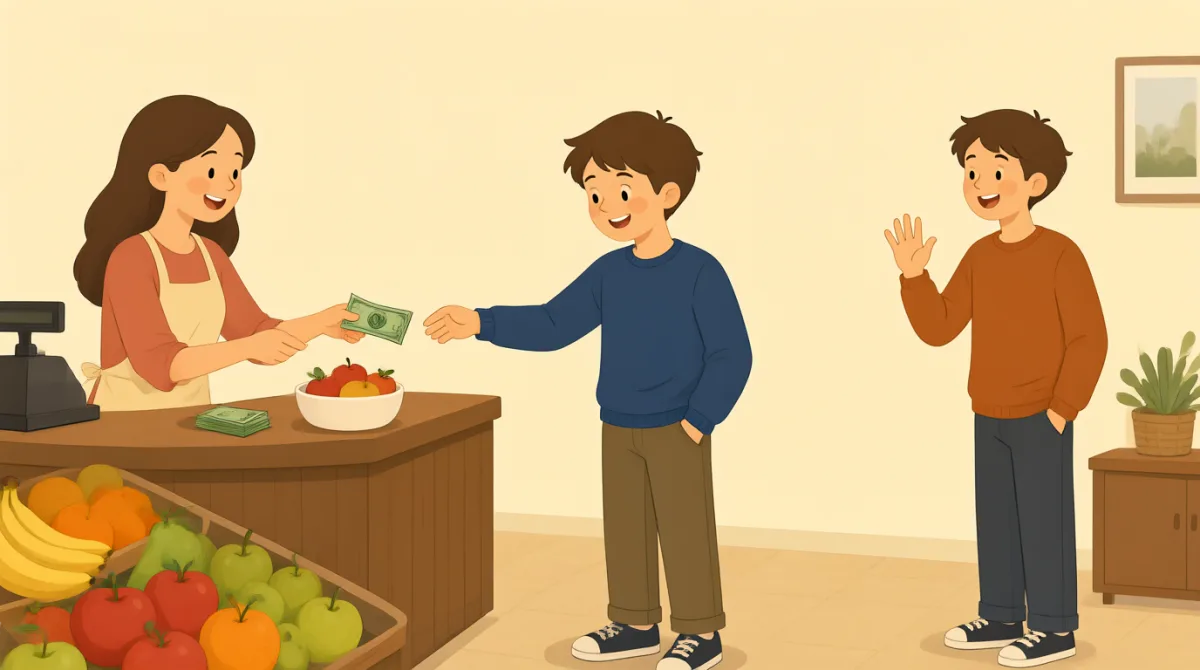

Here you go. Is this ten dollars?
Voilà. C’est bien dix dollars ?

Yes, it is. Your oranges are eight dollars.
Oui. Vos oranges coûtent huit dollars.
I paid with a ten. How much change?
J’ai payé avec un billet de dix. Combien de monnaie ?
Two dollars. Here you are.
Deux dollars. Tenez.
Thanks! The oranges look so fresh.
Merci ! Les oranges ont l’air tellement fraîches.
They are. Have a nice day!
Elles le sont. Passez une bonne journée !
You too. Goodbye!
Vous aussi. Au revoir !
Vocabulaire6
- Here you go.Voilà.
Say this when you give someone something. Here, Emma gives David the money.
Dites « Voilà. » quand vous donnez quelque chose à quelqu’un. Ici, Emma donne l’argent à David.
- changela monnaie
Change is the money you get back when you pay more than the price. Emma gets two dollars back.
La monnaie, c’est l’argent qu’on vous rend quand vous payez plus que le prix demandé. Emma récupère deux dollars.
- Here you are.Tenez.
Say this when you give something to someone. David gives Emma her change.
Dites « Tenez. » quand vous donnez quelque chose à quelqu’un. David rend sa monnaie à Emma.
- freshfrais / fraîche
Fresh means new and good to eat. Emma says the oranges look fresh.
« Fresh » signifie qu’un aliment est frais et bon à manger. Emma dit que les oranges ont l’air fraîches.
- Have a nice day!Passez une bonne journée !
This is a friendly way to say goodbye. You can use it with customers, friends, or other people.
C’est une façon sympathique de dire au revoir. Vous pouvez l’utiliser avec des clients, des amis ou d’autres personnes.
- You too.Vous aussi.
Say this to wish the same good thing to another person. Emma says it after David wishes her a nice day.
Dites « Vous aussi. » pour souhaiter la même chose à quelqu’un. Emma répond ainsi après que David lui a souhaité une bonne journée.
Phrases clés8
- 1
Is this ten dollars?
C’est bien dix dollars ?
Use this question to check the value of money. You can change “ten dollars” to another amount.
Utilisez cette question pour vérifier la valeur d’un billet ou d’une pièce. Vous pouvez remplacer “ten dollars” par un autre montant.
- 2
Your oranges are eight dollars.
Vos oranges coûtent huit dollars.
Use this sentence to tell someone the price. Replace “oranges” with another item and say its cost.
Utilisez cette phrase pour indiquer le prix à quelqu’un. Remplacez “oranges” par un autre article et indiquez son prix.
- 3
I paid with a ten.
J’ai payé avec un billet de dix.
Use this to say you paid with a ten-dollar bill. You can replace “a ten” with another bill amount.
Utilisez cette phrase pour dire que vous avez payé avec un billet de dix dollars. Vous pouvez remplacer “a ten” par un autre montant de billet.
- 4
How much change?
Combien de monnaie ?
Use this short question to ask how much money you will get back. It is useful when you pay with cash.
Utilisez cette courte question pour demander combien d’argent on va vous rendre. Elle est pratique quand vous payez en espèces.
- 5
Two dollars.
Deux dollars.
Use this short answer to say the amount of money. You can replace “two dollars” with another amount.
Utilisez cette réponse courte pour indiquer un montant. Vous pouvez remplacer “two dollars” par un autre montant.
- 6
The oranges look so fresh.
Les oranges ont l’air tellement fraîches.
Use this sentence to say that fruit or food looks very fresh. Replace “oranges” with another food.
Utilisez cette phrase pour dire qu’un fruit ou un aliment a l’air très frais. Remplacez “oranges” par un autre aliment.
- 7
Have a nice day!
Passez une bonne journée !
Use this friendly phrase when saying goodbye. You can also say it to a cashier or a customer.
Utilisez cette formule sympathique pour dire au revoir. Vous pouvez aussi la dire à un caissier ou à un client.
- 8
You too.
Vous aussi.
Use this short reply when you want to wish someone the same thing. For example, say it after someone says, “Have a nice day!”
Utilisez cette réponse courte pour souhaiter la même chose à quelqu’un. Par exemple, dites-la après que quelqu’un vous a dit : “Have a nice day!”