Paying and Getting Change
Emma pays for the fruit with cash. David gives her the change and a friendly goodbye.
Dialogue7
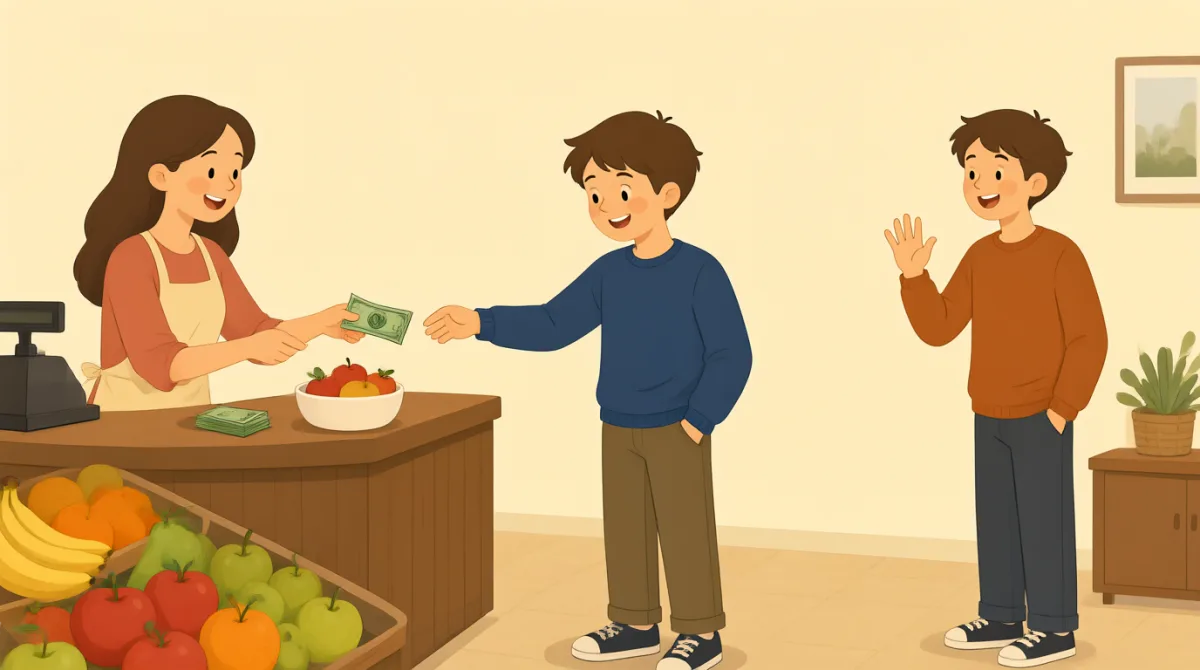

Here you go. Is this ten dollars?

Yes, it is. Your oranges are eight dollars.
I paid with a ten. How much change?
Two dollars. Here you are.
Thanks! The oranges look so fresh.
They are. Have a nice day!
You too. Goodbye!
Vocabulary6
- Here you go.
Say this when you give someone something. Here, Emma gives David the money.
- change
Change is the money you get back when you pay more than the price. Emma gets two dollars back.
- Here you are.
Say this when you give something to someone. David gives Emma her change.
- fresh
Fresh means new and good to eat. Emma says the oranges look fresh.
- Have a nice day!
This is a friendly way to say goodbye. You can use it with customers, friends, or other people.
- You too.
Say this to wish the same good thing to another person. Emma says it after David wishes her a nice day.
Key Sentences8
- 1
Is this ten dollars?
Use this question to check the value of money. You can change “ten dollars” to another amount.
- 2
Your oranges are eight dollars.
Use this sentence to tell someone the price. Replace “oranges” with another item and say its cost.
- 3
I paid with a ten.
Use this to say you paid with a ten-dollar bill. You can replace “a ten” with another bill amount.
- 4
How much change?
Use this short question to ask how much money you will get back. It is useful when you pay with cash.
- 5
Two dollars.
Use this short answer to say the amount of money. You can replace “two dollars” with another amount.
- 6
The oranges look so fresh.
Use this sentence to say that fruit or food looks very fresh. Replace “oranges” with another food.
- 7
Have a nice day!
Use this friendly phrase when saying goodbye. You can also say it to a cashier or a customer.
- 8
You too.
Use this short reply when you want to wish someone the same thing. For example, say it after someone says, “Have a nice day!”