Paying and Getting Change
Pagar y recibir el cambio
Emma pays for the fruit with cash. David gives her the change and a friendly goodbye.
Emma paga la fruta en efectivo. David le da el cambio y se despide amablemente.
Diálogo7
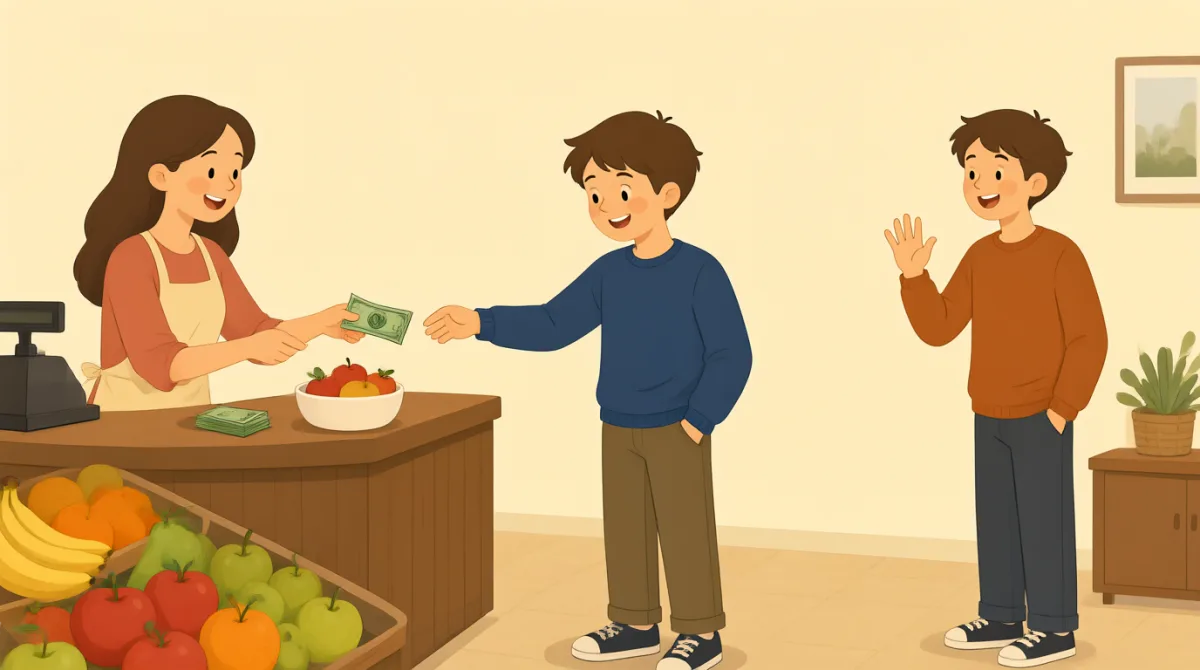

Here you go. Is this ten dollars?
Aquí tiene. ¿Este billete es de diez dólares?

Yes, it is. Your oranges are eight dollars.
Sí. Sus naranjas cuestan ocho dólares.
I paid with a ten. How much change?
Pagué con uno de diez. ¿Cuánto me da de cambio?
Two dollars. Here you are.
Dos dólares. Aquí tiene.
Thanks! The oranges look so fresh.
¡Gracias! Las naranjas se ven muy frescas.
They are. Have a nice day!
Así es. ¡Que tenga un buen día!
You too. Goodbye!
Igualmente. ¡Adiós!
Vocabulario6
- Here you go.Aquí tiene.
Say this when you give someone something. Here, Emma gives David the money.
Di esto cuando le das algo a alguien. Aquí, Emma le da el dinero a David.
- changeel cambio
Change is the money you get back when you pay more than the price. Emma gets two dollars back.
El cambio es el dinero que recibes cuando pagas más de lo que cuesta algo. Emma recibe dos dólares.
- Here you are.Aquí tiene.
Say this when you give something to someone. David gives Emma her change.
Di esto cuando le das algo a alguien. David le da a Emma el cambio.
- freshfresco
Fresh means new and good to eat. Emma says the oranges look fresh.
“Fresh” quiere decir que algo es nuevo y está en buen estado para comer. Emma dice que las naranjas se ven frescas.
- Have a nice day!¡Que tenga un buen día!
This is a friendly way to say goodbye. You can use it with customers, friends, or other people.
Es una forma amable de despedirse. Puedes usarla con clientes, amigos u otras personas.
- You too.Igualmente.
Say this to wish the same good thing to another person. Emma says it after David wishes her a nice day.
Di esto para desearle a otra persona lo mismo que te ha deseado. Emma lo dice después de que David le desea un buen día.
Frases clave8
- 1
Is this ten dollars?
¿Este billete es de diez dólares?
Use this question to check the value of money. You can change “ten dollars” to another amount.
Usa esta pregunta para confirmar cuánto vale el dinero. Puedes cambiar “ten dollars” por otra cantidad.
- 2
Your oranges are eight dollars.
Sus naranjas cuestan ocho dólares.
Use this sentence to tell someone the price. Replace “oranges” with another item and say its cost.
Usa esta frase para decirle a alguien cuánto cuesta algo. Sustituye “oranges” por otro producto y di su precio.
- 3
I paid with a ten.
Pagué con uno de diez.
Use this to say you paid with a ten-dollar bill. You can replace “a ten” with another bill amount.
Usa esta frase para decir que pagaste con un billete de diez dólares. Puedes sustituir “a ten” por el valor de otro billete.
- 4
How much change?
¿Cuánto me da de cambio?
Use this short question to ask how much money you will get back. It is useful when you pay with cash.
Usa esta pregunta breve para preguntar cuánto dinero te devolverán. Es útil cuando pagas en efectivo.
- 5
Two dollars.
Dos dólares.
Use this short answer to say the amount of money. You can replace “two dollars” with another amount.
Usa esta respuesta breve para decir una cantidad de dinero. Puedes sustituir “two dollars” por otra cantidad.
- 6
The oranges look so fresh.
Las naranjas se ven muy frescas.
Use this sentence to say that fruit or food looks very fresh. Replace “oranges” with another food.
Usa esta frase para decir que una fruta o un alimento se ve muy fresco. Sustituye “oranges” por otro alimento.
- 7
Have a nice day!
¡Que tenga un buen día!
Use this friendly phrase when saying goodbye. You can also say it to a cashier or a customer.
Usa esta frase amable al despedirte. También puedes decírsela a un cajero o a un cliente.
- 8
You too.
Igualmente.
Use this short reply when you want to wish someone the same thing. For example, say it after someone says, “Have a nice day!”
Usa esta respuesta breve cuando quieras desearle a alguien lo mismo. Por ejemplo, puedes decirla después de que alguien diga “Have a nice day!”.