Finding Notebooks and Pens
Buscando cuadernos y bolígrafos
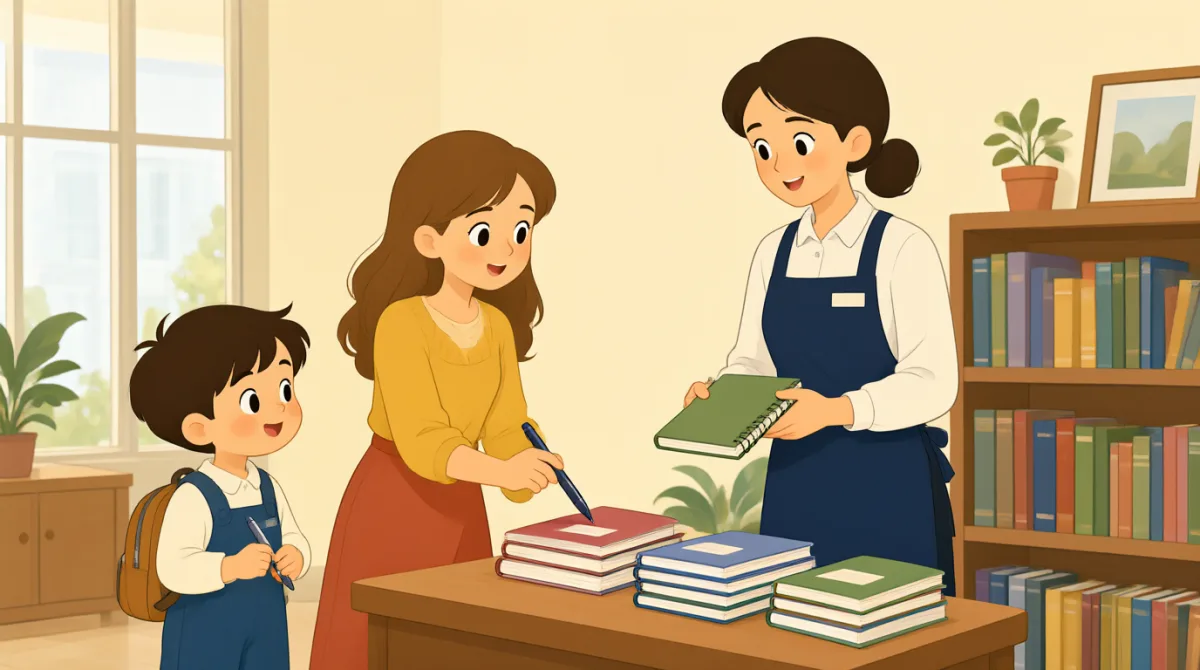
Emma and Grace look for notebooks and pens. A store worker helps them find the right items.
Emma y Grace buscan cuadernos y bolígrafos. Un empleado de la tienda las ayuda a encontrar lo que necesitan.
Diálogo8

I need notebooks and pens for school.
Necesito cuadernos y bolígrafos para la escuela.

Let’s find them on this list.
Vamos a buscarlos en esta lista.
Where are the notebooks, please?
¿Dónde están los cuadernos, por favor?

They’re on that shelf, next to the folders.
Están en ese estante, al lado de las carpetas.
We need two wide-ruled notebooks.
Necesitamos dos cuadernos de renglones anchos.
Are these the right ones?
¿Son estos los que necesitamos?
Yes. The pens are right over here.
Sí. Los bolígrafos están justo aquí.
Great! I need blue pens.
¡Genial! Necesito bolígrafos azules.
Vocabulario8
- for schoolpara la escuela
This means something is needed for use at school. You can say, “I need a bag for school.”
Significa que algo se necesita para usarlo en la escuela. Puedes decir: “I need a bag for school” (Necesito una mochila para la escuela).
- on this listen esta lista
This means written on the list Grace is using. You can say, “The apples are on this list.”
Significa que algo está escrito en la lista que Grace está usando. Puedes decir: “The apples are on this list” (Las manzanas están en esta lista).
- Where are the notebooks, please?¿Dónde están los cuadernos, por favor?
Use this polite question to ask where something is in a store. Replace “the notebooks” with the item you need.
Usa esta pregunta cortés para preguntar dónde está algo en una tienda. Sustituye “the notebooks” por el artículo que necesitas.
- on that shelfen ese estante
This tells you that something is on a shelf farther away. You can use it to describe where an item is.
Indica que algo está en un estante que queda más lejos. Puedes usar esta expresión para describir dónde está un artículo.
- next to the foldersal lado de las carpetas
This means beside the folders. Use “next to” to say where one thing is in relation to another.
Significa junto a las carpetas. Usa “next to” para indicar dónde está una cosa con respecto a otra.
- wide-ruled notebookscuadernos de renglones anchos
These are notebooks with wide spaces between the lines. You can use this phrase when asking for a certain kind of notebook.
Son cuadernos que tienen mucho espacio entre los renglones. Puedes usar esta expresión para pedir un tipo específico de cuaderno.
- right over herejusto aquí
This means very close to the speaker, in this place. It is useful when showing someone where an item is.
Significa que algo está muy cerca de quien habla, en este lugar. Es útil para mostrarle a alguien dónde está un artículo.
- blue pensbolígrafos azules
These are pens that write in blue ink. You can replace “blue” with another color.
Son bolígrafos que escriben con tinta azul. Puedes sustituir “blue” por otro color.
Frases clave8
- 1
I need notebooks and pens for school.
Necesito cuadernos y bolígrafos para la escuela.
Use “I need” to say what you need. You can name one or more items after it.
Usa “I need” para decir qué necesitas. Después puedes nombrar uno o varios artículos.
- 2
Let’s find them on this list.
Vamos a buscarlos en esta lista.
Use “Let’s” to suggest doing something together. Replace “find them” with another activity, such as “check the prices.”
Usa “Let’s” para proponer hacer algo juntos. Puedes sustituir “find them” por otra actividad, como “check the prices”.
- 3
Where are the notebooks, please?
¿Dónde están los cuadernos, por favor?
This is a polite way to ask where something is. Replace “the notebooks” with another item.
Esta es una forma cortés de preguntar dónde está algo. Sustituye “the notebooks” por otro artículo.
- 4
They’re on that shelf, next to the folders.
Están en ese estante, al lado de las carpetas.
Use this sentence to tell someone where items are. “They’re” means “they are,” and “next to” gives an extra location detail.
Usa esta oración para decirle a alguien dónde están las cosas. “They’re” significa “they are”, y “next to” añade otro detalle sobre la ubicación.
- 5
We need two wide-ruled notebooks.
Necesitamos dos cuadernos de renglones anchos.
Use “We need” to say what a group needs, and add a number and item. You can also describe the kind of item you want.
Usa “We need” para decir qué necesita un grupo; después añade una cantidad y el artículo. También puedes describir qué tipo de artículo quieres.
- 6
Are these the right ones?
¿Son estos los que necesitamos?
Use this question to check whether the items you are looking at are correct. “These” refers to items nearby.
Usa esta pregunta para comprobar si los artículos que estás mirando son los correctos. “These” se refiere a artículos que están cerca.
- 7
The pens are right over here.
Los bolígrafos están justo aquí.
Use this to show someone where an item is nearby. Replace “the pens” with another plural item.
Usa esta expresión para mostrarle a alguien dónde está algo que se encuentra cerca. Sustituye “the pens” por otro artículo en plural.
- 8
Great! I need blue pens.
¡Genial! Necesito bolígrafos azules.
Use “I need” to state what you want, and add a color before the item. You can replace “blue” with another color.
Usa “I need” para decir qué necesitas y añade el color antes del artículo. Puedes sustituir “blue” por otro color.