Asking About the Soup
Nach der Suppe fragen
Emma asks if the soup has meat in it. Jack checks the ingredients for her.
Emma fragt, ob die Suppe Fleisch enthält. Jack sieht für sie in der Zutatenliste nach.
Dialog7
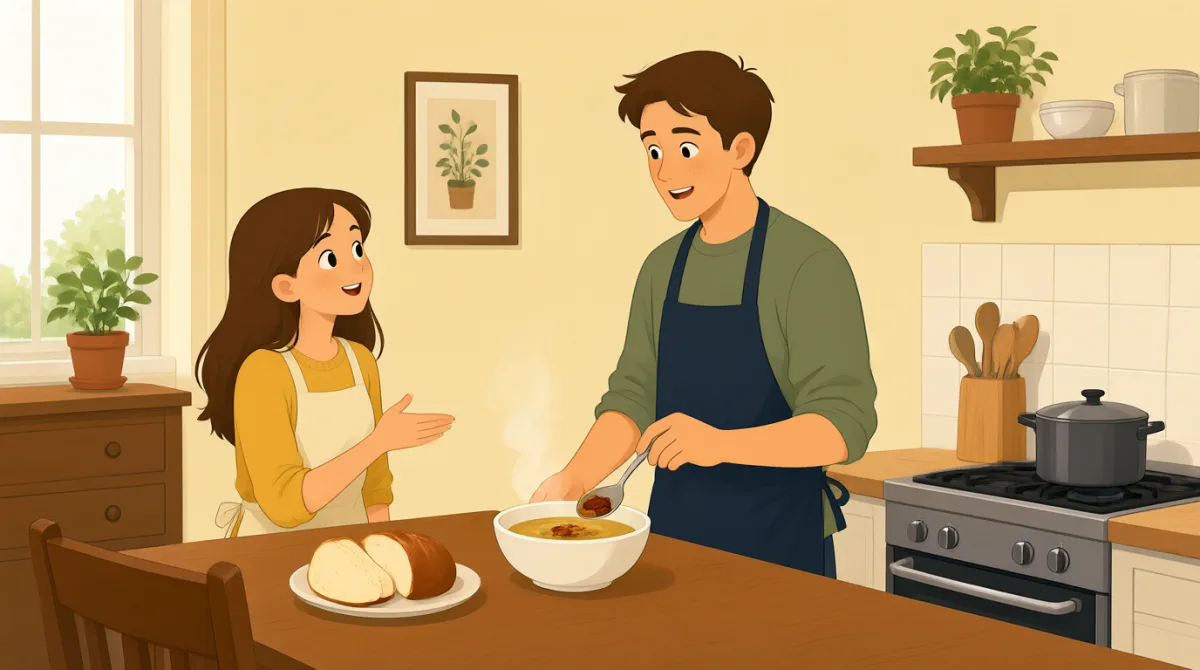

Excuse me, does the soup have meat in it?
Entschuldigung, ist Fleisch in der Suppe?

Let me check the ingredients for you.
Ich sehe für Sie in der Zutatenliste nach.
Thank you. I don't eat meat.
Danke. Ich esse kein Fleisch.
I understand. This soup has chicken in it.
Verstehe. In dieser Suppe ist Hähnchen.
Oh, I can't have that. Is there another soup?
Oh, das kann ich nicht essen. Gibt es noch eine andere Suppe?
Yes. The tomato soup has no meat.
Ja. Die Tomatensuppe ist ohne Fleisch.
Great. I'll have the tomato soup, please.
Prima. Ich nehme bitte die Tomatensuppe.
Wortschatz8
- Excuse meEntschuldigung
A polite way to get someone's attention. Use it when you want to ask a server a question.
Eine höfliche Art, die Aufmerksamkeit einer Person zu bekommen. Verwende den Ausdruck, wenn du einem Kellner oder einer Kellnerin eine Frage stellen möchtest.
- does the soup have meat in it?Ist Fleisch in der Suppe?
Ask this to find out whether meat is an ingredient. You can replace “the soup” with another dish.
Mit dieser Frage findest du heraus, ob Fleisch eine Zutat ist. Du kannst „the soup“ durch ein anderes Gericht ersetzen.
- ingredientsZutaten
The foods used to make a dish. You can ask someone to check the ingredients if you have a food restriction.
Die Lebensmittel, aus denen ein Gericht gemacht wird. Wenn du bestimmte Lebensmittel nicht essen kannst oder möchtest, kannst du jemanden bitten, die Zutaten zu überprüfen.
- I don't eat meat.Ich esse kein Fleisch.
Use this simple sentence to tell someone you do not eat meat. You can replace “meat” with another food.
Mit diesem einfachen Satz sagst du jemandem, dass du kein Fleisch isst. Du kannst „meat“ durch ein anderes Lebensmittel ersetzen.
- I can't have that.Das kann ich nicht essen.
Use this to say that a food is not suitable for you. You can use it after learning what is in a dish.
Mit diesem Satz sagst du, dass ein Lebensmittel für dich nicht geeignet ist. Du kannst ihn verwenden, nachdem du erfahren hast, was in einem Gericht ist.
- another soupeine andere Suppe
This means a different soup. You can ask for another option by saying, “Is there another…?”
Das bedeutet eine Suppe, die anders ist. Du kannst nach einer anderen Möglichkeit fragen, indem du sagst: „Is there another…?“
- no meatohne Fleisch
This means that a dish does not contain meat. You can ask whether a food has no meat.
Das bedeutet, dass ein Gericht kein Fleisch enthält. Du kannst fragen, ob ein Gericht kein Fleisch enthält.
- I'll have the tomato soup, please.Ich nehme bitte die Tomatensuppe.
Use this polite sentence to order something. Replace “the tomato soup” with the food or drink you want.
Mit diesem höflichen Satz kannst du etwas bestellen. Ersetze „the tomato soup“ durch das Essen oder Getränk, das du möchtest.
Wichtige Sätze8
- 1
Excuse me, does the soup have meat in it?
Entschuldigung, ist Fleisch in der Suppe?
This is a polite way to ask whether a dish contains meat. Replace “the soup” with another food to ask about it.
Das ist eine höfliche Frage, um herauszufinden, ob ein Gericht Fleisch enthält. Ersetze „the soup“ durch ein anderes Lebensmittel, nach dem du fragen möchtest.
- 2
Let me check the ingredients for you.
Ich sehe für Sie in der Zutatenliste nach.
This is a helpful response when someone asks what is in a dish. You can use it when you need to find information for someone.
Das ist eine hilfreiche Antwort, wenn jemand fragt, was in einem Gericht ist. Du kannst den Satz verwenden, wenn du für jemanden etwas herausfinden möchtest.
- 3
Thank you. I don't eat meat.
Danke. Ich esse kein Fleisch.
This thanks the server and explains your food choice. You can replace “meat” with another food you do not eat.
Damit bedankst du dich beim Kellner oder bei der Kellnerin und erklärst, was du isst. Du kannst „meat“ durch ein anderes Lebensmittel ersetzen, das du nicht isst.
- 4
This soup has chicken in it.
In dieser Suppe ist Hähnchen.
Use this sentence to say that a dish contains a specific ingredient. Replace “chicken” with another ingredient.
Mit diesem Satz sagst du, dass ein Gericht eine bestimmte Zutat enthält. Ersetze „chicken“ durch eine andere Zutat.
- 5
Oh, I can't have that.
Oh, das kann ich nicht essen.
This is a simple way to say a food is not suitable for you. You can use it after the server tells you what a dish contains.
So kannst du einfach sagen, dass ein Lebensmittel für dich nicht geeignet ist. Du kannst den Satz verwenden, nachdem der Kellner oder die Kellnerin dir gesagt hat, was in einem Gericht ist.
- 6
Is there another soup?
Gibt es noch eine andere Suppe?
Use this question to ask if a different soup is available. Replace “soup” with another type of food or drink.
Mit dieser Frage findest du heraus, ob es eine andere Suppe gibt. Ersetze „soup“ durch eine andere Speise oder ein anderes Getränk.
- 7
The tomato soup has no meat.
Die Tomatensuppe ist ohne Fleisch.
This sentence tells someone that a dish does not contain meat. Replace “the tomato soup” with another dish.
Mit diesem Satz sagst du jemandem, dass ein Gericht kein Fleisch enthält. Ersetze „the tomato soup“ durch ein anderes Gericht.
- 8
Great. I'll have the tomato soup, please.
Prima. Ich nehme bitte die Tomatensuppe.
This is a polite way to choose and order a dish. Replace “the tomato soup” with the item you want.
So kannst du höflich ein Gericht auswählen und bestellen. Ersetze „the tomato soup“ durch das, was du möchtest.