Taking Out the Trash Together
Zusammen den Müll rausbringen
Leo and Jack take the trash out together. They sort the bags and put them by the curb.
Leo und Jack bringen zusammen den Müll raus. Sie sortieren die Säcke und stellen sie an den Straßenrand.
Dialog7
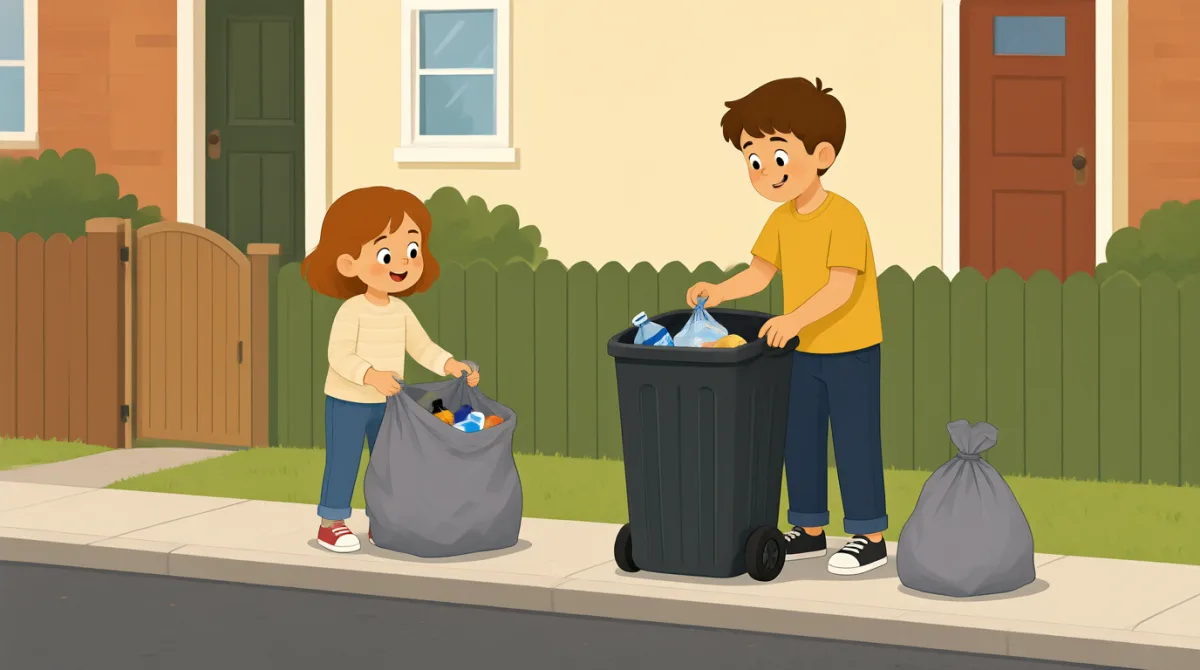

I have two bags. Which one goes out first?
Ich habe zwei Säcke. Welcher kommt zuerst nach draußen?

The blue bag is recycling. The black one is trash.
Der blaue Sack ist für den Recyclingmüll. Der schwarze ist für den Restmüll.
Is this can recycling?
Gehört diese Dose zum Recycling?
Yes, put it in the blue bag.
Ja, tu sie in den blauen Sack.
Okay. Let’s take them to the curb.
Okay. Bringen wir sie zum Straßenrand.
Sure. Put the bags by the curb, not in the street.
Klar. Stell die Säcke an den Straßenrand, nicht auf die Straße.
Done! That was easy.
Fertig! Das war einfach.
Wortschatz8
- bagsSäcke
Bags are containers for holding things. Here, they hold trash and recycling.
Säcke sind Behälter, in denen man Dinge aufbewahrt. Hier kommen Müll und Wertstoffe hinein.
- goes out firstkommt zuerst nach draußen
This asks which bag should be taken outside before the other one.
Damit fragst du, welcher Sack zuerst nach draußen gebracht werden soll.
- recyclingRecycling; Wertstoffe
Recycling is used paper, cans, or other things that can be made into something new.
Wertstoffe sind gebrauchte Dinge wie Papier oder Dosen, aus denen etwas Neues hergestellt werden kann.
- trashMüll
Trash is something people throw away.
Müll sind Dinge, die man wegwirft.
- put it intu es hinein
Use this phrase to say where something should go. For example, put a can in a bag.
Mit dieser Wendung sagst du, wohin etwas gehört. Zum Beispiel: Tu eine Dose in einen Sack.
- curbStraßenrand
The curb is the raised edge of the street, beside the sidewalk.
Der Straßenrand ist der erhöhte Rand der Straße neben dem Gehweg.
- in the streetauf der Straße
This means on the part of the road where cars drive.
Damit ist der Teil der Straße gemeint, auf dem die Autos fahren.
- Done!Fertig!
Say “Done!” when you have finished a task.
Sag „Done!“, wenn du eine Aufgabe erledigt hast.
Wichtige Sätze8
- 1
I have two bags.
Ich habe zwei Säcke.
Use this simple sentence to say how many bags or other items you have. Change “two bags” to another number and item.
Mit diesem einfachen Satz sagst du, wie viele Säcke oder andere Dinge du hast. Ersetze “two bags” durch eine andere Anzahl und einen anderen Gegenstand.
- 2
Which one goes out first?
Welcher kommt zuerst nach draußen?
Use this question when you need to know which item to do or take out before the others. Change “one” to name the item if needed.
Mit dieser Frage möchtest du wissen, welchen Gegenstand du zuerst erledigen oder nach draußen bringen sollst. Ersetze “one” bei Bedarf durch den Namen des Gegenstands.
- 3
The blue bag is recycling.
Der blaue Sack ist für den Recyclingmüll.
This sentence tells someone what belongs in a particular bag. You can change “blue bag” and “recycling” to name other items and categories.
Mit diesem Satz sagst du jemandem, was in einen bestimmten Sack gehört. Du kannst “blue bag” und “recycling” durch andere Gegenstände und Kategorien ersetzen.
- 4
Is this can recycling?
Gehört diese Dose zum Recycling?
Use this question to check where an item belongs. Replace “can” with another item, such as “bottle.”
Mit dieser Frage prüfst du, wohin ein Gegenstand gehört. Ersetze “can” durch einen anderen Gegenstand, zum Beispiel “bottle.”
- 5
Yes, put it in the blue bag.
Ja, tu sie in den blauen Sack.
This gives a simple instruction about where to place something. Change “the blue bag” to another place or container.
Damit sagst du ganz einfach, wohin etwas gelegt werden soll. Ersetze “the blue bag” durch einen anderen Ort oder Behälter.
- 6
Let’s take them to the curb.
Bringen wir sie zum Straßenrand.
Use “Let’s” to suggest doing something together. Replace “take them to the curb” with another action.
Mit “Let’s” schlägst du vor, etwas gemeinsam zu tun. Ersetze “take them to the curb” durch eine andere Handlung.
- 7
Put the bags by the curb, not in the street.
Stell die Säcke an den Straßenrand, nicht auf die Straße.
This sentence gives an instruction and says where not to put something. Use “not” to make a clear warning.
Dieser Satz enthält eine Anweisung und sagt, wohin man etwas nicht stellen soll. Mit “not” formulierst du eine deutliche Warnung.
- 8
That was easy.
Das war einfach.
Say this after a task that did not take much effort. You can use it to share how an activity felt.
Das sagst du nach einer Aufgabe, die nicht viel Mühe gekostet hat. So kannst du mitteilen, wie sich eine Tätigkeit angefühlt hat.