Taking Out the Trash Together
Levando o lixo para fora juntos
Leo and Jack take the trash out together. They sort the bags and put them by the curb.
Leo e Jack levam o lixo para fora juntos. Eles separam os sacos e os colocam junto ao meio-fio.
Diálogo7
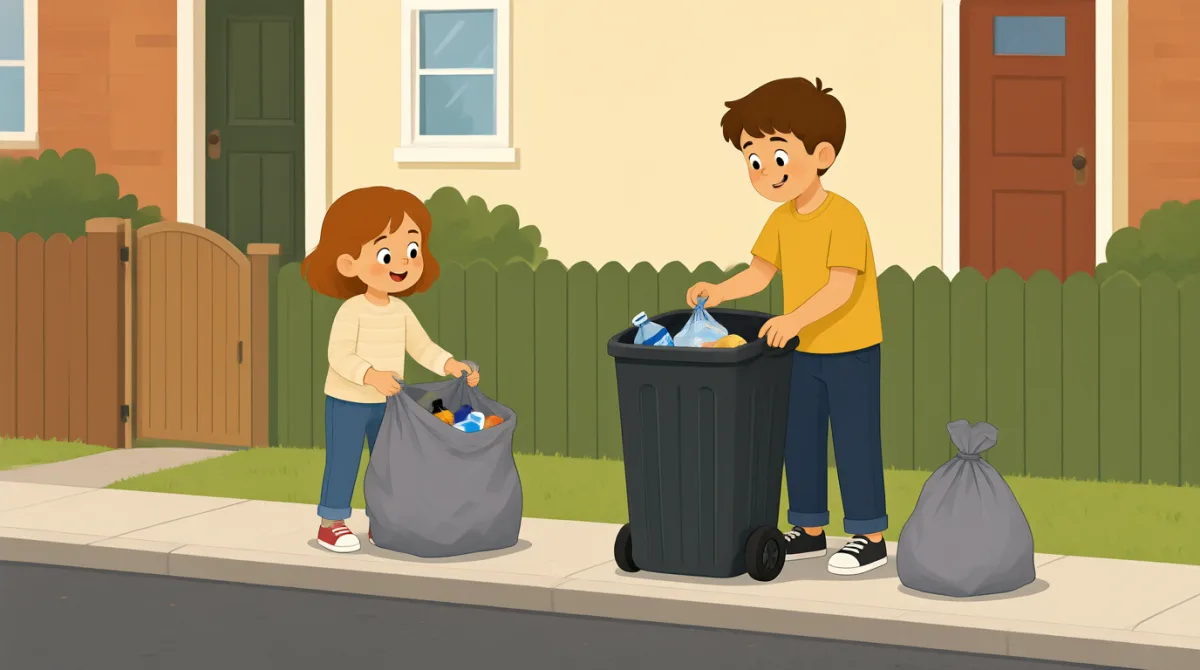

I have two bags. Which one goes out first?
Tenho dois sacos. Qual deles vai para fora primeiro?

The blue bag is recycling. The black one is trash.
O saco azul é para reciclagem. O preto é para o lixo.
Is this can recycling?
Esta lata é reciclável?
Yes, put it in the blue bag.
Sim, coloque-a no saco azul.
Okay. Let’s take them to the curb.
Beleza. Vamos levá-los até o meio-fio.
Sure. Put the bags by the curb, not in the street.
Claro. Coloque os sacos junto ao meio-fio, não na rua.
Done! That was easy.
Pronto! Foi fácil.
Vocabulário8
- bagssacos
Bags are containers for holding things. Here, they hold trash and recycling.
Sacos são recipientes usados para guardar coisas. Aqui, eles servem para colocar lixo e materiais recicláveis.
- goes out firstvai para fora primeiro
This asks which bag should be taken outside before the other one.
Essa pergunta quer saber qual saco deve ser levado para fora antes do outro.
- recyclingreciclagem
Recycling is used paper, cans, or other things that can be made into something new.
Reciclagem são papéis usados, latas ou outras coisas que podem ser transformados em algo novo.
- trashlixo
Trash is something people throw away.
Lixo é algo que as pessoas jogam fora.
- put it incoloque em
Use this phrase to say where something should go. For example, put a can in a bag.
Use essa expressão para dizer onde algo deve ser colocado. Por exemplo: coloque uma lata em um saco.
- curbmeio-fio
The curb is the raised edge of the street, beside the sidewalk.
O meio-fio é a borda elevada da rua, ao lado da calçada.
- in the streetna rua
This means on the part of the road where cars drive.
Isso significa na parte da via por onde os carros passam.
- Done!Pronto!
Say “Done!” when you have finished a task.
Diga “Done!” quando terminar uma tarefa.
Frases-chave8
- 1
I have two bags.
Tenho dois sacos.
Use this simple sentence to say how many bags or other items you have. Change “two bags” to another number and item.
Use essa frase simples para dizer quantos sacos ou outros itens você tem. Troque “two bags” por outro número e item.
- 2
Which one goes out first?
Qual deles vai para fora primeiro?
Use this question when you need to know which item to do or take out before the others. Change “one” to name the item if needed.
Use essa pergunta quando precisar saber qual item deve ser feito ou levado para fora antes dos outros. Se precisar, troque “one” pelo nome do item.
- 3
The blue bag is recycling.
O saco azul é para reciclagem.
This sentence tells someone what belongs in a particular bag. You can change “blue bag” and “recycling” to name other items and categories.
Essa frase diz a alguém o que deve ser colocado em determinado saco. Você pode trocar “blue bag” e “recycling” por outros itens e categorias.
- 4
Is this can recycling?
Esta lata é reciclável?
Use this question to check where an item belongs. Replace “can” with another item, such as “bottle.”
Use essa pergunta para confirmar onde um item deve ser colocado. Troque “can” por outro item, como “bottle.”
- 5
Yes, put it in the blue bag.
Sim, coloque-a no saco azul.
This gives a simple instruction about where to place something. Change “the blue bag” to another place or container.
Essa frase dá uma instrução simples sobre onde colocar algo. Troque “the blue bag” por outro lugar ou recipiente.
- 6
Let’s take them to the curb.
Vamos levá-los até o meio-fio.
Use “Let’s” to suggest doing something together. Replace “take them to the curb” with another action.
Use “Let’s” para sugerir que façam algo juntos. Troque “take them to the curb” por outra ação.
- 7
Put the bags by the curb, not in the street.
Coloque os sacos junto ao meio-fio, não na rua.
This sentence gives an instruction and says where not to put something. Use “not” to make a clear warning.
Essa frase dá uma instrução e diz onde não colocar algo. Use “not” para fazer um alerta claro.
- 8
That was easy.
Foi fácil.
Say this after a task that did not take much effort. You can use it to share how an activity felt.
Diga isso depois de uma tarefa que não exigiu muito esforço. Você pode usar essa frase para contar como foi fazer uma atividade.