Taking Out the Trash Together
Sacando la basura juntos
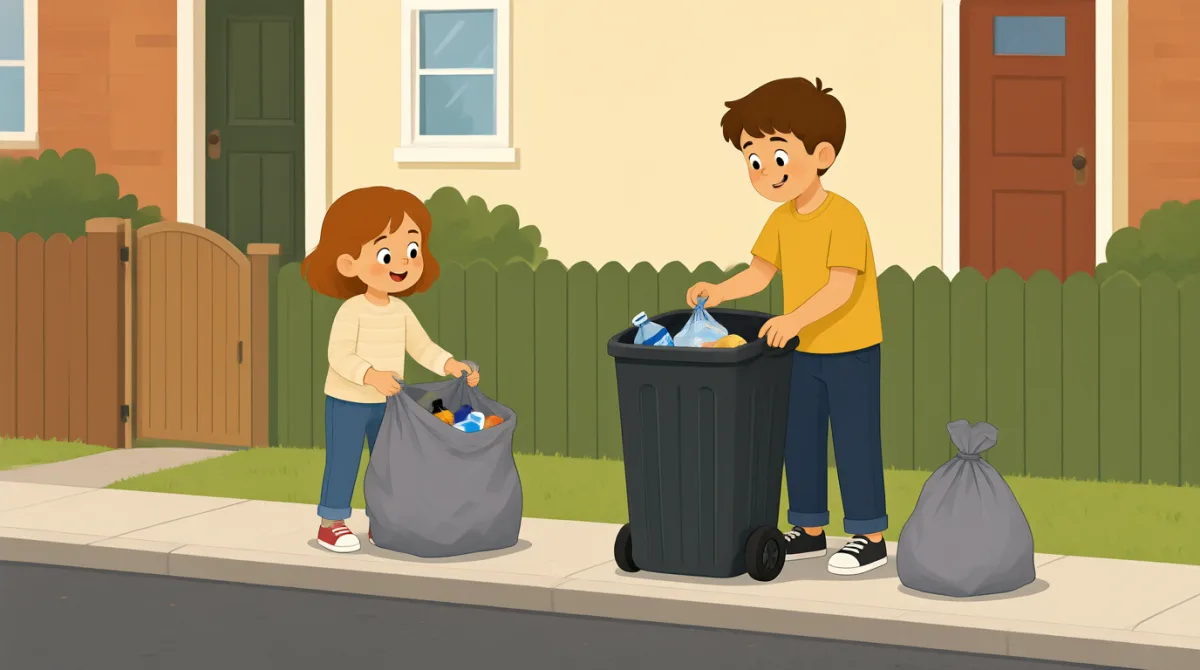
Leo and Jack take the trash out together. They sort the bags and put them by the curb.
Leo y Jack sacan la basura juntos. Separan las bolsas y las dejan junto al bordillo.
Diálogo7

I have two bags. Which one goes out first?
Tengo dos bolsas. ¿Cuál sacamos primero?

The blue bag is recycling. The black one is trash.
La bolsa azul es para reciclar. La negra es para la basura.
Is this can recycling?
¿Esta lata va para reciclar?
Yes, put it in the blue bag.
Sí, ponla en la bolsa azul.
Okay. Let’s take them to the curb.
Vale. Llevémoslas al bordillo.
Sure. Put the bags by the curb, not in the street.
Claro. Deja las bolsas junto al bordillo, no en la calle.
Done! That was easy.
¡Listo! Fue fácil.
Vocabulario8
- bagsbolsas
Bags are containers for holding things. Here, they hold trash and recycling.
Las bolsas son recipientes para guardar cosas. En este caso, sirven para poner la basura y los materiales reciclables.
- goes out firstsacar primero
This asks which bag should be taken outside before the other one.
Esta expresión pregunta qué bolsa hay que sacar antes que la otra.
- recyclingreciclaje
Recycling is used paper, cans, or other things that can be made into something new.
El reciclaje incluye papel usado, latas y otras cosas que se pueden convertir en algo nuevo.
- trashbasura
Trash is something people throw away.
La basura es algo que la gente tira.
- put it inponerlo en
Use this phrase to say where something should go. For example, put a can in a bag.
Usa esta frase para decir dónde debe ir algo. Por ejemplo, pon una lata en una bolsa.
- curbbordillo
The curb is the raised edge of the street, beside the sidewalk.
El bordillo es el borde elevado de la calle, junto a la acera.
- in the streeten la calle
This means on the part of the road where cars drive.
Significa en la parte de la vía por donde circulan los autos.
- Done!¡Listo!
Say “Done!” when you have finished a task.
Di “Done!” cuando hayas terminado una tarea.
Frases clave8
- 1
I have two bags.
Tengo dos bolsas.
Use this simple sentence to say how many bags or other items you have. Change “two bags” to another number and item.
Usa esta frase sencilla para decir cuántas bolsas u otras cosas tienes. Cambia “two bags” por otro número y otro objeto.
- 2
Which one goes out first?
¿Cuál sacamos primero?
Use this question when you need to know which item to do or take out before the others. Change “one” to name the item if needed.
Usa esta pregunta cuando quieras saber qué cosa hay que hacer o sacar antes que las demás. Si hace falta, cambia “one” por el nombre del objeto.
- 3
The blue bag is recycling.
La bolsa azul es para reciclar.
This sentence tells someone what belongs in a particular bag. You can change “blue bag” and “recycling” to name other items and categories.
Esta frase le dice a alguien qué va en una bolsa determinada. Puedes cambiar “blue bag” y “recycling” por otros objetos y categorías.
- 4
Is this can recycling?
¿Esta lata va para reciclar?
Use this question to check where an item belongs. Replace “can” with another item, such as “bottle.”
Usa esta pregunta para comprobar dónde va un objeto. Cambia “can” por otro objeto, como “bottle.”
- 5
Yes, put it in the blue bag.
Sí, ponla en la bolsa azul.
This gives a simple instruction about where to place something. Change “the blue bag” to another place or container.
Esta frase da una instrucción sencilla sobre dónde poner algo. Cambia “the blue bag” por otro lugar o recipiente.
- 6
Let’s take them to the curb.
Llevémoslas al bordillo.
Use “Let’s” to suggest doing something together. Replace “take them to the curb” with another action.
Usa “Let’s” para proponer hacer algo juntos. Cambia “take them to the curb” por otra acción.
- 7
Put the bags by the curb, not in the street.
Deja las bolsas junto al bordillo, no en la calle.
This sentence gives an instruction and says where not to put something. Use “not” to make a clear warning.
Esta frase da una instrucción y dice dónde no hay que poner algo. Usa “not” para dejar clara la advertencia.
- 8
That was easy.
Fue fácil.
Say this after a task that did not take much effort. You can use it to share how an activity felt.
Di esto después de una tarea que no requirió mucho esfuerzo. También puedes usarlo para contar cómo te pareció una actividad.