When Is Trash Day?
Wann ist Müllabfuhr?
Emma asks Grace when trash day is. Grace tells her the pickup day and time.
Emma fragt Grace, wann die Müllabfuhr kommt. Grace sagt ihr, an welchem Tag und um wie viel Uhr der Müll abgeholt wird.
Dialog7
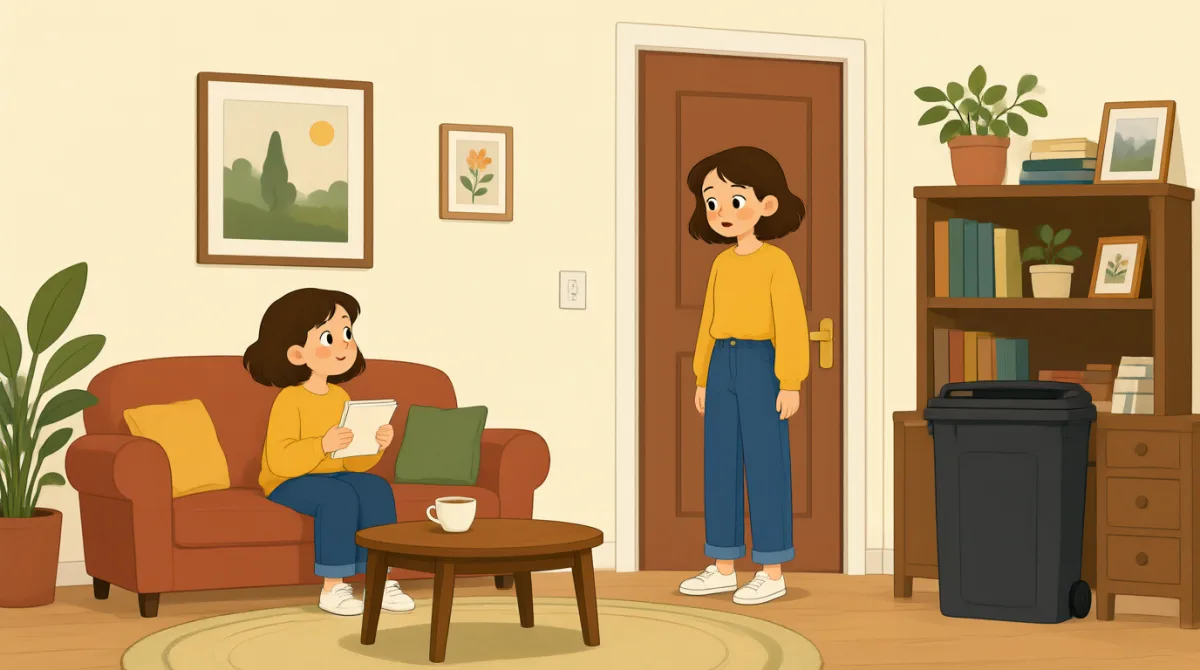

Grace, when is trash day?
Grace, wann kommt die Müllabfuhr?

It is every Tuesday.
Jeden Dienstag.
What time do they come?
Um wie viel Uhr kommen sie?
They come early in the morning.
Sie kommen früh am Morgen.
Should I put the bags out tonight?
Soll ich die Müllsäcke heute Abend rausstellen?
Yes. Put them by the curb tonight.
Ja. Stell sie heute Abend an den Straßenrand.
Okay, I’ll do that. Thanks!
Okay, mach ich. Danke!
Wortschatz6
- trash daytrash day (Tag der Müllabfuhr)
This is the day when trash is picked up. You can ask, “When is trash day?”
So nennt man den Tag, an dem der Müll abgeholt wird. Du kannst fragen: “When is trash day?” (Wann kommt die Müllabfuhr?)
- every Tuesdayevery Tuesday (jeden Dienstag)
This means something happens each Tuesday. Use it to say how often an event happens.
Das bedeutet, dass etwas jeden Dienstag passiert. Damit kannst du sagen, wie oft etwas stattfindet.
- early in the morningearly in the morning (früh am Morgen)
This means near the start of the morning. You can use it to say when someone arrives.
Das bedeutet, dass etwas kurz nach Beginn des Morgens passiert. Du kannst damit sagen, wann jemand ankommt.
- put the bags output the bags out (die Müllsäcke rausstellen)
This means to take the bags outside for pickup. Use “put” plus an object and “out” to talk about placing something outside.
Das bedeutet, die Säcke nach draußen zu bringen, damit sie abgeholt werden. Mit “put” plus einem Gegenstand und “out” kannst du sagen, dass du etwas nach draußen stellst.
- by the curbby the curb (am Straßenrand)
This means next to the edge of the street. It tells someone where to leave the bags.
Das bedeutet, dass etwas neben dem Rand der Straße steht. So sagst du jemandem, wo die Säcke abgestellt werden sollen.
- tonighttonight (heute Abend / heute Nacht)
This means this evening or night. Use it to say when you will do something.
Das bedeutet heute Abend oder heute Nacht. Du kannst es verwenden, um zu sagen, wann du etwas machst.
Wichtige Sätze8
- 1
Grace, when is trash day?
Grace, wann kommt die Müllabfuhr?
Use this simple question to ask which day trash is picked up. You can replace “trash day” with another event, such as “the meeting.”
Mit dieser einfachen Frage fragst du, an welchem Tag der Müll abgeholt wird. Du kannst “trash day” durch ein anderes Ereignis ersetzen, zum Beispiel durch “the meeting” (das Treffen).
- 2
It is every Tuesday.
Jeden Dienstag.
This gives the day something happens. You can replace “Tuesday” with another day of the week.
Damit sagst du, an welchem Tag etwas stattfindet. Du kannst “Tuesday” durch einen anderen Wochentag ersetzen.
- 3
What time do they come?
Um wie viel Uhr kommen sie?
Use this question to ask when people or a service will arrive. You can replace “they” with a person or group.
Mit dieser Frage erkundigst du dich, wann Personen oder ein Dienst ankommen. Du kannst “they” durch eine Person oder Gruppe ersetzen.
- 4
They come early in the morning.
Sie kommen früh am Morgen.
This tells someone when people will arrive. Replace “early in the morning” with another time phrase.
Damit sagst du, wann jemand ankommt. Ersetze “early in the morning” durch eine andere Zeitangabe.
- 5
Should I put the bags out tonight?
Soll ich die Müllsäcke heute Abend rausstellen?
Use “Should I…?” to ask if something is a good idea or is needed. You can replace “put the bags out” with another task.
Mit “Should I…?” fragst du, ob etwas eine gute Idee oder nötig ist. Du kannst “put the bags out” durch eine andere Aufgabe ersetzen.
- 6
Yes.
Ja.
This is a short way to answer a yes-or-no question positively. You can use it in everyday conversations.
Das ist eine kurze, positive Antwort auf eine Ja-Nein-Frage. Du kannst sie in alltäglichen Gesprächen verwenden.
- 7
Put them by the curb tonight.
Stell sie heute Abend an den Straßenrand.
This is a direct, simple instruction about where and when to leave the bags. Replace “them” with the item you need to place.
Das ist eine direkte, einfache Anweisung, wo und wann die Säcke abgestellt werden sollen. Ersetze “them” durch den Gegenstand, den du abstellen musst.
- 8
Okay, I’ll do that.
Okay, mach ich.
Use this to agree to do something someone has asked you to do. “I’ll” is a common short form of “I will.”
Damit stimmst du zu, etwas zu tun, worum dich jemand gebeten hat. “I’ll” ist eine häufige Kurzform von “I will.”