Finding the Plastic Bin
Die richtige Tonne für Plastik finden
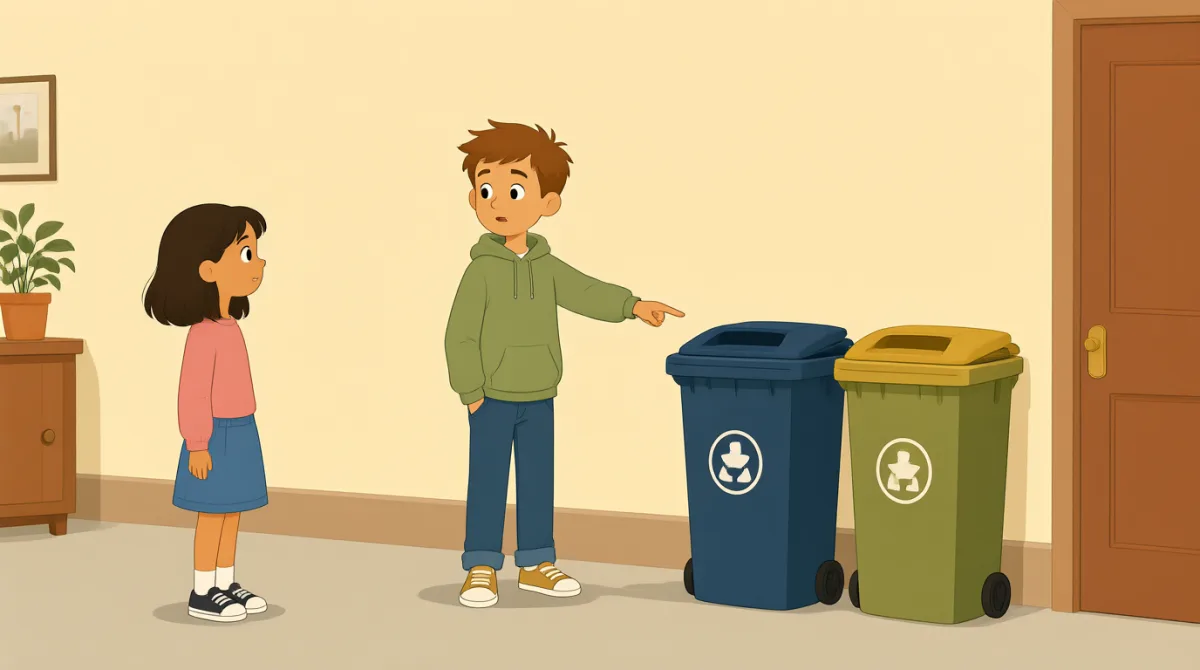
Emma asks Jack which bin is for plastic. Jack points out the right bin.
Emma fragt Jack, welche Tonne für Plastik ist. Jack zeigt ihr die richtige Tonne.
Dialog7

Jack, which bin is for plastic?
Jack, welche Tonne ist für Plastik?

The blue one is for plastic.
Die blaue ist für Plastik.
Can I put this bottle in it?
Kann ich diese Flasche da reinwerfen?
Yes. Please rinse it first.
Ja. Spül sie bitte vorher aus.
Where do I put the bottle cap?
Wo kommt der Flaschendeckel hin?
Put it in the blue bin, too.
Wirf ihn auch in die blaue Tonne.
Okay, thanks for showing me.
Okay, danke, dass du’s mir gezeigt hast.
Wortschatz7
- which binwelche Tonne
Use this to ask which container is right for something. You can say, “Which bin is for paper?”
Damit fragst du, welcher Behälter für etwas gedacht ist. Du kannst zum Beispiel fragen: “Which bin is for paper?” (Welche Tonne ist für Papier?)
- plasticPlastik
Plastic is a material used to make things like bottles. You can ask which bin is for plastic.
Plastik ist ein Material, aus dem zum Beispiel Flaschen hergestellt werden. Du kannst fragen, welche Tonne für Plastik ist.
- the blue onedie blaue
This means the blue bin. Use “the [color] one” to point out an item by its color.
Das bedeutet die blaue Tonne. Mit “the [color] one” (die [Farbe]) kannst du etwas anhand seiner Farbe benennen.
- put this bottle in itdiese Flasche da reinwerfen
This means to place the bottle inside the bin. Use “put [something] in it” to ask where to place an item.
Das bedeutet, die Flasche in die Tonne zu legen. Mit “put [something] in it” (etwas da reinlegen) kannst du fragen, wohin etwas gehört.
- rinse it firstsie vorher ausspülen
This means to wash the bottle with water before putting it in the bin. Use “rinse it first” when something needs a quick wash.
Das bedeutet, die Flasche mit Wasser auszuspülen, bevor du sie in die Tonne wirfst. “rinse it first” (spül sie vorher aus) kannst du sagen, wenn etwas kurz abgewaschen werden soll.
- bottle capFlaschendeckel
A bottle cap is the small cover on top of a bottle. You can ask where to put it.
Ein Flaschendeckel ist der kleine Verschluss oben auf einer Flasche. Du kannst fragen, wo er hingehört.
- showing medass du’s mir gezeigt hast
This means helping someone by pointing something out or explaining it. You can say “Thanks for showing me” to thank someone for help.
Damit ist gemeint, jemandem zu helfen, indem man auf etwas hinweist oder es erklärt. Mit “Thanks for showing me” (Danke, dass du’s mir gezeigt hast) kannst du dich für die Hilfe bedanken.
Wichtige Sätze7
- 1
Jack, which bin is for plastic?
Jack, welche Tonne ist für Plastik?
Use this to ask where to put plastic items. Replace “plastic” with another material, such as “paper.”
Damit fragst du, wohin Gegenstände aus Plastik gehören. Ersetze “plastic” durch ein anderes Material, zum Beispiel “paper”.
- 2
The blue one is for plastic.
Die blaue ist für Plastik.
This tells someone which bin to use. Replace “blue” with the color of the correct bin.
Damit sagst du jemandem, welche Tonne er oder sie benutzen soll. Ersetze “blue” durch die Farbe der richtigen Tonne.
- 3
Can I put this bottle in it?
Kann ich diese Flasche da reinwerfen?
Use this to ask if an item can go in a bin or container. Replace “this bottle” with another item.
Damit fragst du, ob ein Gegenstand in eine Tonne oder einen Behälter darf. Ersetze “this bottle” durch einen anderen Gegenstand.
- 4
Yes. Please rinse it first.
Ja. Spül sie bitte vorher aus.
This gives permission and a simple instruction. Use “Please [verb] it first” to say what someone should do before the next step.
Damit gibst du die Erlaubnis und eine einfache Anweisung. Mit “Please [verb] it first” sagst du, was jemand vor dem nächsten Schritt tun soll.
- 5
Where do I put the bottle cap?
Wo kommt der Flaschendeckel hin?
Use this to ask where something belongs. Replace “the bottle cap” with another item.
Damit fragst du, wohin etwas gehört. Ersetze “the bottle cap” durch einen anderen Gegenstand.
- 6
Put it in the blue bin, too.
Wirf ihn auch in die blaue Tonne.
This tells someone where to place an item. Use “Put it in the [color] bin” to give a simple direction.
Damit sagst du jemandem, wohin er oder sie etwas legen soll. Mit “Put it in the [color] bin” gibst du eine einfache Anweisung.
- 7
Okay, thanks for showing me.
Okay, danke, dass du’s mir gezeigt hast.
Use this to thank someone for helping you understand or find something. You can say it after someone gives you directions.
Damit bedankst du dich bei jemandem, der dir geholfen hat, etwas zu verstehen oder zu finden. Du kannst das sagen, nachdem dir jemand erklärt hat, wohin etwas gehört.