Is It Under the Sofa?
Czy są pod kanapą?
Mia asks if the keys are under the sofa. Emma looks and finds nothing there.
Mia pyta, czy klucze są pod kanapą. Emma zagląda i nic tam nie znajduje.
Dialog7
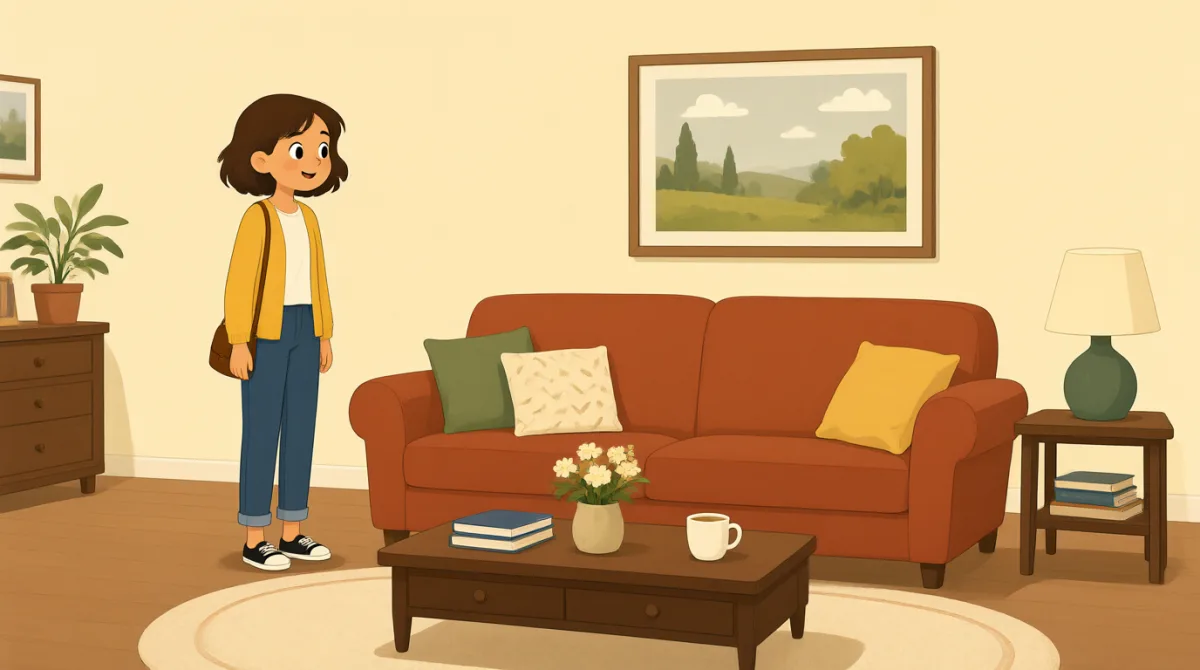

Is it under the sofa?
Czy są pod kanapą?

Let me look. I don't see them.
Zaraz sprawdzę. Nie widzę ich.
Look on the floor, too.
Zajrzyj też na podłogę.
No, they aren't on the floor.
Nie, nie ma ich na podłodze.
Maybe they're next to the sofa.
Może są obok kanapy.
No. They're not here either.
Nie. Tu też ich nie ma.
Let's check by the front door.
Sprawdźmy przy drzwiach wejściowych.
Słownictwo6
- under the sofapod kanapą
This means below the sofa. Use it to say where you think something is.
To znaczy, że coś znajduje się niżej niż kanapa. Użyj tego wyrażenia, gdy mówisz, gdzie twoim zdaniem coś jest.
- Let me look.Zaraz sprawdzę.
This means “I will check.” Use it when you want to search for something.
„Let me look.” znaczy „Zaraz sprawdzę”. Użyj tego wyrażenia, gdy chcesz czegoś poszukać.
- on the floorna podłodze
This means on the ground inside a room. Use it to say where something is.
To znaczy, że coś znajduje się na podłożu wewnątrz pomieszczenia. Użyj tego wyrażenia, by powiedzieć, gdzie coś jest.
- next to the sofaobok kanapy
This means beside the sofa. Use it to describe where something may be.
To znaczy, że coś znajduje się przy kanapie. Użyj tego wyrażenia, by opisać, gdzie coś może być.
- eitherteż (w przeczeniu)
Here, “either” means “also” in a negative sentence. Use it when saying something is not in another place, too.
W tym zdaniu „either” oznacza „też” i pojawia się w przeczeniu. Użyj go, gdy mówisz, że czegoś nie ma również w innym miejscu.
- front doordrzwi wejściowe
This is the main door at the front of a home. Use it when talking about the entrance.
To główne drzwi z przodu domu. Użyj tego wyrażenia, gdy mówisz o wejściu.
Kluczowe zdania8
- 1
Is it under the sofa?
Czy są pod kanapą?
This is a useful way to ask if one thing is in a certain place. Change “under the sofa” to ask about another location.
To przydatny sposób, by zapytać, czy coś znajduje się w konkretnym miejscu. Zmień „under the sofa” na inne miejsce, o które chcesz zapytać.
- 2
Let me look.
Zaraz sprawdzę.
Use this short sentence when you are going to check or search for something. You can also say it before looking for a person or an object.
Użyj tego krótkiego zdania, gdy zamierzasz coś sprawdzić lub czegoś poszukać. Możesz tak powiedzieć również przed rozpoczęciem poszukiwań osoby albo przedmiotu.
- 3
I don't see them.
Nie widzę ich.
Use this to say that you cannot find or see something. “Them” refers to more than one person or thing.
Użyj tego zdania, by powiedzieć, że nie możesz czegoś znaleźć lub zobaczyć. „Them” odnosi się do więcej niż jednej osoby lub rzeczy.
- 4
Look on the floor, too.
Zajrzyj też na podłogę.
This is a simple way to ask someone to check another place. You can replace “on the floor” with a different location.
To prosty sposób, by poprosić kogoś o sprawdzenie innego miejsca. Możesz zastąpić „on the floor” nazwą innego miejsca.
- 5
No, they aren't on the floor.
Nie, nie ma ich na podłodze.
Use this sentence to say that several things are not in a place. Replace “on the floor” with another location.
Użyj tego zdania, by powiedzieć, że kilku rzeczy nie ma w danym miejscu. Zastąp „on the floor” nazwą innego miejsca.
- 6
Maybe they're next to the sofa.
Może są obok kanapy.
Use “Maybe” to say where something could be when you are not sure. Change the location to suggest another place.
Użyj „Maybe”, by powiedzieć, gdzie coś może być, gdy nie masz pewności. Zmień nazwę miejsca, by zasugerować inną lokalizację.
- 7
No. They're not here either.
Nie. Tu też ich nie ma.
Use this to say that something is not in this place, just as it was not in another place. “Either” is common in negative sentences.
Użyj tego zdania, by powiedzieć, że czegoś nie ma w tym miejscu, tak samo jak nie było w innym. „Either” często pojawia się w przeczeniach.
- 8
Let's check by the front door.
Sprawdźmy przy drzwiach wejściowych.
Use “Let's check” to suggest looking somewhere together. Replace “by the front door” with another place.
Użyj „Let's check”, by zaproponować wspólne sprawdzenie jakiegoś miejsca. Zastąp „by the front door” nazwą innego miejsca.