Looking in the Living Room
Szukanie w salonie
Emma and Mia look around the living room. They check the table and the chair.
Emma i Mia rozglądają się po salonie. Sprawdzają stół i krzesło.
Dialog7
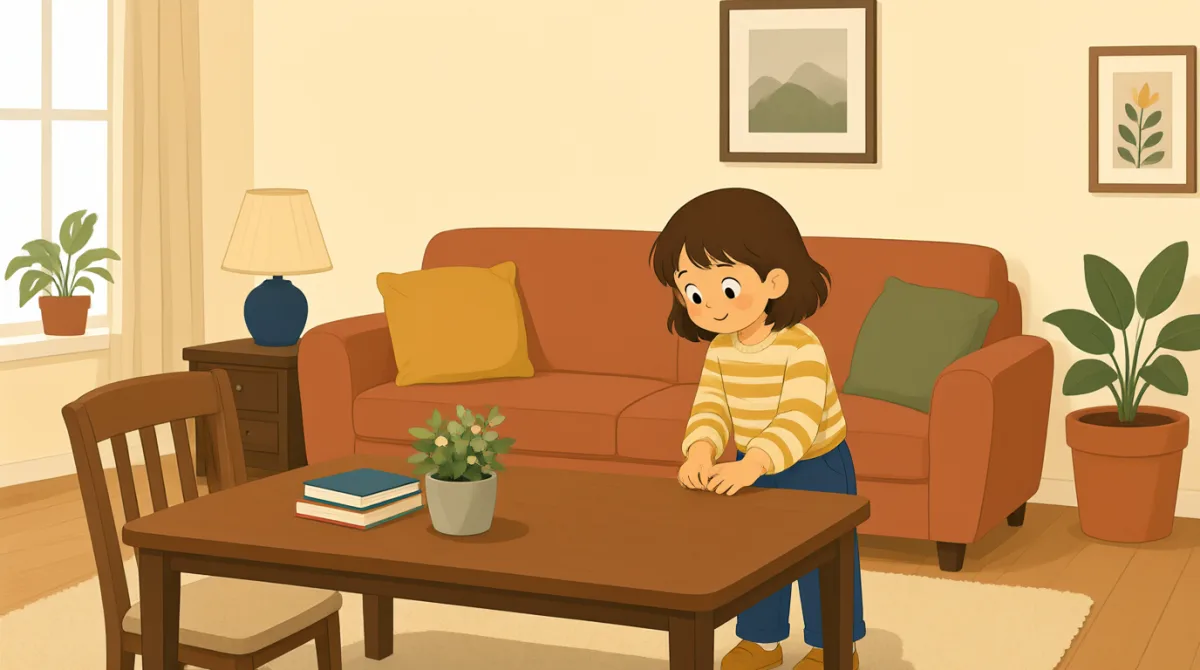

Can you help me look in the living room?
Pomożesz mi poszukać w salonie?

Sure. Where did you last see them?
Jasne. Gdzie ostatnio je widziałaś?
I think they were on the table.
Chyba leżały na stole.
The table is empty. Check the chair.
Na stole nic nie ma. Sprawdź krzesło.
I see a book on the chair, but no keys.
Widzę książkę na krześle, ale kluczy nie ma.
Look next to the table. Do you see them?
Sprawdź obok stołu. Widzisz je?
No, I don't. Let's look by the sofa.
Nie, nie widzę. Poszukajmy przy kanapie.
Słownictwo6
- look in the living roomszukać w salonie
To search inside the living room. Use this phrase to say where you want to look for something.
To znaczy szukać czegoś w salonie. Użyj tego wyrażenia, żeby powiedzieć, gdzie chcesz czegoś poszukać.
- last seewidzieć ostatnio
To remember the most recent time or place you saw something. Ask, “Where did you last see it?” when looking for a lost item.
Pamiętać, kiedy lub gdzie ostatnio widziało się daną rzecz. Gdy szukasz zguby, zapytaj: “Where did you last see it?” (Gdzie ostatnio to widziałeś/widziałaś?).
- on the tablena stole
This means on top of the table. Use “on” to say where something is.
To znaczy na blacie stołu. Użyj “on”, żeby powiedzieć, gdzie coś się znajduje.
- emptypusty
There is nothing on or inside a place. Here, there are no keys on the table.
Na danym miejscu ani w nim niczego nie ma. Tutaj chodzi o to, że na stole nie ma kluczy.
- next to the tableobok stołu
This means beside the table. Use “next to” to describe where something is.
To znaczy przy stole, z jego boku. Użyj “next to”, żeby opisać, gdzie coś się znajduje.
- by the sofaprzy kanapie
This means near the sofa. Use “by” to say that something is close to a place or object.
To znaczy niedaleko kanapy. Użyj “by”, żeby powiedzieć, że coś znajduje się blisko jakiegoś miejsca lub przedmiotu.
Kluczowe zdania8
- 1
Can you help me look in the living room?
Pomożesz mi poszukać w salonie?
Use this question to ask someone to help you search a place. You can replace “the living room” with another place.
Użyj tego pytania, żeby poprosić kogoś o pomoc w przeszukaniu jakiegoś miejsca. Możesz zastąpić “the living room” nazwą innego miejsca.
- 2
Where did you last see them?
Gdzie ostatnio je widziałaś?
Use this question to ask where someone saw something most recently. Replace “them” with the item you are looking for.
Użyj tego pytania, żeby dowiedzieć się, gdzie ktoś ostatnio widział daną rzecz. Zastąp “them” nazwą szukanego przedmiotu.
- 3
I think they were on the table.
Chyba leżały na stole.
Use this sentence to say where you think something was. “I think” shows that you are not completely sure.
Użyj tego zdania, żeby powiedzieć, gdzie twoim zdaniem coś było. “I think” pokazuje, że nie masz całkowitej pewności.
- 4
The table is empty.
Na stole nic nie ma.
Use this simple sentence to say that nothing is on the table. You can replace “the table” with another place.
Użyj tego prostego zdania, żeby powiedzieć, że na stole niczego nie ma. Możesz zastąpić “the table” nazwą innego miejsca.
- 5
Check the chair.
Sprawdź krzesło.
Use this short instruction to tell someone to look at or search a place. Replace “the chair” with another place or object.
Użyj tego krótkiego polecenia, żeby powiedzieć komuś, by sprawdził jakieś miejsce lub coś przeszukał. Zastąp “the chair” innym miejscem lub przedmiotem.
- 6
I see a book on the chair, but no keys.
Widzę książkę na krześle, ale kluczy nie ma.
Use this sentence to say what you can see and what is missing. You can change the objects to describe what you find.
Użyj tego zdania, żeby powiedzieć, co widzisz, a czego brakuje. Możesz zmienić nazwy przedmiotów i opisać, co udało ci się znaleźć.
- 7
Do you see them?
Widzisz je?
Use this question to ask if someone can see the things you are looking for. Replace “them” with a person or object.
Użyj tego pytania, żeby zapytać, czy ktoś widzi rzeczy, których szukacie. Zastąp “them” nazwą osoby lub przedmiotu.
- 8
Let's look by the sofa.
Poszukajmy przy kanapie.
Use “Let's” to suggest doing something together. Replace “by the sofa” with another place to suggest where to search.
Użyj “Let's”, żeby zaproponować wspólne działanie. Zastąp “by the sofa” innym miejscem, żeby zasugerować, gdzie szukać.