Choosing Between Two Gifts
The assistant shows Emma a book and a mug. Emma asks which one is better for her friend.
Dialogue6
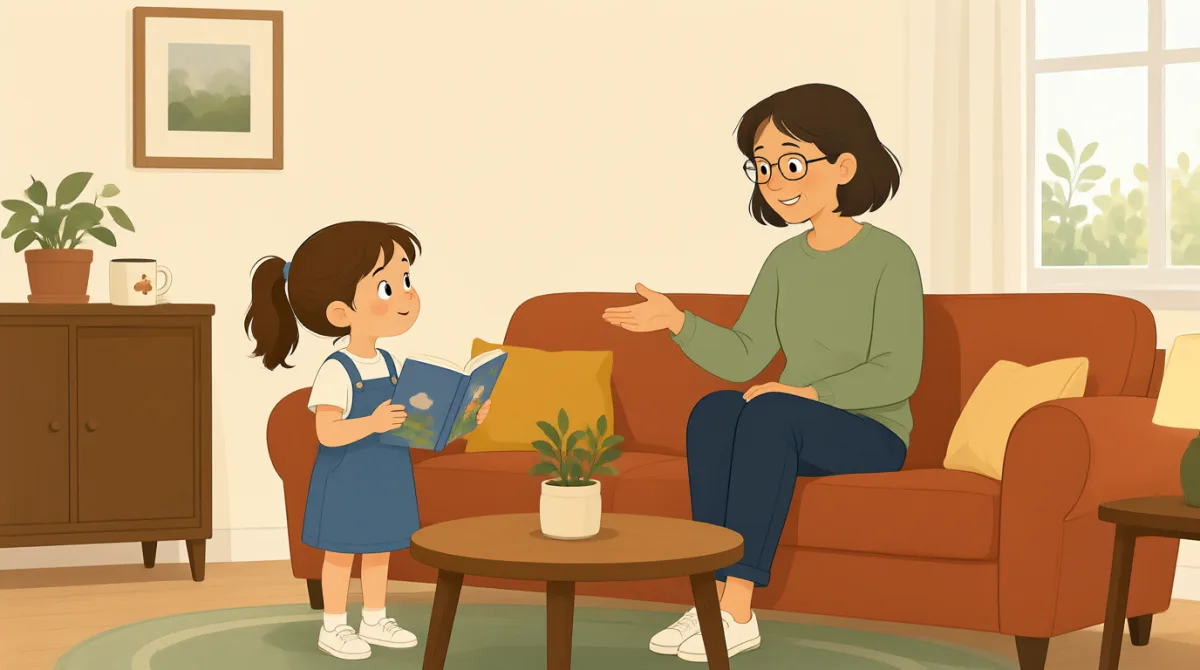

Here is a book and a mug.

Which one is better for my friend?
Does your friend like reading?
Yes, she does. She reads every day.
Then I think the book is better.
That sounds good. I’ll take the book.
Vocabulary7
- a book
A book is something you read. You can give it as a gift.
- a mug
A mug is a cup for hot drinks like tea or coffee. It can be a gift.
- Which one is better?
Use this question to ask which of two things is the better choice.
- like reading
This means to enjoy reading books. You can ask, “Does your friend like reading?”
- every day
This means each day. Use it to talk about something you do regularly.
- I think
Use “I think” to share your opinion. For example, “I think the book is better.”
- I’ll take the book.
Use this phrase to say you choose or want the book. You can replace “the book” with another item.
Key Sentences8
- 1
Here is a book and a mug.
Use “Here is” to show someone something. You can name one or more items after it.
- 2
Which one is better for my friend?
Use this question to ask which choice is best for someone. Replace “my friend” with another person or situation.
- 3
Does your friend like reading?
Use “Does” to ask about one person’s likes. Replace “reading” with another activity, such as “cooking.”
- 4
Yes, she does.
This is a short answer to a question that begins with “Does.” Use “Yes, he does” or “Yes, it does” for other subjects.
- 5
She reads every day.
Use this sentence to talk about a daily habit. For he, she, or it, add “s” to the verb: “reads.”
- 6
Then I think the book is better.
Use “Then” to give a conclusion based on what you just learned. You can replace “the book” with another choice.
- 7
That sounds good.
Use this phrase to say that an idea or choice seems good to you.
- 8
I’ll take the book.
Use this sentence to make your choice. Replace “the book” with the item you want.