Giving Advice
Donner des conseils
Mia suggests a few simple ways to sleep better, such as putting away his phone and going to bed earlier. Leo decides to try them.
Mia suggère quelques moyens simples de mieux dormir, comme ranger son téléphone et se coucher plus tôt. Leo décide d’essayer.
Dialogue8
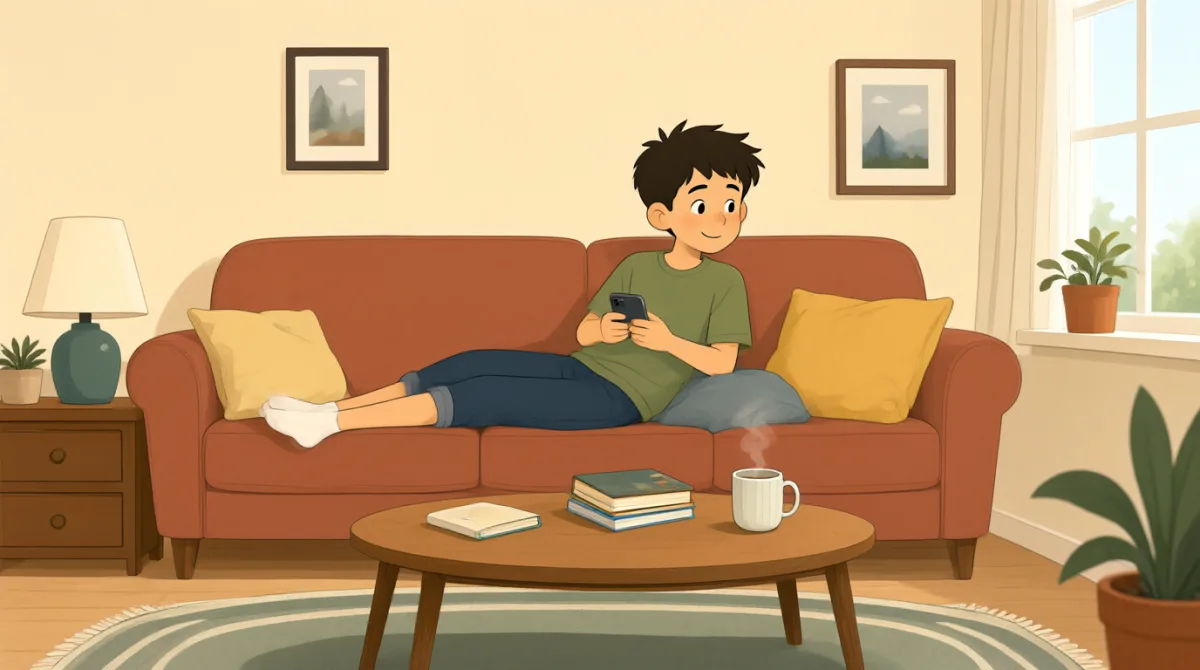

You should put your phone away before bed. The screen can keep you awake.
Tu devrais ranger ton téléphone avant de te coucher. L’écran peut t’empêcher de dormir.

I check it right before I go to sleep. I can stop doing that.
Je le regarde juste avant de m’endormir. Je peux arrêter de faire ça.
Good idea. You could also go to bed thirty minutes earlier.
Bonne idée. Tu pourrais aussi te coucher trente minutes plus tôt.
That might help. I usually stay up too late watching videos.
Ça pourrait aider. D’habitude, je veille trop tard à regarder des vidéos.
Try turning off your videos and reading a book instead.
Essaie d’éteindre tes vidéos et de lire un livre à la place.
Okay, I’ll try that tonight. Should I avoid coffee in the evening too?
D’accord, je vais essayer ce soir. Je devrais aussi éviter le café le soir ?
Yes, that’s a good idea. Try some water or warm milk instead.
Oui, c’est une bonne idée. Essaie plutôt de boire de l’eau ou du lait chaud.
Thanks, Mia. I’ll put my phone away and go to bed earlier tonight.
Merci, Mia. Je vais ranger mon téléphone et me coucher plus tôt ce soir.
Vocabulaire8
- put your phone awayranger son téléphone
To put your phone away is to stop using it and place it somewhere. Here, Mia suggests doing this before bed.
« Put your phone away » signifie arrêter d’utiliser son téléphone et le mettre quelque part. Ici, Mia suggère de le faire avant de se coucher.
- keep you awakeempêcher de dormir
If something keeps you awake, it makes it hard to sleep. You can use this phrase to talk about things that affect your sleep.
« Keep you awake » signifie empêcher quelqu’un de dormir. Cette expression permet de parler de choses qui perturbent le sommeil.
- right beforejuste avant
Right before means just before something happens. For example, you can say, “I brush my teeth right before bed.”
« Right before » signifie juste avant que quelque chose arrive. Par exemple, tu peux dire : “I brush my teeth right before bed.” (Je me brosse les dents juste avant de me coucher.)
- go to bedse coucher
To go to bed means to get into bed to sleep. You can use it to talk about when you plan to sleep.
« Go to bed » signifie aller au lit pour dormir. Tu peux utiliser cette expression pour parler de l’heure à laquelle tu prévois de te coucher.
- stay up too lateveiller trop tard
To stay up too late means to go to bed later than you should. You can use this phrase to describe a sleep habit.
« Stay up too late » signifie se coucher plus tard qu’on ne devrait. Tu peux utiliser cette expression pour décrire une habitude de sommeil.
- turning offéteindre
Turning off means stopping a device or activity. Here, Leo can turn off his videos before bed.
« Turning off » signifie arrêter un appareil ou une activité. Ici, Leo peut éteindre ses vidéos avant de se coucher.
- insteadà la place
Instead means in place of something else. You can use it to suggest a different choice, such as reading instead of watching videos.
« Instead » signifie à la place de quelque chose d’autre. Tu peux l’utiliser pour suggérer une autre option, comme lire plutôt que regarder des vidéos.
- in the eveningle soir
In the evening means during the later part of the day, before night. You can use it when talking about habits, such as drinking coffee.
« In the evening » signifie pendant la dernière partie de la journée, avant la nuit. Tu peux utiliser cette expression pour parler d’habitudes, comme boire du café.
Phrases clés8
- 1
You should put your phone away before bed.
Tu devrais ranger ton téléphone avant de te coucher.
Use “You should” to give someone simple advice. You can change the action to suggest another helpful habit.
Utilise “You should” pour donner un conseil simple. Tu peux changer l’action pour suggérer une autre habitude utile.
- 2
The screen can keep you awake.
L’écran peut t’empêcher de dormir.
This sentence explains how something may cause a problem. Use “can keep you awake” to talk about things that make sleeping difficult.
Cette phrase explique comment quelque chose peut causer un problème. Utilise “can keep you awake” pour parler de choses qui rendent le sommeil difficile.
- 3
I can stop doing that.
Je peux arrêter de faire ça.
Use this sentence to say you can stop a habit. Replace “that” with an action you want to change.
Utilise cette phrase pour dire que tu peux arrêter une habitude. Remplace “that” par l’action que tu veux changer.
- 4
You could also go to bed thirty minutes earlier.
Tu pourrais aussi te coucher trente minutes plus tôt.
Use “You could” to make a gentle suggestion. You can change the action or the amount of time to fit your advice.
Utilise “You could” pour faire une suggestion douce. Tu peux changer l’action ou la durée pour adapter ton conseil.
- 5
I usually stay up too late watching videos.
D’habitude, je veille trop tard à regarder des vidéos.
Use “I usually” to describe a regular habit. This sentence is useful for explaining a sleep problem or another routine.
Utilise “I usually” pour décrire une habitude régulière. Cette phrase est utile pour expliquer un problème de sommeil ou une autre routine.
- 6
Try turning off your videos and reading a book instead.
Essaie d’éteindre tes vidéos et de lire un livre à la place.
Use “Try” plus an action to suggest something that may help. “Instead” shows that one activity can replace another.
Utilise “Try” suivi d’une action pour suggérer quelque chose qui pourrait aider. “Instead” indique qu’une activité peut en remplacer une autre.
- 7
Should I avoid coffee in the evening too?
Je devrais aussi éviter le café le soir ?
Use “Should I…?” to ask for advice. You can change the action and time to ask about other habits.
Utilise “Should I…?” pour demander conseil. Tu peux changer l’action et le moment pour poser des questions sur d’autres habitudes.
- 8
I’ll put my phone away and go to bed earlier tonight.
Je vais ranger mon téléphone et me coucher plus tôt ce soir.
Use “I’ll” to say what you have decided to do. You can use this pattern to share a plan for later.
Utilise “I’ll” pour dire ce que tu as décidé de faire. Tu peux employer cette tournure pour parler d’un projet pour plus tard.