Finding the Elevator
Trouver l’ascenseur
Emma asks Mia where the elevator is. Mia helps her find it near the stairs.
Emma demande à Mia où se trouve l’ascenseur. Mia l’aide à le trouver près des escaliers.
Dialogue8
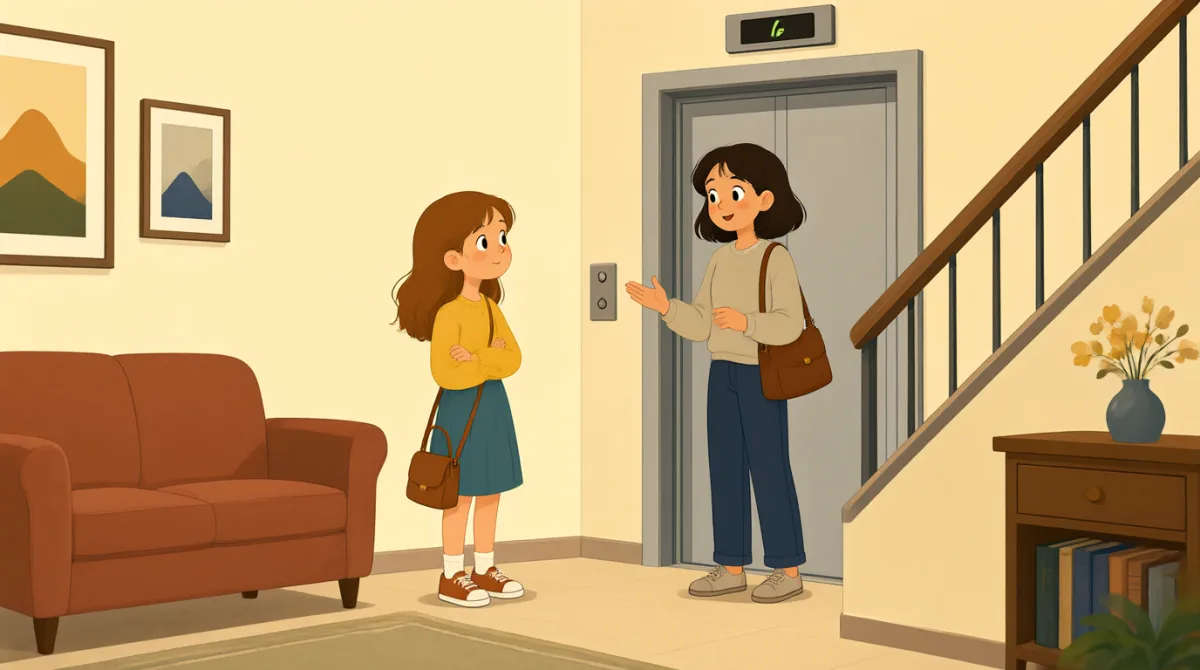

Excuse me, where is the elevator?
Excusez-moi, où se trouve l’ascenseur ?

It is near the stairs, over there.
Il est près des escaliers, là-bas.
Are those the stairs by the big sign?
Ce sont les escaliers près du grand panneau ?
Yes. Walk straight, then turn left.
Allez tout droit, puis tournez à gauche.
Is the elevator next to the stairs?
L’ascenseur est à côté des escaliers ?
Yes, it is on your right.
Oui, il est à votre droite.
Great, thank you for your help!
Super, merci pour votre aide !
You’re welcome. Have a nice day!
Je vous en prie. Bonne journée !
Vocabulaire8
- Excuse meExcusez-moi
Use this polite phrase to get someone's attention before asking a question.
Utilisez cette formule polie pour attirer l’attention de quelqu’un avant de lui poser une question.
- where is the elevator?Où se trouve l’ascenseur ?
Use this question to ask for the location of an elevator.
Utilisez cette question pour demander où se trouve un ascenseur.
- near the stairsprès des escaliers
This means the elevator is close to the stairs.
Cela signifie que l’ascenseur est proche des escaliers.
- over therelà-bas
Use this phrase to point to a place that is not close to you.
Utilisez cette expression pour indiquer un endroit qui n’est pas près de vous.
- Walk straightAllez tout droit
Use this direction to tell someone to go forward without turning.
Utilisez cette indication pour dire à quelqu’un d’avancer sans tourner.
- turn lefttournez à gauche
Use this direction to tell someone to go to the left.
Utilisez cette indication pour dire à quelqu’un d’aller vers la gauche.
- on your rightà votre droite
This means something is on the right side as you face or walk forward.
Cela signifie qu’une chose se trouve du côté droit lorsque vous regardez devant vous ou avancez.
- You’re welcome.Je vous en prie.
Say this after someone thanks you.
Dites cela après que quelqu’un vous a remercié.
Phrases clés8
- 1
Excuse me, where is the elevator?
Excusez-moi, où se trouve l’ascenseur ?
Use this polite question to ask where an elevator is. You can replace “the elevator” with another place or thing.
Utilisez cette question polie pour demander où se trouve un ascenseur. Vous pouvez remplacer “the elevator” par un autre lieu ou objet.
- 2
It is near the stairs, over there.
Il est près des escaliers, là-bas.
Use this sentence to say that a place is close to the stairs and point toward it. Replace “the stairs” with another nearby place.
Utilisez cette phrase pour dire qu’un endroit est proche des escaliers et le montrer du doigt. Remplacez “the stairs” par un autre lieu à proximité.
- 3
Are those the stairs by the big sign?
Ce sont les escaliers près du grand panneau ?
Use this question to check whether you have found the right place. You can replace “the stairs” and “the big sign” with other landmarks.
Utilisez cette question pour vérifier que vous avez trouvé le bon endroit. Vous pouvez remplacer “the stairs” et “the big sign” par d’autres repères.
- 4
Walk straight, then turn left.
Allez tout droit, puis tournez à gauche.
Use this sentence to give two simple directions in order. Change “left” to “right” when needed.
Utilisez cette phrase pour donner deux indications simples dans l’ordre. Remplacez “left” par “right” si nécessaire.
- 5
Is the elevator next to the stairs?
L’ascenseur est à côté des escaliers ?
Use this question to check whether one place is beside another. Replace the places to ask about a different location.
Utilisez cette question pour vérifier si un endroit se trouve à côté d’un autre. Remplacez les lieux pour demander où se trouve autre chose.
- 6
Yes, it is on your right.
Oui, il est à votre droite.
Use this sentence to confirm a location and say which side it is on. You can say “on your left” for the other side.
Utilisez cette phrase pour confirmer un emplacement et indiquer de quel côté il se trouve. Vous pouvez dire “on your left” pour l’autre côté.
- 7
Great, thank you for your help!
Super, merci pour votre aide !
Use this friendly phrase to thank someone who has helped you. You can also say it after receiving directions.
Utilisez cette formule amicale pour remercier quelqu’un qui vous a aidé. Vous pouvez aussi la dire après avoir reçu des indications.
- 8
You’re welcome. Have a nice day!
Je vous en prie. Bonne journée !
Use this polite reply after someone thanks you. The second sentence is a friendly way to end the conversation.
Utilisez cette réponse polie après que quelqu’un vous a remercié. La deuxième phrase permet de terminer la conversation de façon amicale.