Finding the Elevator
Encontrar el ascensor
Emma asks Mia where the elevator is. Mia helps her find it near the stairs.
Emma le pregunta a Mia dónde está el ascensor. Mia la ayuda a encontrarlo cerca de las escaleras.
Diálogo8
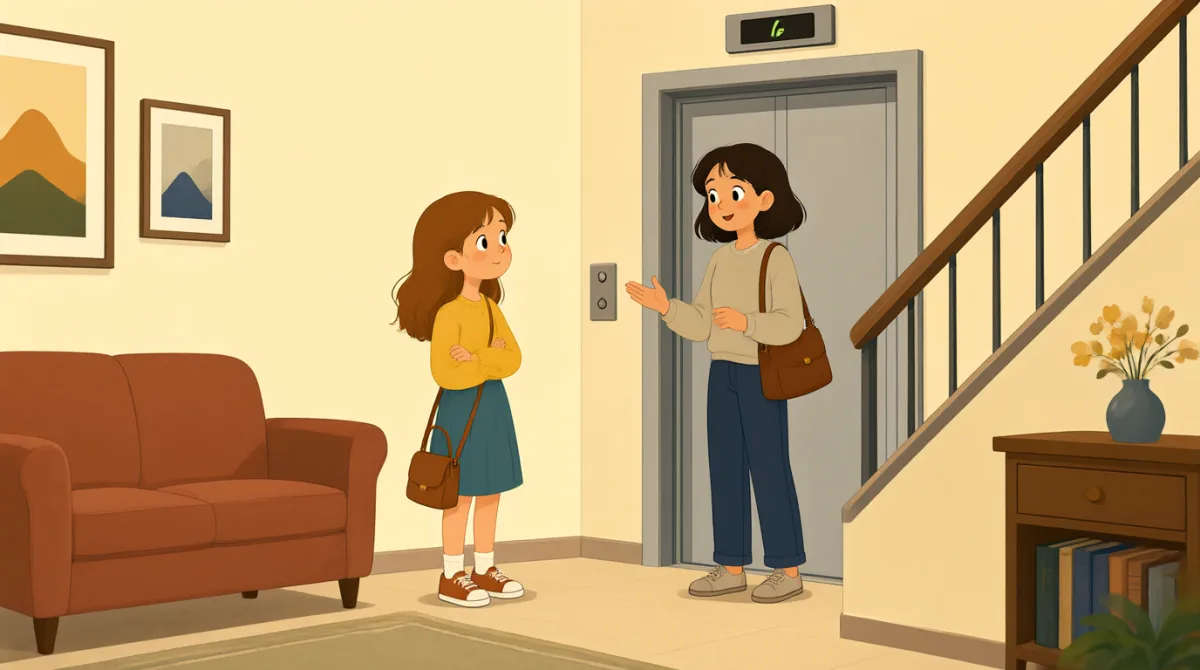

Excuse me, where is the elevator?
Disculpa, ¿dónde está el ascensor?

It is near the stairs, over there.
Está cerca de las escaleras, por allí.
Are those the stairs by the big sign?
¿Esas son las escaleras que están junto al letrero grande?
Yes. Walk straight, then turn left.
Sí. Sigue recto y luego gira a la izquierda.
Is the elevator next to the stairs?
¿El ascensor está al lado de las escaleras?
Yes, it is on your right.
Sí, está a tu derecha.
Great, thank you for your help!
¡Genial, gracias por tu ayuda!
You’re welcome. Have a nice day!
De nada. ¡Que tengas un buen día!
Vocabulario8
- Excuse meDisculpa
Use this polite phrase to get someone's attention before asking a question.
Usa esta expresión cortés para llamar la atención de alguien antes de hacerle una pregunta.
- where is the elevator?¿dónde está el ascensor?
Use this question to ask for the location of an elevator.
Usa esta pregunta para preguntar dónde está un ascensor.
- near the stairscerca de las escaleras
This means the elevator is close to the stairs.
Significa que el ascensor está próximo a las escaleras.
- over therepor allí
Use this phrase to point to a place that is not close to you.
Usa esta expresión para señalar un lugar que no está cerca de ti.
- Walk straightSigue recto
Use this direction to tell someone to go forward without turning.
Usa esta indicación para decirle a alguien que avance sin girar.
- turn leftgira a la izquierda
Use this direction to tell someone to go to the left.
Usa esta indicación para decirle a alguien que vaya hacia la izquierda.
- on your righta tu derecha
This means something is on the right side as you face or walk forward.
Significa que algo está del lado derecho cuando miras hacia delante o avanzas.
- You’re welcome.De nada.
Say this after someone thanks you.
Di esto después de que alguien te dé las gracias.
Frases clave8
- 1
Excuse me, where is the elevator?
Disculpa, ¿dónde está el ascensor?
Use this polite question to ask where an elevator is. You can replace “the elevator” with another place or thing.
Usa esta pregunta cortés para preguntar dónde está un ascensor. Puedes sustituir “the elevator” por otro lugar u objeto.
- 2
It is near the stairs, over there.
Está cerca de las escaleras, por allí.
Use this sentence to say that a place is close to the stairs and point toward it. Replace “the stairs” with another nearby place.
Usa esta oración para decir que un lugar está cerca de las escaleras y señalar hacia él. Sustituye “the stairs” por otro lugar cercano.
- 3
Are those the stairs by the big sign?
¿Esas son las escaleras que están junto al letrero grande?
Use this question to check whether you have found the right place. You can replace “the stairs” and “the big sign” with other landmarks.
Usa esta pregunta para comprobar si encontraste el lugar correcto. Puedes sustituir “the stairs” y “the big sign” por otros puntos de referencia.
- 4
Walk straight, then turn left.
Sigue recto y luego gira a la izquierda.
Use this sentence to give two simple directions in order. Change “left” to “right” when needed.
Usa esta oración para dar dos indicaciones sencillas en orden. Cambia “left” por “right” cuando sea necesario.
- 5
Is the elevator next to the stairs?
¿El ascensor está al lado de las escaleras?
Use this question to check whether one place is beside another. Replace the places to ask about a different location.
Usa esta pregunta para comprobar si un lugar está junto a otro. Sustituye los lugares para preguntar por una ubicación diferente.
- 6
Yes, it is on your right.
Sí, está a tu derecha.
Use this sentence to confirm a location and say which side it is on. You can say “on your left” for the other side.
Usa esta oración para confirmar una ubicación e indicar de qué lado está. Puedes decir “on your left” para referirte al otro lado.
- 7
Great, thank you for your help!
¡Genial, gracias por tu ayuda!
Use this friendly phrase to thank someone who has helped you. You can also say it after receiving directions.
Usa esta expresión amistosa para agradecerle a alguien que te ha ayudado. También puedes decirla después de recibir indicaciones.
- 8
You’re welcome. Have a nice day!
De nada. ¡Que tengas un buen día!
Use this polite reply after someone thanks you. The second sentence is a friendly way to end the conversation.
Usa esta respuesta cortés después de que alguien te dé las gracias. La segunda oración es una forma amistosa de terminar la conversación.