Finding the Elevator
Encontrando o elevador
Emma asks Mia where the elevator is. Mia helps her find it near the stairs.
Emma pergunta a Mia onde fica o elevador. Mia a ajuda a encontrá-lo perto das escadas.
Diálogo8
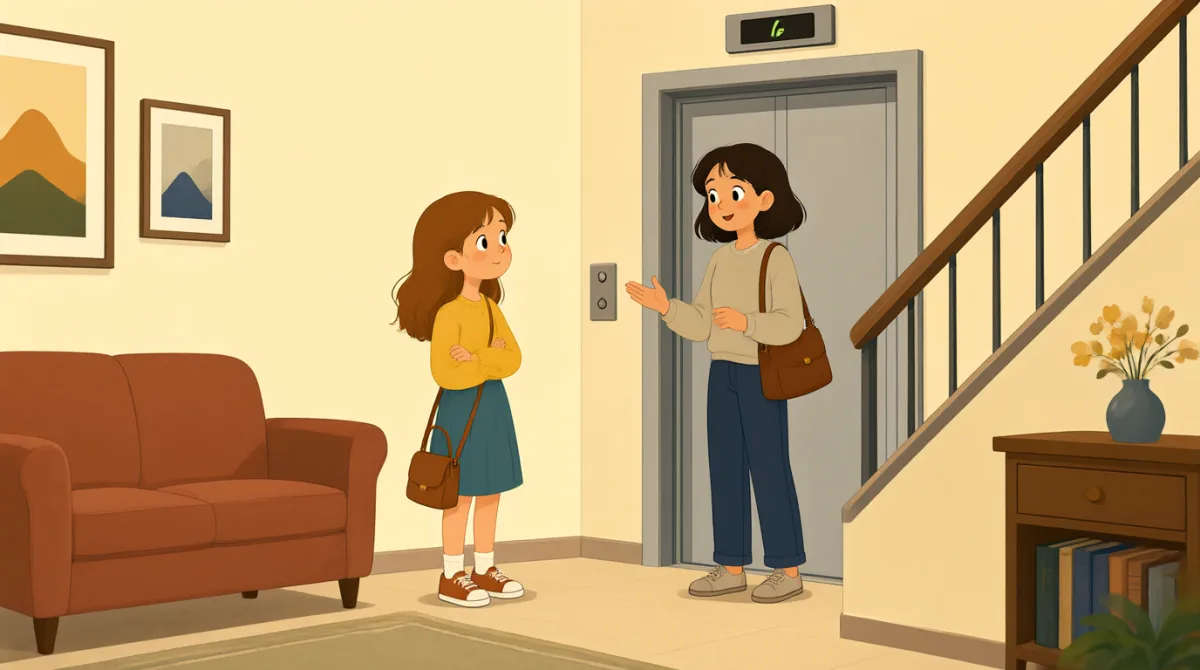

Excuse me, where is the elevator?
Com licença, onde fica o elevador?

It is near the stairs, over there.
Fica perto das escadas, ali.
Are those the stairs by the big sign?
Aquelas são as escadas perto da placa grande?
Yes. Walk straight, then turn left.
Sim. Siga em frente e depois vire à esquerda.
Is the elevator next to the stairs?
O elevador fica ao lado das escadas?
Yes, it is on your right.
Sim, fica à sua direita.
Great, thank you for your help!
Ótimo, obrigada pela ajuda!
You’re welcome. Have a nice day!
Por nada. Tenha um bom dia!
Vocabulário8
- Excuse meCom licença
Use this polite phrase to get someone's attention before asking a question.
Use essa expressão educada para chamar a atenção de alguém antes de fazer uma pergunta.
- where is the elevator?onde fica o elevador?
Use this question to ask for the location of an elevator.
Use essa pergunta para saber onde fica um elevador.
- near the stairsperto das escadas
This means the elevator is close to the stairs.
Isso quer dizer que o elevador fica próximo das escadas.
- over thereali
Use this phrase to point to a place that is not close to you.
Use essa expressão para indicar um lugar que não fica perto de você.
- Walk straightSiga em frente
Use this direction to tell someone to go forward without turning.
Use essa orientação para dizer a alguém que siga adiante sem virar.
- turn leftvire à esquerda
Use this direction to tell someone to go to the left.
Use essa orientação para dizer a alguém que vá para a esquerda.
- on your rightà sua direita
This means something is on the right side as you face or walk forward.
Isso quer dizer que algo fica do lado direito quando você está de frente ou caminhando para a frente.
- You’re welcome.Por nada.
Say this after someone thanks you.
Diga isso depois que alguém agradecer.
Frases-chave8
- 1
Excuse me, where is the elevator?
Com licença, onde fica o elevador?
Use this polite question to ask where an elevator is. You can replace “the elevator” with another place or thing.
Use esta pergunta educada para saber onde fica um elevador. Você pode substituir “the elevator” por outro lugar ou objeto.
- 2
It is near the stairs, over there.
Fica perto das escadas, ali.
Use this sentence to say that a place is close to the stairs and point toward it. Replace “the stairs” with another nearby place.
Use esta frase para dizer que um lugar fica perto das escadas e apontar para ele. Substitua “the stairs” por outro lugar próximo.
- 3
Are those the stairs by the big sign?
Aquelas são as escadas perto da placa grande?
Use this question to check whether you have found the right place. You can replace “the stairs” and “the big sign” with other landmarks.
Use esta pergunta para confirmar se você encontrou o lugar certo. Você pode substituir “the stairs” e “the big sign” por outros pontos de referência.
- 4
Walk straight, then turn left.
Siga em frente e depois vire à esquerda.
Use this sentence to give two simple directions in order. Change “left” to “right” when needed.
Use esta frase para dar duas orientações simples em sequência. Troque “left” por “right” quando necessário.
- 5
Is the elevator next to the stairs?
O elevador fica ao lado das escadas?
Use this question to check whether one place is beside another. Replace the places to ask about a different location.
Use esta pergunta para confirmar se um lugar fica ao lado de outro. Substitua os lugares para perguntar sobre outra localização.
- 6
Yes, it is on your right.
Sim, fica à sua direita.
Use this sentence to confirm a location and say which side it is on. You can say “on your left” for the other side.
Use esta frase para confirmar uma localização e dizer de que lado ela fica. Você pode dizer “on your left” para indicar o outro lado.
- 7
Great, thank you for your help!
Ótimo, obrigada pela ajuda!
Use this friendly phrase to thank someone who has helped you. You can also say it after receiving directions.
Use esta expressão simpática para agradecer a alguém que ajudou você. Você também pode dizê-la depois de receber orientações.
- 8
You’re welcome. Have a nice day!
Por nada. Tenha um bom dia!
Use this polite reply after someone thanks you. The second sentence is a friendly way to end the conversation.
Use esta resposta educada depois que alguém agradecer. A segunda frase é uma forma simpática de encerrar a conversa.