Finding the Elevator
หาลิฟต์
Emma asks Mia where the elevator is. Mia helps her find it near the stairs.
เอ็มมาถามมีอาว่าลิฟต์อยู่ที่ไหน มีอาช่วยบอกทางไปหาลิฟต์ซึ่งอยู่ใกล้บันได
บทสนทนา8
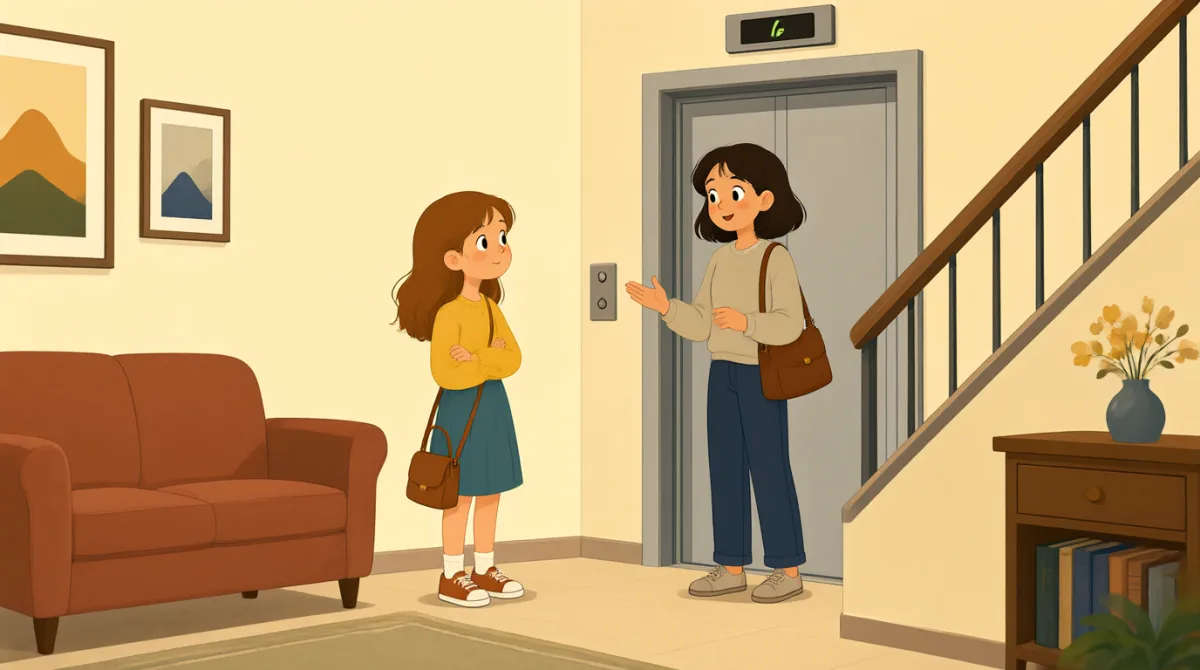

Excuse me, where is the elevator?
ขอโทษนะ ลิฟต์อยู่ตรงไหนเหรอ

It is near the stairs, over there.
อยู่ใกล้บันไดตรงโน้นน่ะ
Are those the stairs by the big sign?
บันไดตรงป้ายใหญ่ ๆ นั่นใช่ไหม
Yes. Walk straight, then turn left.
ใช่ เดินตรงไป แล้วเลี้ยวซ้าย
Is the elevator next to the stairs?
ลิฟต์อยู่ข้าง ๆ บันไดใช่ไหม
Yes, it is on your right.
ใช่ อยู่ทางขวามือของเธอ
Great, thank you for your help!
เยี่ยมเลย ขอบคุณที่ช่วยนะ!
You’re welcome. Have a nice day!
ยินดีจ้า ขอให้วันนี้เป็นวันที่ดีนะ!
คำศัพท์8
- Excuse meขอโทษนะ
Use this polite phrase to get someone's attention before asking a question.
ใช้คำพูดสุภาพนี้เพื่อเรียกความสนใจของใครสักคนก่อนถามคำถาม
- where is the elevator?ลิฟต์อยู่ตรงไหน
Use this question to ask for the location of an elevator.
ใช้คำถามนี้เพื่อถามว่าลิฟต์อยู่ที่ไหน
- near the stairsใกล้บันได
This means the elevator is close to the stairs.
หมายถึงลิฟต์อยู่ไม่ไกลจากบันได
- over thereตรงโน้น
Use this phrase to point to a place that is not close to you.
ใช้คำนี้เพื่อชี้ไปยังสถานที่ที่อยู่ห่างจากตัวเรา
- Walk straightเดินตรงไป
Use this direction to tell someone to go forward without turning.
ใช้บอกทางให้ใครสักคนเดินไปข้างหน้าโดยไม่เลี้ยว
- turn leftเลี้ยวซ้าย
Use this direction to tell someone to go to the left.
ใช้บอกทางให้ใครสักคนไปทางซ้าย
- on your rightทางขวามือของคุณ
This means something is on the right side as you face or walk forward.
หมายถึงสิ่งนั้นอยู่ทางด้านขวามือเมื่อคุณหันหน้าหรือเดินไปข้างหน้า
- You’re welcome.ยินดี
Say this after someone thanks you.
พูดคำนี้หลังจากมีคนขอบคุณคุณ
ประโยคสำคัญ8
- 1
Excuse me, where is the elevator?
ขอโทษนะ ลิฟต์อยู่ตรงไหนเหรอ
Use this polite question to ask where an elevator is. You can replace “the elevator” with another place or thing.
ใช้คำถามสุภาพนี้เพื่อถามว่าลิฟต์อยู่ที่ไหน คุณเปลี่ยน “the elevator” เป็นสถานที่หรือสิ่งของอย่างอื่นได้
- 2
It is near the stairs, over there.
อยู่ใกล้บันไดตรงโน้นน่ะ
Use this sentence to say that a place is close to the stairs and point toward it. Replace “the stairs” with another nearby place.
ใช้ประโยคนี้เพื่อบอกว่าสถานที่หนึ่งอยู่ใกล้บันได พร้อมชี้ไปทางนั้น คุณเปลี่ยน “the stairs” เป็นสถานที่ใกล้เคียงอื่นได้
- 3
Are those the stairs by the big sign?
บันไดตรงป้ายใหญ่ ๆ นั่นใช่ไหม
Use this question to check whether you have found the right place. You can replace “the stairs” and “the big sign” with other landmarks.
ใช้คำถามนี้เพื่อตรวจสอบว่าคุณเจอสถานที่ที่ถูกต้องหรือยัง คุณเปลี่ยน “the stairs” และ “the big sign” เป็นจุดสังเกตอื่นได้
- 4
Walk straight, then turn left.
เดินตรงไป แล้วเลี้ยวซ้าย
Use this sentence to give two simple directions in order. Change “left” to “right” when needed.
ใช้ประโยคนี้เพื่อบอกทางง่าย ๆ สองขั้นตอนตามลำดับ หากจำเป็นให้เปลี่ยน “left” เป็น “right”
- 5
Is the elevator next to the stairs?
ลิฟต์อยู่ข้าง ๆ บันไดใช่ไหม
Use this question to check whether one place is beside another. Replace the places to ask about a different location.
ใช้คำถามนี้เพื่อตรวจสอบว่าสถานที่หนึ่งอยู่ข้างอีกสถานที่หนึ่งหรือไม่ คุณเปลี่ยนชื่อสถานที่เพื่อถามถึงตำแหน่งอื่นได้
- 6
Yes, it is on your right.
ใช่ อยู่ทางขวามือของคุณ
Use this sentence to confirm a location and say which side it is on. You can say “on your left” for the other side.
ใช้ประโยคนี้เพื่อยืนยันตำแหน่งและบอกว่าอยู่ด้านไหน คุณพูด “on your left” เพื่อบอกว่าอยู่อีกด้านได้
- 7
Great, thank you for your help!
เยี่ยมเลย ขอบคุณที่ช่วยนะ!
Use this friendly phrase to thank someone who has helped you. You can also say it after receiving directions.
ใช้คำพูดเป็นกันเองนี้เพื่อขอบคุณคนที่ช่วยคุณ และยังพูดได้หลังจากมีคนบอกทางให้
- 8
You’re welcome. Have a nice day!
ยินดีจ้า ขอให้วันนี้เป็นวันที่ดีนะ!
Use this polite reply after someone thanks you. The second sentence is a friendly way to end the conversation.
ใช้คำตอบสุภาพนี้หลังจากมีคนขอบคุณคุณ ประโยคที่สองเป็นคำพูดเป็นกันเองเพื่อจบบทสนทนา