Going into the Water
Allons dans l’eau
Emma and Mia walk to the water together. They talk about the cool waves and swimming safely.
Emma et Mia marchent ensemble jusqu’à l’eau. Elles parlent des vagues fraîches et de la sécurité quand on nage.
Dialogue8
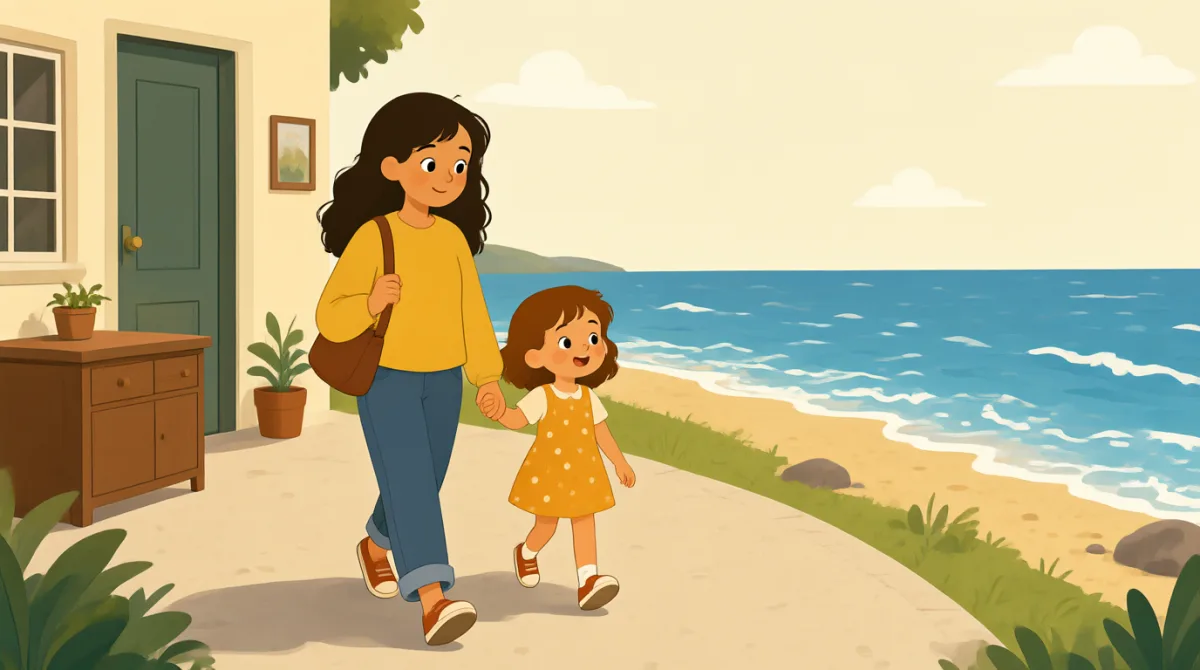

The water looks so cool. Shall we go in?
L’eau a l’air tellement fraîche. On y va ?

Yes. Let's walk slowly. The sand is hot.
Oui. Marchons doucement. Le sable est brûlant.
The waves are small. Can we swim here?
Les vagues sont petites. On peut nager ici ?
Yes, but let's stay close to the shore.
Oui, mais restons près du rivage.
Okay. The water feels cold on my feet!
D’accord. L’eau est froide sur mes pieds !
It will feel warmer soon. Hold my hand.
Elle te semblera bientôt plus chaude. Prends ma main.
Let's swim where we can still stand.
Nageons là où on a encore pied.
Good idea. We can watch the waves together.
Bonne idée. On peut regarder les vagues ensemble.
Vocabulaire7
- go inentrer dans l’eau
Here, it means to enter the water. You can say “go in” when you are about to enter a pool or the sea.
Ici, « go in » veut dire entrer dans l’eau. Tu peux dire « go in » quand tu es sur le point d’entrer dans une piscine ou dans la mer.
- walk slowlymarcher lentement
This means to walk without going fast. You can use it to suggest moving carefully.
Cela veut dire marcher sans aller vite. Tu peux employer cette expression pour suggérer d’avancer prudemment.
- wavesvagues
Waves are moving parts of the sea. You can describe them as small or big.
Les vagues sont les mouvements de la mer. Tu peux les décrire comme petites ou grandes.
- shorerivage
The shore is the land next to the sea. You can stay close to the shore to be near the beach.
Le rivage est la terre au bord de la mer. Tu peux rester près du rivage pour être près de la plage.
- feels coldêtre froid au toucher
This describes how something seems when you touch it. You can say “The water feels cold” or “The sand feels hot.”
Cette expression décrit la sensation que donne quelque chose quand tu le touches. Tu peux dire « The water feels cold » ou « The sand feels hot. »
- Hold my hand.Prends ma main.
This is a request for someone to take your hand. You can say it to help someone feel safe or steady.
C’est une demande pour que quelqu’un prenne ta main. Tu peux le dire pour aider quelqu’un à se sentir en sécurité ou à garder l’équilibre.
- standse tenir debout
Here, “stand” means to be upright with your feet on the ground. In the water, you can stand when it is not too deep.
Ici, « stand » signifie être debout, les pieds au sol. Dans l’eau, tu peux te tenir debout quand elle n’est pas trop profonde.
Phrases clés8
- 1
Shall we go in?
On y va ?
Use this to suggest doing something together. Replace “go in” with another activity, such as “Shall we sit down?”
Utilise cette phrase pour proposer de faire quelque chose ensemble. Remplace « go in » par une autre activité, comme dans « Shall we sit down? »
- 2
Let's walk slowly.
Marchons doucement.
Use “Let's” to suggest doing something together. You can change the action, as in “Let's walk carefully.”
Utilise « Let's » pour proposer de faire quelque chose ensemble. Tu peux changer l’action, comme dans « Let's walk carefully. »
- 3
Can we swim here?
On peut nager ici ?
Use this to ask if it is possible or allowed to do something in a place. Replace “swim” and “here” to ask about another activity or location.
Utilise cette phrase pour demander si une activité est possible ou autorisée dans un endroit. Remplace « swim » et « here » pour poser une question sur une autre activité ou un autre lieu.
- 4
Let's stay close to the shore.
Restons près du rivage.
Use this to suggest staying near a place. You can replace “the shore” with another location, such as “the door.”
Utilise cette phrase pour proposer de rester près d’un endroit. Tu peux remplacer « the shore » par un autre lieu, comme dans « the door. »
- 5
The water feels cold on my feet!
L’eau est froide sur mes pieds !
Use “feels” to describe how something feels when you touch it. You can change the subject and the feeling, as in “The sand feels hot.”
Utilise « feels » pour décrire la sensation que donne quelque chose quand tu le touches. Tu peux changer le sujet et la sensation, comme dans « The sand feels hot. »
- 6
Hold my hand.
Prends ma main.
Use this short sentence to ask someone to take your hand. You can also say “Hold my arm” or “Hold the rope.”
Utilise cette phrase courte pour demander à quelqu’un de prendre ta main. Tu peux aussi dire « Hold my arm » ou « Hold the rope. »
- 7
Let's swim where we can still stand.
Nageons là où on a encore pied.
Use “Let's” to suggest an activity, then say where to do it. This is a useful way to suggest a safe place to swim.
Utilise « Let's » pour proposer une activité, puis indique où la faire. C’est une façon pratique de suggérer un endroit sûr pour nager.
- 8
We can watch the waves together.
On peut regarder les vagues ensemble.
Use “We can” to talk about something you can do as a group. Replace “watch the waves” with another activity, such as “walk together.”
Utilise « We can » pour parler de quelque chose que vous pouvez faire ensemble. Remplace « watch the waves » par une autre activité, comme dans « walk together. »