Asking to Use the Washing Machine
Fragen, ob man die Waschmaschine benutzen darf
Emma asks Grace how to use the washing machine and when it is okay to do laundry. Grace shows her the settings and offers some helpful tips.
Emma fragt Grace, wie man die Waschmaschine benutzt und wann sie am besten Wäsche waschen kann. Grace zeigt ihr die Einstellungen und gibt ihr ein paar hilfreiche Tipps.
Dialog8
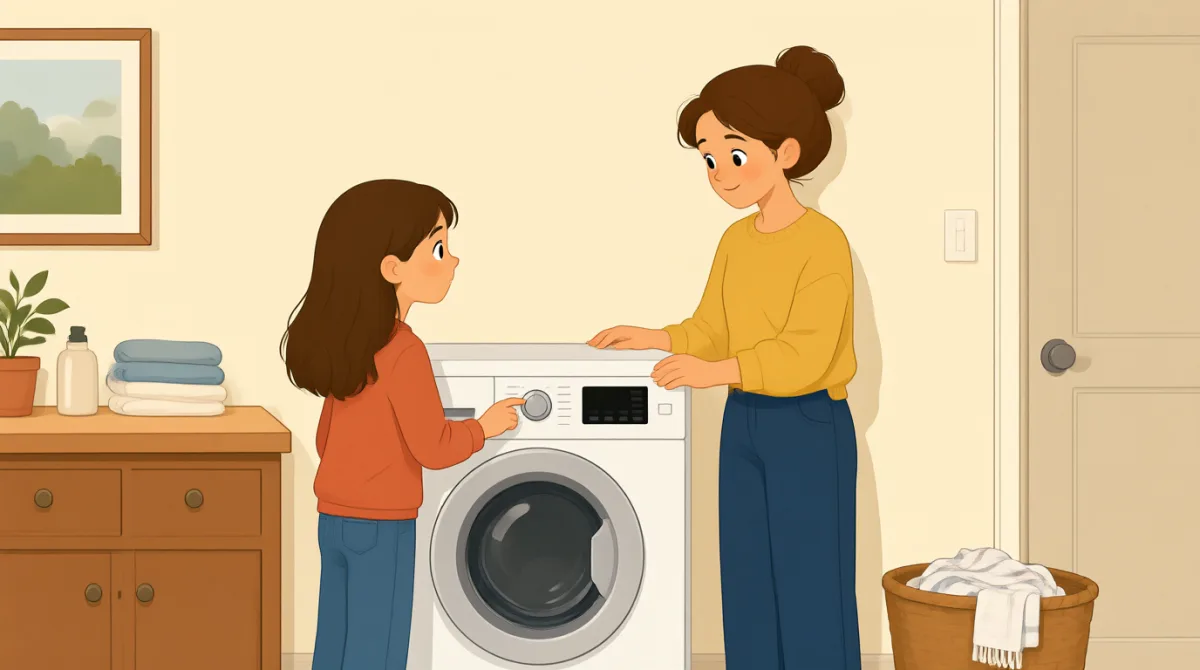

Grace, can I use the washing machine this afternoon?
Grace, kann ich heute Nachmittag die Waschmaschine benutzen?

Of course. It’s in the laundry room, next to the kitchen.
Klar. Sie steht im Waschraum neben der Küche.
Great. Which button should I press for a normal wash?
Super. Welche Taste muss ich für einen normalen Waschgang drücken?
Use this setting for everyday clothes, and add one cup of detergent.
Nimm dieses Programm für Alltagskleidung und gib eine Tasse Waschmittel dazu.
Should I wash my light and dark clothes separately?
Soll ich meine helle und dunkle Wäsche getrennt waschen?
Yes, please. And don’t put sweaters in the dryer; hang them up.
Ja, bitte. Und steck keine Pullover in den Trockner, sondern häng sie zum Trocknen auf.
Okay. What time is best? I don’t want to make noise late.
Okay. Wann passt es am besten? Ich möchte nicht spät noch Lärm machen.
Any time before nine is fine. Just take your clothes out when it’s done.
Jederzeit vor neun ist in Ordnung. Hol deine Wäsche einfach raus, wenn die Maschine fertig ist.
Wortschatz8
- washing machineWaschmaschine
A machine that washes clothes with water and soap. You can use it to do laundry at home.
Eine Maschine, die Kleidung mit Wasser und Waschmittel wäscht. Damit kannst du zu Hause Wäsche waschen.
- laundry roomWaschraum
A room where people wash and dry clothes. In this conversation, it is next to the kitchen.
Ein Raum, in dem man Wäsche wäscht und trocknet. In diesem Gespräch liegt er neben der Küche.
- normal washnormaler Waschgang
A regular washing program for everyday clothes. You can ask which setting to use by saying, “Which button should I press for a normal wash?”
Ein gewöhnliches Waschprogramm für Alltagskleidung. Du kannst fragen, welche Einstellung du verwenden sollst: “Which button should I press for a normal wash?” (Welche Taste muss ich für einen normalen Waschgang drücken?)
- settingEinstellung
A choice on a machine that controls how it works. Choose the right setting for the clothes you are washing.
Eine Auswahl an einer Maschine, mit der du steuerst, wie sie funktioniert. Wähle die passende Einstellung für die Kleidung, die du wäschst.
- detergentWaschmittel
A soap or liquid used to clean clothes. You add it to the washing machine before you start a wash.
Ein Waschpulver oder eine Flüssigkeit, mit der Kleidung gereinigt wird. Du gibst es in die Waschmaschine, bevor du den Waschgang startest.
- separatelygetrennt
In different groups, not together. People often wash light and dark clothes separately.
In verschiedenen Gruppen und nicht zusammen. Helle und dunkle Kleidung wäscht man oft getrennt.
- hang them upsie zum Trocknen aufhängen
Put clothes on a hanger or clothesline to dry. This is useful for sweaters that should not go in the dryer.
Kleidung zum Trocknen auf einen Kleiderbügel oder eine Wäscheleine hängen. Das ist praktisch bei Pullovern, die nicht in den Trockner dürfen.
- take your clothes outdeine Wäsche herausnehmen
Remove your clothes from the washing machine. You can use this phrase when reminding someone to get their laundry.
Deine Kleidung aus der Waschmaschine nehmen. Mit dieser Wendung kannst du jemanden daran erinnern, seine Wäsche herauszuholen.
Wichtige Sätze8
- 1
Can I use the washing machine this afternoon?
Kann ich heute Nachmittag die Waschmaschine benutzen?
Use this polite question to ask permission to use something. You can replace “the washing machine” with another item and “this afternoon” with a different time.
Mit dieser höflichen Frage bittest du um Erlaubnis, etwas zu benutzen. Du kannst “the washing machine” durch einen anderen Gegenstand und “this afternoon” durch eine andere Zeit ersetzen.
- 2
Which button should I press for a normal wash?
Welche Taste muss ich für einen normalen Waschgang drücken?
Use this question when you need help choosing a machine setting. You can replace “a normal wash” with another program or function.
Mit dieser Frage bittest du um Hilfe bei der Auswahl eines Maschinenprogramms. Du kannst “a normal wash” durch ein anderes Programm oder eine andere Funktion ersetzen.
- 3
Use this setting for everyday clothes, and add one cup of detergent.
Nimm dieses Programm für Alltagskleidung und gib eine Tasse Waschmittel dazu.
This sentence gives simple instructions for using a washing machine. You can reuse “Use this setting for…” to explain which option is right for a particular task.
Dieser Satz enthält einfache Anweisungen zur Benutzung einer Waschmaschine. Mit “Use this setting for…” kannst du erklären, welche Einstellung für eine bestimmte Aufgabe geeignet ist.
- 4
Should I wash my light and dark clothes separately?
Soll ich meine helle und dunkle Wäsche getrennt waschen?
Use “Should I…?” to ask for advice about what to do. You can replace the clothes or action to ask about another household task.
Mit “Should I…?” fragst du nach einem Rat, was du tun sollst. Du kannst die Kleidung oder die Handlung ändern, um nach einer anderen Aufgabe im Haushalt zu fragen.
- 5
And don’t put sweaters in the dryer; hang them up.
Und steck keine Pullover in den Trockner, sondern häng sie zum Trocknen auf.
This sentence gives a warning and a helpful alternative. Use “Don’t…” to say what to avoid, then give a better action.
Dieser Satz warnt vor etwas und nennt eine hilfreiche Alternative. Mit “Don’t…” sagst du, was man vermeiden soll, und nennst anschließend eine bessere Handlung.
- 6
What time is best?
Wann passt es am besten?
Use this short question to ask when something is most convenient. You can add an activity, such as “What time is best for laundry?”
Mit dieser kurzen Frage fragst du, wann etwas am günstigsten ist. Du kannst eine Tätigkeit ergänzen, zum Beispiel: “What time is best for laundry?” (Wann passt es am besten, Wäsche zu waschen?)
- 7
Any time before nine is fine.
Jederzeit vor neun ist in Ordnung.
This is a simple way to say that several times are okay, as long as they are before a certain time. Replace “nine” with another time to give a different limit.
So sagst du einfach, dass mehrere Zeitpunkte passen, solange sie vor einer bestimmten Uhrzeit liegen. Ersetze “nine” durch eine andere Uhrzeit, um eine andere Grenze anzugeben.
- 8
Just take your clothes out when it’s done.
Hol deine Wäsche einfach raus, wenn die Maschine fertig ist.
Use this sentence to remind someone to do something after a machine finishes. You can replace “take your clothes out” with another action.
Mit diesem Satz erinnerst du jemanden daran, etwas zu tun, wenn eine Maschine fertig ist. Du kannst “take your clothes out” durch eine andere Handlung ersetzen.