Whose Turn Is It?
Wer ist dran?
Emma asks whose turn it is. Mia checks the game and tells her.
Emma fragt, wer dran ist. Mia schaut auf das Spielbrett und sagt es ihr.
Dialog6
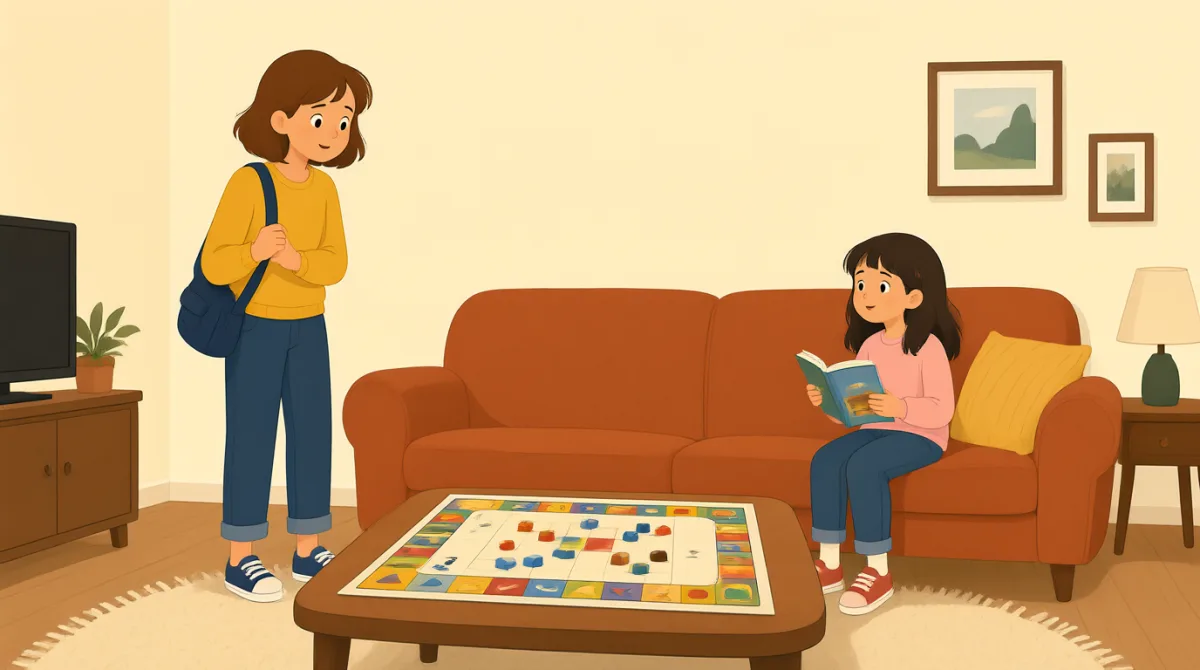

Mia, whose turn is it now?
Mia, wer ist jetzt dran?

Let me check the board.
Ich schau mal auf das Spielbrett.
It’s your turn, Emma.
Du bist dran, Emma.
Oh, it is? I thought it was yours.
Ach, echt? Ich dachte, du bist dran.
I went before you. Now you go.
Ich war vor dir dran. Jetzt bist du dran.
Okay. I’m ready to play.
Okay. Ich bin bereit zu spielen.
Wortschatz8
- whose turnwer dran ist
This asks who should play now. Use “Whose turn is it?” to ask who goes next.
Damit fragst du, wer jetzt spielen soll. Mit “Whose turn is it?” fragst du, wer als Nächstes dran ist.
- Let me checkIch schau mal nach
This means “I will look and find out.” Use it when you need to check something.
Das bedeutet: „Ich sehe nach und finde es heraus.“ Das kannst du sagen, wenn du etwas überprüfen musst.
- the boarddas Spielbrett
The board is the game surface where you play. You can say “Let me check the board” when you look at the game.
Das Spielbrett ist die Fläche, auf der ihr spielt. Wenn du auf das Spiel schaust, kannst du sagen: “Let me check the board”.
- your turndu bist dran
This means it is your time to play. Use “It’s your turn” to tell someone to go next.
Das bedeutet, dass du jetzt spielen darfst. Mit “It’s your turn” sagst du jemandem, dass er oder sie als Nächstes dran ist.
- I thought it was yours.Ich dachte, du bist dran.
This means you believed it was the other person’s turn. Use “I thought it was…” to talk about what you believed.
Damit sagst du, dass du dachtest, die andere Person sei dran. Mit “I thought it was…” sprichst du darüber, was du geglaubt hast.
- I went before you.Ich war vor dir dran.
This means I played before you. Use it to explain who played first.
Das bedeutet, dass ich vor dir gespielt habe. Damit kannst du erklären, wer zuerst gespielt hat.
- you godu bist dran
This means it is your time to play now. Use “Now you go” to tell someone to take their turn.
Das bedeutet, dass du jetzt spielen darfst. Mit “Now you go” sagst du jemandem, dass er oder sie an der Reihe ist.
- I’m ready to play.Ich bin bereit zu spielen.
This means you are prepared to start playing. Use it when you are ready for a game.
Das bedeutet, dass du bereit bist, mit dem Spielen anzufangen. Das kannst du sagen, wenn du für ein Spiel bereit bist.
Wichtige Sätze8
- 1
Mia, whose turn is it now?
Mia, wer ist jetzt dran?
Use this question to ask who should play next. You can replace “Mia” with another person’s name.
Mit dieser Frage möchtest du wissen, wer als Nächstes spielen soll. Du kannst “Mia” durch den Namen einer anderen Person ersetzen.
- 2
Let me check the board.
Ich schau mal auf das Spielbrett.
Use this when you want to look at the game before answering. You can also say “Let me check” when checking other things.
Das sagst du, wenn du vor deiner Antwort auf das Spiel schauen möchtest. Wenn du etwas anderes überprüfst, kannst du auch “Let me check” sagen.
- 3
It’s your turn, Emma.
Du bist dran, Emma.
Use this sentence to tell someone it is time for them to play. Replace “Emma” with the person’s name.
Mit diesem Satz sagst du jemandem, dass es Zeit ist zu spielen. Ersetze “Emma” durch den Namen der Person.
- 4
Oh, it is?
Ach, echt?
Use this short question when you are surprised or want to check what someone said. Your voice usually goes up at the end.
Diese kurze Frage kannst du stellen, wenn du überrascht bist oder überprüfen möchtest, was jemand gesagt hat. Am Ende geht deine Stimme normalerweise nach oben.
- 5
I thought it was yours.
Ich dachte, du bist dran.
Use this to say what you believed before. “Yours” means something belongs to the other person, or in this game, it was their turn.
Damit sagst du, was du vorher geglaubt hast. “Yours” bedeutet, dass etwas der anderen Person gehört oder dass sie in diesem Spiel dran war.
- 6
I went before you.
Ich war vor dir dran.
Use this to explain that you did something before another person. You can use it when talking about taking turns.
Damit erklärst du, dass du etwas vor einer anderen Person getan hast. Du kannst den Satz verwenden, wenn es ums Abwechseln geht.
- 7
Now you go.
Jetzt bist du dran.
Use this simple phrase to tell someone to take their turn. It works for games and other activities.
Mit diesem einfachen Satz sagst du jemandem, dass er oder sie an der Reihe ist. Er passt zu Spielen und anderen Aktivitäten.
- 8
Okay. I’m ready to play.
Okay. Ich bin bereit zu spielen.
Use this to agree and say you are prepared to begin. You can change “play” to another activity, such as “I’m ready to eat.”
Damit stimmst du zu und sagst, dass du bereit bist anzufangen. Du kannst “play” durch eine andere Aktivität ersetzen, zum Beispiel in “I’m ready to eat.”