It Is Too Spicy!
Es ist zu scharf!
Emma tries her curry and finds it too spicy. Jack checks if she is all right.
Emma probiert ihr Curry und findet es zu scharf. Jack fragt, ob es ihr gut geht.
Dialog6
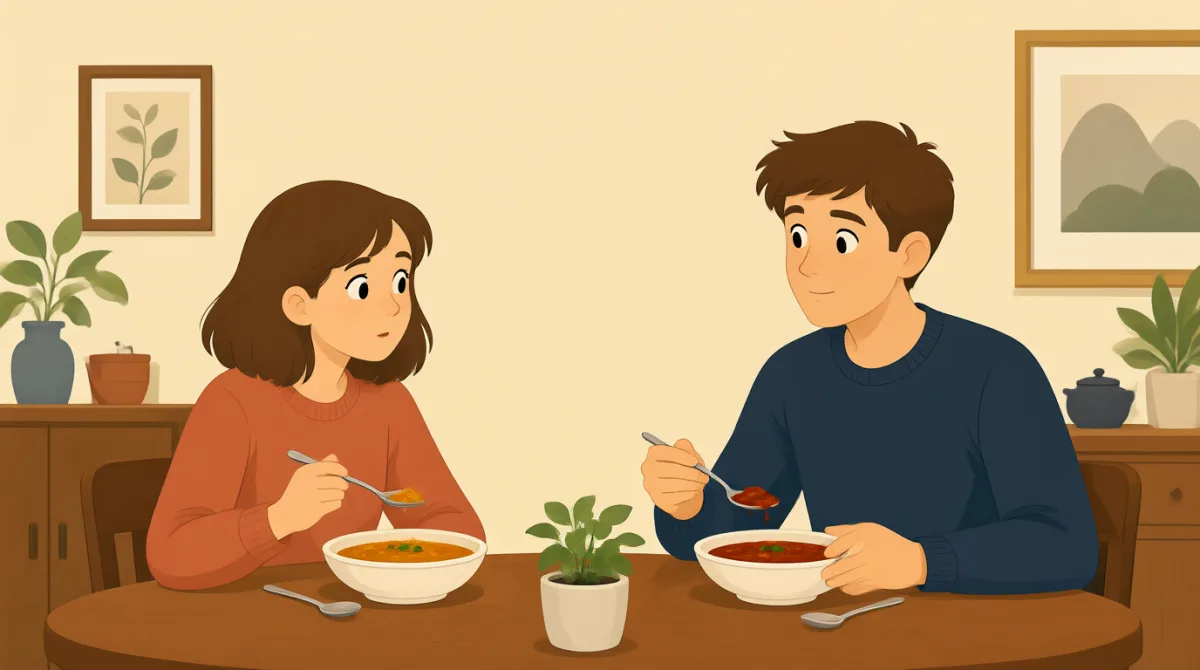

Oh, this curry is too spicy!
Oh, dieses Curry ist zu scharf!

Are you all right, Emma?
Geht es dir gut, Emma?
My mouth is so hot!
Mein Mund brennt so!
I'm sorry. Is it very hot?
Tut mir leid. Ist es sehr scharf?
Yes! I can't eat this.
Ja! Das kann ich nicht essen.
Take a small bite. It's okay.
Nimm einen kleinen Bissen. Das ist schon okay.
Wortschatz7
- too spicyzu scharf
This means the food has more spice than you can enjoy. Use “too” before an adjective to say something is more than you want.
Das bedeutet, dass das Essen schärfer ist, als du es magst. Mit „too“ vor einem Adjektiv sagst du, dass etwas mehr ist, als du möchtest.
- Are you all right?Geht es dir gut?
This is a way to ask if someone is okay. You can use it when someone seems hurt or uncomfortable.
So fragst du, ob es jemandem gut geht. Du kannst das sagen, wenn jemand verletzt oder unwohl wirkt.
- My mouth is so hot!Mein Mund brennt so!
Emma says this because the spicy curry makes her mouth feel hot. Use “My mouth is…” to describe how your mouth feels.
Emma sagt das, weil das scharfe Curry ihren Mund heiß werden lässt. Mit “My mouth is…” beschreibst du, wie sich dein Mund anfühlt.
- I'm sorry.Tut mir leid.
This is a simple way to show you feel bad about a problem. You can say it when something has gone wrong.
Damit zeigst du auf einfache Weise, dass dir ein Problem leidtut. Du kannst es sagen, wenn etwas schiefgegangen ist.
- I can't eat this.Das kann ich nicht essen.
This means you are not able to eat the food. You can use “I can't eat…” to explain that a food is difficult or not possible for you to eat.
Das bedeutet, dass du das Essen nicht essen kannst. Mit “I can't eat…” erklärst du, dass ein bestimmtes Essen schwer oder gar nicht für dich zu essen ist.
- Take a small bite.Nimm einen kleinen Bissen.
This means to eat a little piece of food. Use it to suggest trying just a little.
Das bedeutet, ein kleines Stück Essen zu essen. Damit schlägst du vor, nur ein wenig zu probieren.
- It's okay.Das ist schon okay.
This can mean that something is all right or not a problem. Here, Jack uses it to reassure Emma.
Das kann bedeuten, dass alles in Ordnung oder kein Problem ist. Hier sagt Jack es, um Emma zu beruhigen.
Wichtige Sätze8
- 1
Oh, this curry is too spicy!
Oh, dieses Curry ist zu scharf!
Use “This [food] is too [adjective]” to say something is more than you want. For example, “This soup is too hot!”
Mit “This [food] is too [adjective]” sagst du, dass etwas mehr ist, als du möchtest. Zum Beispiel: “This soup is too hot!”
- 2
Are you all right, Emma?
Geht es dir gut, Emma?
This is a useful way to check if someone feels okay. You can use it with a name or leave the name out.
So kannst du gut nachfragen, ob sich jemand wohlfühlt. Du kannst dabei einen Namen nennen oder ihn weglassen.
- 3
My mouth is so hot!
Mein Mund brennt so!
Use “My [body part] is so…” to describe a strong feeling. For example, “My feet are so cold!”
Mit “My [body part] is so…” beschreibst du ein starkes Gefühl. Zum Beispiel: “My feet are so cold!”
- 4
I'm sorry.
Tut mir leid.
Use this short phrase to show concern or regret. It is common in everyday conversations.
Mit dieser kurzen Wendung zeigst du Mitgefühl oder Bedauern. Sie kommt in alltäglichen Gesprächen häufig vor.
- 5
Is it very hot?
Ist es sehr scharf?
This is a yes-or-no question about how hot something is. You can use “Is it very [adjective]?” to ask about other things, too.
Das ist eine Ja-Nein-Frage dazu, wie scharf etwas ist. Mit “Is it very [adjective]?” kannst du auch nach anderen Eigenschaften fragen.
- 6
Yes!
Ja!
This short answer shows agreement. You can use it to answer a question when the meaning is clear.
Diese kurze Antwort drückt Zustimmung aus. Du kannst sie als Antwort auf eine Frage verwenden, wenn klar ist, was gemeint ist.
- 7
I can't eat this.
Das kann ich nicht essen.
Use “I can't eat…” to say that you are unable to eat something. You can replace “this” with a food name, like “I can't eat curry.”
Mit “I can't eat…” sagst du, dass du etwas nicht essen kannst. Du kannst “this” durch den Namen eines Essens ersetzen, zum Beispiel: “I can't eat curry.”
- 8
Take a small bite.
Nimm einen kleinen Bissen.
Use this phrase to suggest trying a little food. You can change “small” to “big” to suggest a bigger bite.
Mit dieser Wendung schlägst du vor, ein wenig zu probieren. Du kannst “small” durch “big” ersetzen, wenn du einen größeren Bissen vorschlagen möchtest.