Describing the Suitcase
Grace asks Emma about the suitcase’s color, size, and other details. Emma also explains what is inside it.
Dialogue8
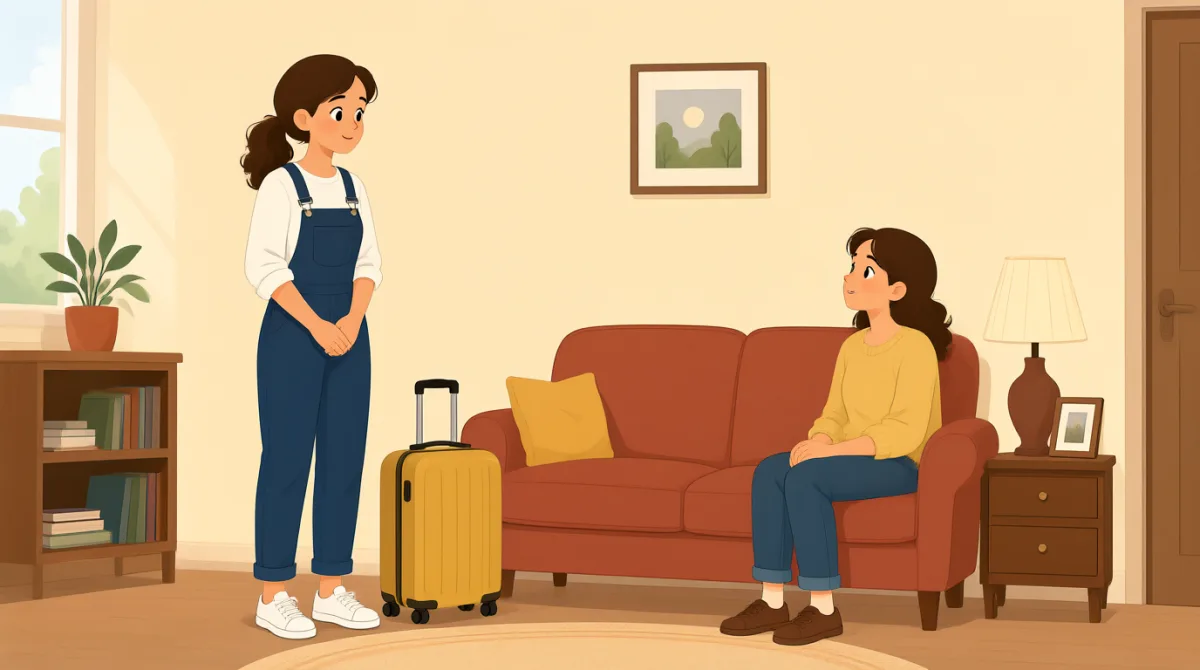

What color is your suitcase, and how big is it?

It’s black and medium-sized, with two wheels on each side.
Does it have any special marks or a name tag?
It has a red ribbon on the handle and a white name tag.
Thank you. What was inside the suitcase?
Some clothes, a pair of shoes, and my toiletries. Nothing valuable.
All right. I’ll add those details to your report.
Thanks. I hope you can find it soon.
Vocabulary8
- medium-sized
This describes something that is not small or large. Use it to give the size of an object, such as a suitcase.
- on each side
This means on both sides of something. Here, it tells Grace where the suitcase’s wheels are.
- special marks
These are noticeable details that help identify an item. You can mention special marks when describing lost property.
- name tag
A name tag shows a person’s name or contact details. It can help someone identify the owner of a suitcase.
- on the handle
This means attached to or placed on the part you hold. Use it to explain where a detail is on an object.
- a pair of shoes
This means two shoes that belong together. It is a common way to describe something in your luggage.
- toiletries
These are personal items such as a toothbrush, soap, or shampoo. The word is useful when describing what you packed.
- add those details
This means to include the information in a record or report. You can use it when someone is writing down details you provide.
Key Sentences8
- 1
What color is your suitcase, and how big is it?
Use this to ask about an item’s color and size. You can replace “suitcase” with another object, such as “bag” or “car.”
- 2
It’s black and medium-sized, with two wheels on each side.
This sentence gives the color, size, and a useful identifying detail. Replace these descriptions with details about your own item.
- 3
Does it have any special marks or a name tag?
Use this yes-or-no question to ask about details that can help identify something. You can also ask, “Does it have a label?”
- 4
It has a red ribbon on the handle and a white name tag.
This is a useful way to describe identifying details and where they are. Change the colors and objects to match what you see.
- 5
What was inside the suitcase?
Use this question to ask what someone had in a bag or another container. “Was” is used because the question refers to the past.
- 6
Some clothes, a pair of shoes, and my toiletries.
This is a simple way to list several items. You can use the same pattern to describe what was in your luggage.
- 7
I’ll add those details to your report.
Use this to say that you will include information in a report or record. “I’ll” is a short form of “I will.”
- 8
I hope you can find it soon.
This sentence expresses a wish for something to happen. Use “I hope you can…” to talk about what you want someone to do.