Comparing Two Laptops
Jack shows Emma two laptops and explains their prices and sizes. Emma asks which one is better for her needs.
Dialogue8
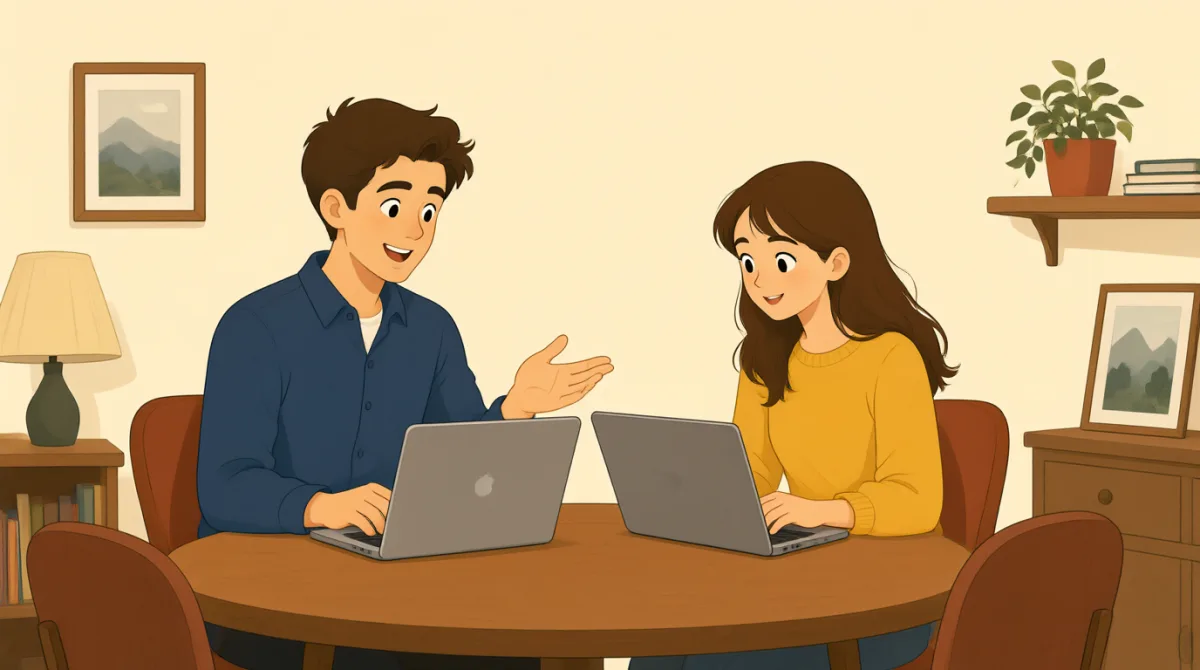

Here are two laptops. This one is small and costs six hundred dollars.

That sounds good. How much is the larger one?
It costs eight hundred dollars. It has a bigger screen and more storage.
I need it for work and watching videos. I also want to carry it easily.
The smaller one is lighter, so it’s easier to take with you.
Is the screen big enough for watching videos?
Yes, it’s clear and large enough. The bigger one is better for long work sessions.
The smaller one fits my budget. I think it’s better for me.
Vocabulary7
- costs six hundred dollars
This tells the price of the smaller laptop. You can use “costs” to ask or talk about the price of something.
- How much is the larger one?
Use this question to ask the price of an item. “The larger one” means the larger laptop.
- more storage
This means the laptop can save more files, photos, or videos. You can compare devices by saying one has “more storage.”
- carry it easily
This means you can take the laptop with you without difficulty. Use “carry” when talking about taking something by hand.
- lighter
This means the laptop weighs less. You can compare two things by saying one is “lighter” than the other.
- large enough
This means the screen is big to the level that is needed. Use “adjective + enough” to say something meets a need.
- fits my budget
This means the laptop costs an amount you can afford. You can use this phrase when choosing something within your spending limit.
Key Sentences8
- 1
How much is the larger one?
This is a useful way to ask the price of one item in a group. Replace “the larger one” with another description, such as “the cheaper one.”
- 2
It has a bigger screen and more storage.
Use this sentence to explain the features of a product. You can replace “screen” and “storage” with other features.
- 3
I need it for work and watching videos.
This sentence explains what you plan to use an item for. You can reuse “I need it for” and name your own activities.
- 4
I also want to carry it easily.
Use this sentence to say that something should be easy to take with you. You can replace “carry it” with another action, such as “use it.”
- 5
The smaller one is lighter, so it’s easier to take with you.
This sentence compares two products and gives a reason to choose one. Use “so” to connect a result to its reason.
- 6
Is the screen big enough for watching videos?
This question checks whether something meets a need. Use “Is it [adjective] enough for…” to ask about other requirements.
- 7
The bigger one is better for long work sessions.
Use this sentence to say which option is more suitable for a particular activity. Replace “long work sessions” with another use.
- 8
The smaller one fits my budget.
This is a simple way to say that an item is affordable for you. You can use it when comparing prices while shopping.